

Panic attacks often feel as though they appear “out of the blue.” A person may be working, driving, sitting at home, or even resting when intense fear suddenly develops together with physical symptoms such as a racing heart, shortness of breath, chest discomfort, dizziness, or trembling. Because there seems to be no immediate danger, many people struggle to understand why the attack occurred.
In reality, there is usually no single cause of panic attacks. Panic disorder develops through an interaction between biological vulnerability, the body’s response to stress, psychological factors, previous experiences, and the way physical sensations are perceived.
Major life changes or prolonged stress may contribute to the first attack, while fear of further attacks, increased attention to bodily sensations, and avoidance can later maintain the disorder.
It is therefore useful to distinguish between vulnerability, which makes a person more susceptible to panic; triggers, which may contribute to an individual attack; and maintaining factors, which can turn isolated attacks into a persistent panic disorder.
For More Information, Contact Our Specialist
Why Do Panic Attacks Seem to Come Out of Nowhere?
One of the defining characteristics of panic disorder is that attacks can occur unexpectedly. Unlike a specific phobia, in which anxiety is associated with an identifiable situation or object, a panic attack may initially seem to have no obvious trigger.
However, “unexpected” does not necessarily mean that nothing preceded the attack. Looking back, some patients describe weeks or months of increased stress, disturbed sleep, physical exhaustion, relationship difficulties, occupational pressure, or major changes in their lives before the first episode. These factors may have been present for so long that they were no longer consciously perceived as unusual.
The first attack can therefore be experienced as completely inexplicable even though the person’s psychological and physiological stress level had already increased.
Biological Vulnerability to Panic Attacks
People differ in how strongly their nervous systems respond to stress and perceived danger. Some appear to have a lower threshold for autonomic arousal and react more readily with an increased heart rate, sweating, trembling, dizziness, or changes in breathing.
Genetic and neurobiological factors probably contribute to this vulnerability. Research into panic disorder has identified involvement of brain systems responsible for detecting threat and coordinating the body’s fear response. Structures within the limbic system, including the amygdala, participate in processing potentially threatening information and activating autonomic responses.
This does not mean that panic disorder can be reduced to a single chemical imbalance or abnormal brain region. Biological factors are better understood as contributing to susceptibility. They may help explain why one person develops panic attacks under stress while another exposed to similar circumstances does not.
The Fight-or-Flight Response
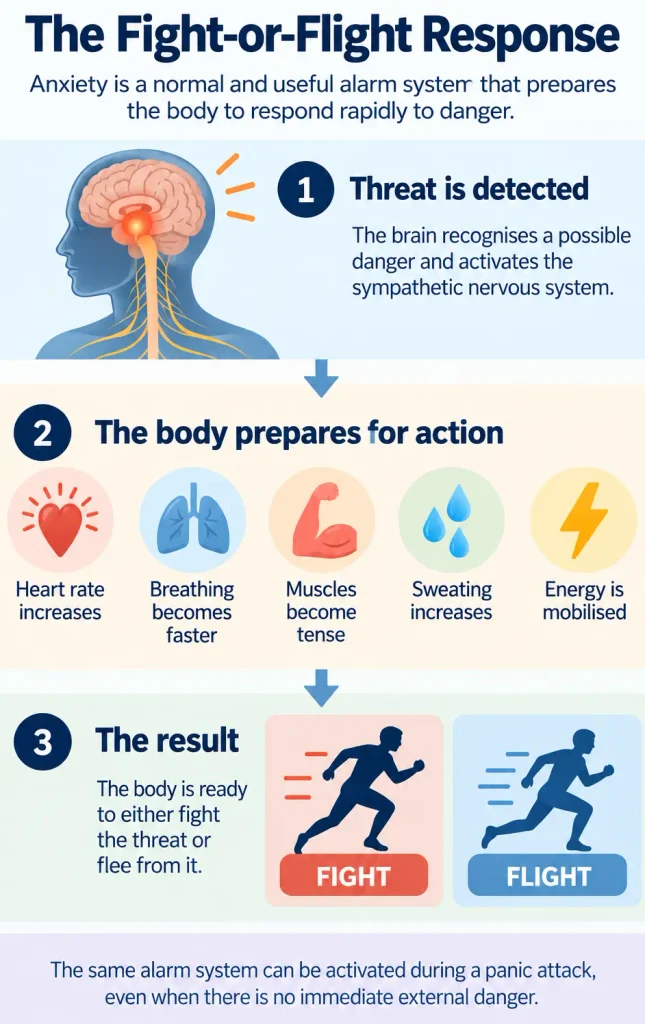
Anxiety itself is not an illness. It is part of an ancient biological alarm system that prepares the body to respond rapidly to danger. When a threat is perceived, the sympathetic nervous system becomes activated. Heart rate and breathing increase, muscles become tense, sweating increases, and energy is mobilised. These changes prepare the body for fight or flight.
During a panic attack, the same biological alarm system can become activated even when there is no immediate external danger. The resulting increase in heart rate, breathing, and muscle tension may feel overwhelming. Although these reactions are part of the body’s natural response to perceived danger, they can become frightening when they occur unexpectedly or without an obvious explanation.
How Physical Sensations Can Trigger Panic
Panic attacks do not always begin with a frightening thought or an obvious stressful situation. Sometimes, the first trigger is a change in the body’s physical state. Sleep deprivation, exhaustion, illness, dehydration, excessive caffeine intake, or fluctuations in blood sugar can produce sensations such as palpitations, dizziness, trembling, weakness, or changes in breathing. Physical exercise can also temporarily increase heart rate and respiration.
These bodily sensations are not necessarily dangerous. Most people experience them occasionally without becoming frightened. However, individuals who are particularly sensitive to changes in their bodies may notice even minor sensations that others would barely register.
In susceptible individuals, these physical changes can become the starting point of a panic attack. This helps explain why panic attacks sometimes occur during ordinary daily activities or periods of rest, without any obvious external danger.
Stress and Panic Attacks
Chronic stress is an important factor in many patients with panic disorder. The first attack may occur during a period of prolonged occupational pressure, relationship conflict, financial worries, illness, or emotional exhaustion. Stress does not necessarily need to result from one dramatic event. Numerous smaller pressures can accumulate over time. A person may continue functioning despite increasing tension, poor sleep, irritability, or occasional palpitations until an apparently insignificant event becomes the final stressor preceding the first panic attack.
Interestingly, panic attacks do not always occur at the height of a stressful period. Some people experience their first episode when the external pressure begins to decrease. This helps explain why patients sometimes cannot identify any obvious connection between their current circumstances and the attack.
Major Life Changes and Panic Disorder
Major life events can increase psychological stress and contribute to the onset of panic attacks in susceptible individuals. Bereavement, separation, relationship difficulties, unemployment, financial problems, serious illness, or relocation can challenge a person’s previous sense of stability and security.
Even positive changes may create considerable psychological pressure. Marriage, pregnancy, becoming a parent, beginning university, starting a new career, or moving to another country require adaptation to unfamiliar responsibilities and circumstances. Although these events may be consciously welcomed, they can still be accompanied by uncertainty, emotional tension, and changes in established routines.
The psychological impact of a life event depends not only on what has happened but also on how the individual experiences and processes the change. A transition that one person manages relatively easily may be deeply unsettling for another. In vulnerable individuals, major life changes may therefore contribute to the development of panic attacks, particularly when combined with biological sensitivity, insufficient sleep, or prolonged stress.
Childhood Experiences and Vulnerability to Anxiety
Early experiences can influence how a person later responds to uncertainty, stress, and bodily sensations. Growing up in an unpredictable or threatening environment may encourage persistent vigilance. A child who repeatedly needs to monitor a volatile parent’s mood, for example, may learn to pay unusually close attention to subtle signs of danger. Such patterns can continue into adulthood and contribute to heightened sensitivity to stress.
Parental behaviour may also influence how bodily sensations and danger are interpreted. If ordinary physical changes are consistently regarded as threatening, a child may learn to interpret palpitations, dizziness, or other harmless sensations as evidence of illness or danger. These experiences do not inevitably cause panic disorder. Rather, they may contribute to a vulnerability that becomes clinically relevant when combined with later stress, life events, and other factors.
Psychological Interpretation of Bodily Sensations
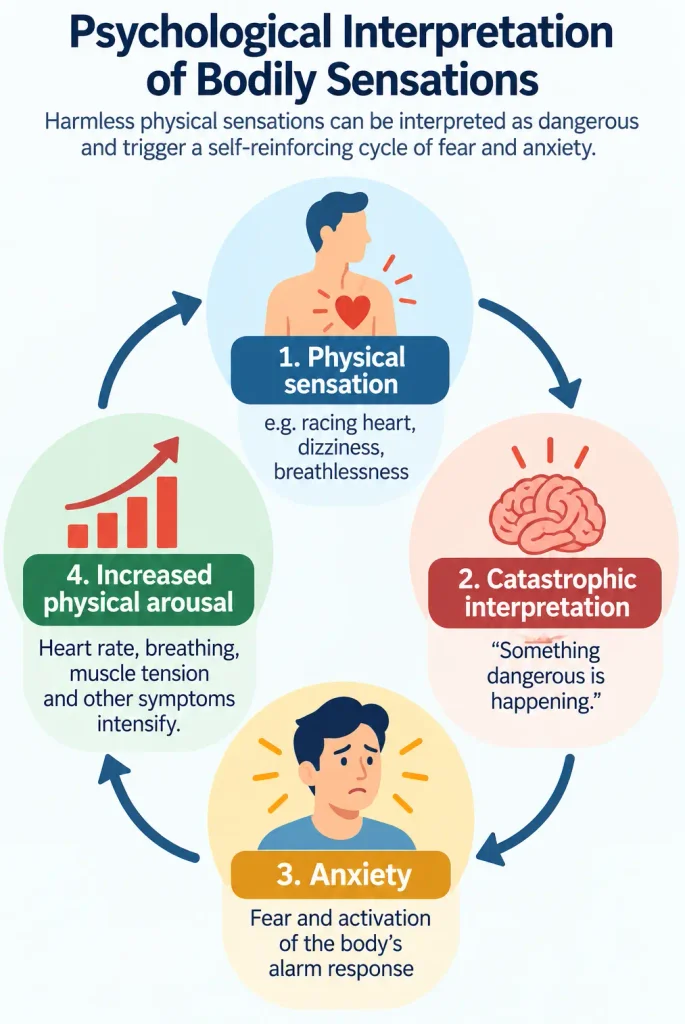
An important psychological factor in panic attacks is the way a person interprets physical sensations. Cognitive models of panic disorder suggest that individuals who are particularly sensitive to bodily changes may interpret harmless or ordinary sensations as signs of immediate danger.
For example, a racing heart may be interpreted as evidence of a heart attack, dizziness as impending collapse, or breathlessness as a sign of suffocation. Some individuals experience feelings of unreality or detachment and become frightened that they are losing control of their minds.
These catastrophic interpretations increase fear and activate the body’s alarm system. As anxiety rises, heart rate and breathing may increase further, intensifying the original physical sensations. The person may then regard these stronger sensations as confirmation that something dangerous is happening.
This creates a self-reinforcing cycle in which bodily sensations, catastrophic thoughts, anxiety, and physiological arousal intensify one another. The attack can escalate rapidly, even when no external danger is present.
Repeated experiences of this cycle can gradually increase sensitivity to bodily changes and contribute to the development of persistent panic disorder.
How Previous Panic Attacks Create Anticipatory Anxiety
After experiencing a severe panic attack, many people become increasingly concerned about having another episode. The memory of overwhelming fear, palpitations, chest discomfort, or the feeling of losing control can remain distressing long after the attack has ended.
As a result, attention may gradually shift toward monitoring the body for possible warning signs. Changes in heartbeat, breathing, balance, or other physical sensations that previously went unnoticed are now interpreted as indications that another attack might be approaching.
This heightened awareness can lead to anticipatory anxiety, which refers to persistent fear of experiencing another panic attack. People may begin worrying about having an attack while driving, travelling, attending meetings, or being alone in public places. Sometimes, the expectation of another attack is enough to increase anxiety and produce the very physical sensations they fear.
Over time, fear of another panic attack can become more important in maintaining panic disorder than the circumstances that triggered the first episode. Patients may begin restricting their activities or developing behaviours intended to prevent future attacks, gradually reinforcing their anxiety.
Avoidance and Safety Behaviours
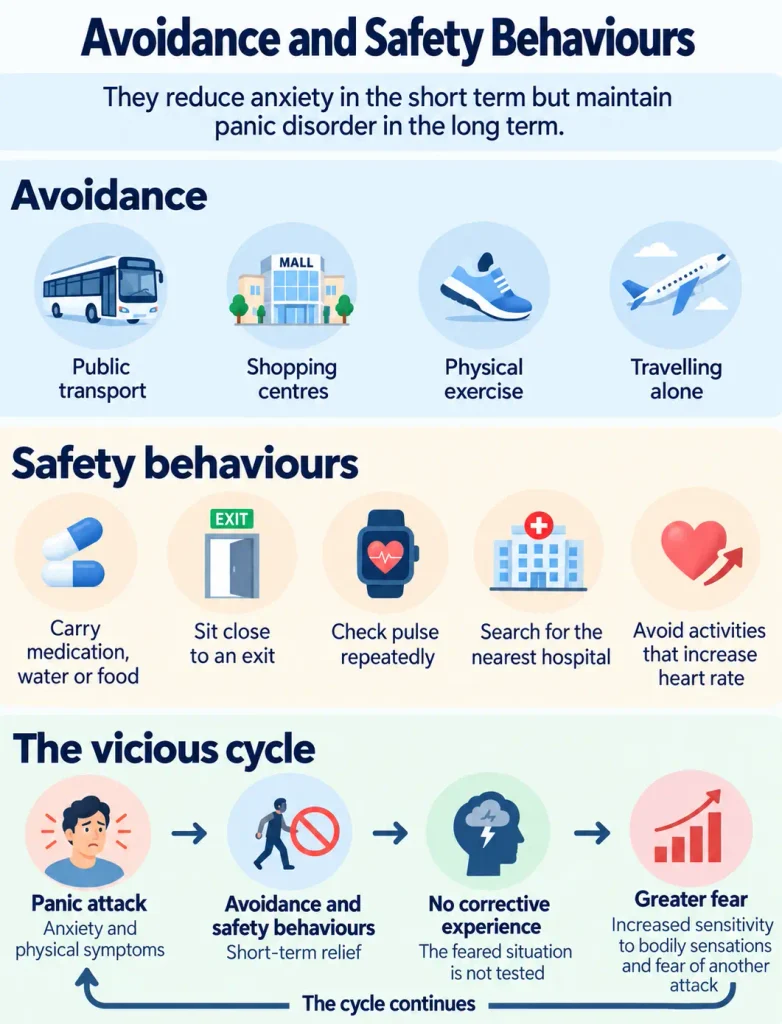
Avoidance is one of the most important mechanisms that can maintain panic disorder. After experiencing panic attacks in particular situations, patients may begin avoiding circumstances in which they fear another episode could occur. They may stop using public transport, avoid shopping centres, reduce physical exercise, or become reluctant to travel alone.
Other people develop safety behaviours, such as always carrying medication or water, sitting near an exit, repeatedly checking their pulse, or searching for the nearest hospital. These precautions create a temporary feeling of security and may reduce anxiety in the moment.
However, avoidance and safety behaviours can become problematic when patients believe that these precautions are the only reason they remain safe. By consistently avoiding feared situations or relying on unnecessary precautions, they have fewer opportunities to learn that anxiety and bodily sensations can often be tolerated without the feared catastrophe occurring.
The short-term relief provided by avoidance can therefore reinforce anxiety in the long term. Situations previously considered harmless gradually become associated with danger, while patients increasingly lose confidence in their ability to manage anxiety.
This process helps explain how occasional panic attacks can develop into persistent panic disorder and, in some patients, become associated with agoraphobia.
Can Caffeine, Nicotine, or Alcohol Trigger Panic Attacks?
Substances that alter physical arousal can contribute to panic symptoms in susceptible individuals. Caffeine can increase heart rate, alertness, and trembling. Nicotine affects the cardiovascular and nervous systems. Alcohol may temporarily reduce anxiety but can contribute to anxiety during intoxication, disrupted sleep, or withdrawal. Recreational drugs can also provoke anxiety and panic-like states.
These substances do not explain every case of panic disorder, but the bodily changes they produce can become triggers when they are interpreted as signs of danger.
Can Medication or Physical Illness Cause Panic-Like Symptoms?
Not every episode of intense anxiety accompanied by physical symptoms is caused by panic disorder. Several medical conditions can produce palpitations, breathlessness, dizziness, trembling, or sweating that closely resemble panic attacks.
Cardiovascular disorders, thyroid dysfunction, respiratory illnesses, and metabolic disturbances, including hypoglycaemia, may cause similar symptoms. Certain medications and stimulants can also increase physiological arousal or produce anxiety-like reactions.
For this reason, panic disorder should not be diagnosed solely on the basis of physical symptoms. A psychiatric assessment must consider possible medical causes, medication effects, substance use, and other psychiatric conditions. The extent of further medical investigation depends on the patient’s symptoms, history, and clinical findings.
New or severe chest pain, significant breathing difficulties, fainting, or other concerning symptoms may require urgent medical evaluation rather than being assumed to represent a panic attack.
For more information about clinical assessment and the exclusion of other causes, read our article on Diagnosis of Panic Disorder
Panic Attacks and Other Psychiatric Disorders
Panic attacks are not limited to panic disorder. They may occur in association with other anxiety disorders, phobias, post-traumatic stress disorder, depression, and other psychiatric conditions.
The context is important. An unexpected panic attack occurring without a specific situational trigger is different from a panic-like episode that consistently appears when a person confronts a particular phobic situation. For this reason, understanding why someone experiences panic attacks requires looking beyond the attack itself and considering the broader psychiatric picture.
Psychodynamic Understanding of Panic Attacks
Psychodynamic approaches to panic attacks explore the possible relationship between anxiety, emotional conflicts, interpersonal experiences, and significant changes in a person’s life. While cognitive models focus primarily on the interpretation of bodily sensations, psychodynamic perspectives also consider emotional experiences that may not be fully recognised or consciously understood.
Major life transitions can challenge an individual’s established psychological balance. Separation from parents, marriage, pregnancy, parenthood, changes in professional identity, ageing, or children leaving home may evoke conflicting emotions. A person may consciously welcome a new situation while simultaneously experiencing insecurity, fear of separation, increased responsibility, or a sense of losing control.
From a psychodynamic perspective, panic attacks may sometimes arise during periods when emotional tensions become difficult to recognise, express, or manage. Exploring these experiences can help patients understand the personal circumstances surrounding the onset of anxiety and the ways in which they respond to stress.
Psychodynamic explanations should not be regarded as universal causes of panic disorder. They represent one psychological approach that may provide useful insights into an individual’s experiences, particularly when considered alongside biological vulnerability, cognitive mechanisms, and current life circumstances.
Why Panic Disorder Usually Has More Than One Cause
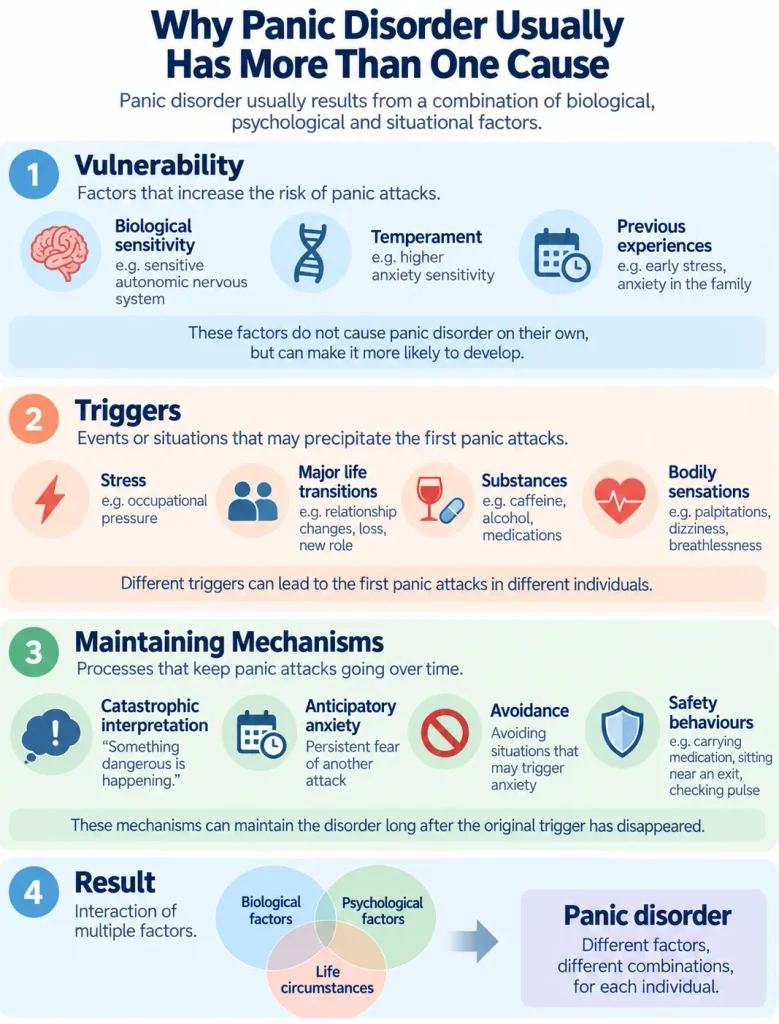
Panic disorder rarely develops because of a single identifiable cause. In most patients, several biological, psychological, and environmental factors interact. Their relative importance differs from person to person and may change as the disorder progresses.
A useful way of understanding the development of panic disorder is to distinguish between vulnerability, triggers, and maintaining factors.
Biological sensitivity, temperament, and early experiences may increase a person’s vulnerability to anxiety. Stressful life events, physical exhaustion, unusual bodily sensations, or stimulant substances may contribute to the onset of individual panic attacks. Once attacks have occurred, catastrophic interpretations, anticipatory anxiety, avoidance, and safety behaviours can gradually maintain the disorder.
These mechanisms explain why panic attacks may continue even after the original stressful circumstances have resolved. What initially triggered the first attack is not always the same as what keeps the disorder active.
Understanding the interaction between these factors is more useful than searching for one isolated cause. It allows the psychiatrist to develop an individual understanding of the patient’s difficulties and identify the mechanisms that need to be addressed during treatment.
Understanding the Individual Causes of Panic Attacks
Understanding why panic attacks occur requires more than identifying the symptoms experienced during an episode. A comprehensive psychiatric assessment considers the patient’s biological vulnerability, psychological history, current life circumstances, and the events surrounding the first panic attack.
Particular attention is given to changes in stress levels, sleep, physical health, interpersonal relationships, and the way the patient interprets bodily sensations. The assessment also explores whether fear of further attacks, avoidance, or safety behaviours have developed over time.
In many patients, the mechanisms that currently maintain panic disorder are different from the factors that initially contributed to its onset. Recognising this distinction helps explain why panic attacks may persist even when the original stressor is no longer present.
Identifying these individual mechanisms provides an important foundation for effective treatment. Depending on the patient’s clinical needs, treatment may include psychotherapy, medication, or a combination of approaches aimed at reducing panic attacks, anticipatory anxiety, and avoidance.
For more information about available treatment approaches, read our article on Treatment for Panic Attacks in Dubai.