

The diagnosis of panic disorder in Dubai requires more than recognising the symptoms of a panic attack. Palpitations, chest discomfort, breathlessness, dizziness, trembling and intense fear can occur during panic attacks, but similar symptoms may also result from medical conditions, medications, substances or other psychiatric disorders.
At CHMC Dubai, diagnosis begins with a comprehensive psychiatric assessment. The psychiatrist evaluates the nature and frequency of the panic attacks, whether they occur unexpectedly, what happens between episodes, and whether the patient has developed persistent fear of another attack or started avoiding certain situations.
Particular attention is given to the distinction between an isolated panic attack and panic disorder. A person can experience one or several panic attacks without having panic disorder. The diagnosis becomes more likely when unexpected attacks recur and are followed by persistent anticipatory anxiety or changes in behaviour.
Medical causes also need to be considered, particularly when panic-like symptoms appear for the first time. Depending on the patient’s symptoms and medical history, physical examination, laboratory investigations, an ECG or other diagnostic procedures may be indicated.
Book a Panic Disorder Assessment at CHMC Dubai
Panic Attack or Panic Disorder?
A panic attack is a sudden episode of intense fear or discomfort that develops rapidly and reaches its peak within minutes. It can involve physical and psychological symptoms such as palpitations, sweating, trembling, breathlessness, chest discomfort, dizziness, nausea, numbness, derealisation, or fear of losing control or dying.
Panic disorder is characterised by recurrent, unexpected panic attacks followed by persistent concern about further attacks or their consequences, or significant behavioural changes intended to prevent another episode. These changes may include heightened attention to bodily sensations, avoidance of certain activities or situations, and persistent fear of experiencing another attack.
Panic disorder refers to a recurring pattern in which panic attacks occur unexpectedly and are followed by ongoing psychological or behavioural consequences. These may include persistent fear of another attack, concern about its possible consequences, heightened attention to bodily sensations, or changes in everyday behaviour intended to prevent or manage further episodes.
How Is Panic Disorder Diagnosed?
Panic disorder is diagnosed through a comprehensive psychiatric assessment, rather than a single laboratory test, brain scan or questionnaire. The psychiatrist begins with a detailed clinical interview to understand how the panic attacks developed, how frequently they occur and whether they arise unexpectedly or in response to particular situations.
The assessment examines both the physical and psychological symptoms experienced during an attack and what happens between episodes. Particular attention is given to anticipatory anxiety, the persistent fear of further panic attacks, and behavioural changes such as avoiding places, travelling alone or exercising because of fear that another attack may occur.
The psychiatrist also reviews the patient’s psychiatric and medical history, current medications, substance use and other relevant clinical information. These findings are evaluated alongside recognised diagnostic criteria to determine whether panic disorder is present or whether another psychiatric or medical condition better explains the symptoms.
Diagnostic Criteria for a Panic Attack
According to the DSM-5-TR, a panic attack is an abrupt surge of intense fear or discomfort that reaches a peak within minutes and involves four or more characteristic physical or psychological symptoms. These may include palpitations, sweating, trembling, breathlessness, chest discomfort, dizziness, derealisation, or fear of losing control or dying.
A panic attack alone does not establish a diagnosis of panic disorder. The psychiatrist must also assess the pattern, recurrence and consequences of the attacks, which are considered in the diagnostic criteria for panic disorder below.
For a detailed description of the individual physical and psychological manifestations, read more about symptoms of panic attacks
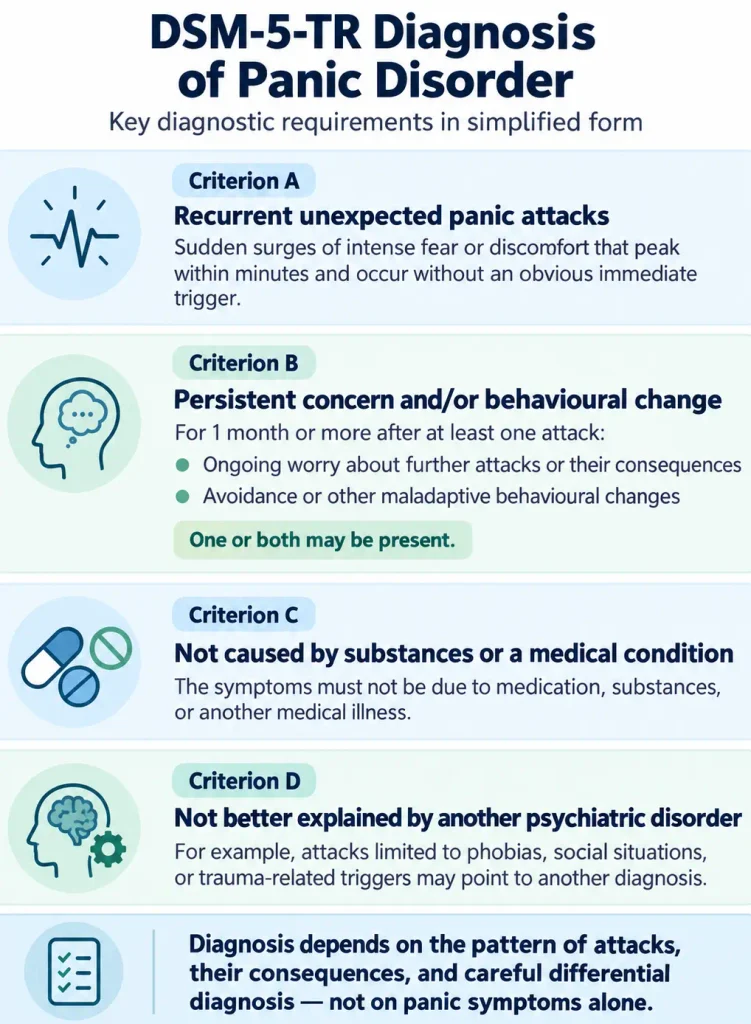
DSM-5-TR Diagnosis of Panic Disorder
According to the Diagnostic and Statistical Manual of Mental Disorders, Fifth Edition, Text Revision (DSM-5-TR), the diagnosis of panic disorder requires recurrent, unexpected panic attacks and specific psychological or behavioural changes following at least one of these episodes. The psychiatrist must also exclude other medical, substance-related and psychiatric explanations for the symptoms.
Criterion A: Recurrent Unexpected Panic Attacks
Panic disorder is characterised by recurrent panic attacks that occur unexpectedly, without an obvious immediate trigger. A panic attack involves a sudden surge of intense fear or discomfort that reaches its peak within minutes and is accompanied by characteristic physical or psychological symptoms.
Criterion B: Persistent Concern or Behavioural Changes
At least one panic attack must be followed by one month or more of one or both of the following:
- Persistent concern or worry about additional panic attacks or their consequences, such as losing control, having a heart attack or becoming seriously ill.
- Significant maladaptive changes in behaviour related to the attacks, such as avoiding exercise, unfamiliar places or activities because of fear that they might trigger another episode.
Both features do not need to be present. Persistent concern alone, significant behavioural changes alone, or a combination of both may satisfy this criterion.
Criterion C: Not Caused by Substances or Medical Conditions
The panic attacks must not be attributable to the physiological effects of medication, substances or another medical condition. Depending on the clinical situation, the psychiatrist may therefore consider cardiovascular, respiratory, endocrine or other medical explanations.
Criterion D: Not Better Explained by Another Psychiatric Disorder
The panic attacks must not be better explained by another psychiatric disorder. For example, panic attacks occurring exclusively in response to feared social situations, specific phobias or trauma-related triggers may form part of another condition rather than panic disorder.
An accurate diagnosis therefore depends on the pattern of attacks, their psychological and behavioural consequences, and careful differential diagnosis, rather than on the presence of panic symptoms alone.
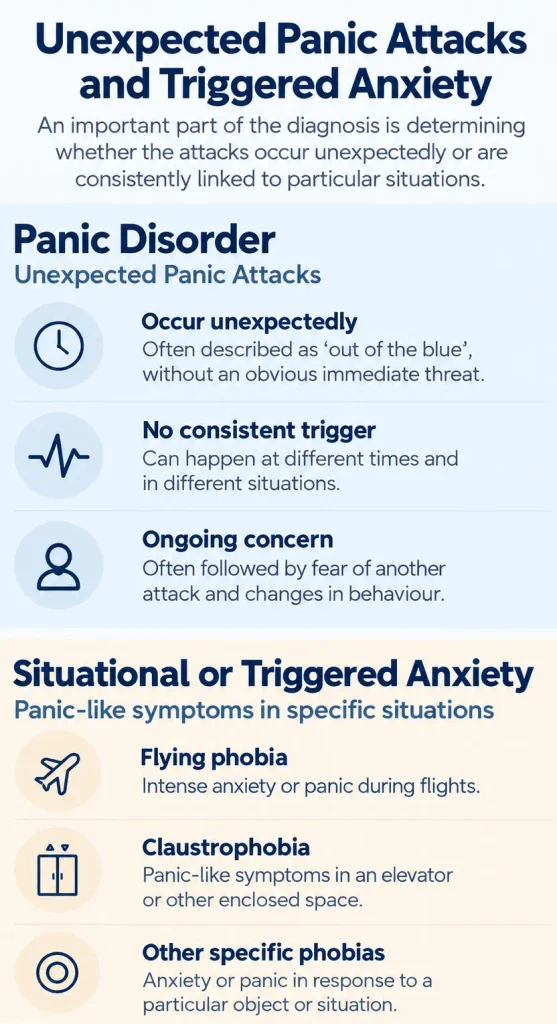
Unexpected Panic Attacks and Triggered Anxiety
An important part of the diagnosis is determining whether the attacks are unexpected or consistently associated with particular situations. In panic disorder, attacks characteristically occur unexpectedly. The patient may describe them as appearing “out of the blue,” without an obvious immediate threat.
This differs from anxiety that occurs predictably in response to a specific object or situation. For example, a person with a flying phobia may experience intense panic-like symptoms during a flight, while someone with claustrophobia may experience them in an elevator or another enclosed space. The physical experience can be very similar, but the diagnostic context is different. The psychiatrist therefore needs to establish not only what happens during the attack, but also when, where and under what circumstances it occurs.
Anticipatory Anxiety and Avoidance Behaviour
The period between attacks provides some of the most important diagnostic information. After experiencing an unexpected panic attack, patients may become increasingly concerned that another attack could occur. This is known as anticipatory anxiety. Attention becomes focused on bodily sensations, and ordinary changes in heart rate, breathing or balance may be interpreted as signs that another episode is beginning.
Behaviour may gradually change in response to this fear. A patient may avoid crowded places, driving, exercise, public transport, airplanes, elevators or situations in which immediate escape appears difficult. These avoidance strategies can initially seem protective but may progressively restrict the person’s everyday life. Assessing their extent helps determine the severity and functional impact of panic disorder.
Panic Disorder and Agoraphobia
Panic disorder and agoraphobia are separate psychiatric conditions, although they frequently occur together. Panic disorder is characterised by recurrent unexpected panic attacks and persistent concern or behavioural changes related to further attacks. Agoraphobia involves marked fear or anxiety about situations in which escape might be difficult or help might not be available if panic-like or other incapacitating symptoms occur.
People with agoraphobia may avoid public transport, crowded places, shopping centres, open or enclosed spaces, or being outside the home alone. These situations are often avoided, endured with intense anxiety or managed only with the presence of a trusted companion.
Agoraphobia can occur with or without panic disorder. During psychiatric assessment, the psychiatrist therefore evaluates whether the patient meets the diagnostic criteria for either condition or both. This distinction is important because the extent and pattern of avoidance influence treatment planning, particularly the use of exposure-based psychotherapy.
Medical Conditions That Can Mimic Panic Attacks
One of the most important aspects of diagnosing panic disorder is considering physical conditions that can cause similar symptoms. Heart palpitations, sweating, breathlessness, dizziness and trembling are not specific to panic disorder. Similar complaints may occur with cardiac arrhythmias, thyroid dysfunction, asthma and other respiratory disorders, metabolic disturbances, neurological conditions and other medical illnesses.
This is particularly important when symptoms occur for the first time. Chest pain, severe shortness of breath, loss of consciousness or other new and concerning physical symptoms should not automatically be attributed to anxiety before appropriate medical causes have been considered.
A careful assessment helps avoid unnecessary repeated investigations when panic disorder is already established, while ensuring that new or unusual physical symptoms are not prematurely attributed to anxiety.
Can Medication or Substances Cause Panic Attacks?
Medication and substances can also produce symptoms resembling panic attacks. The assessment should therefore include current prescription and non-prescription medication as well as caffeine, nicotine, alcohol and recreational drug use. Some medications, including certain decongestants, thyroid medications and bronchodilators, can increase heart rate, cause trembling or produce sensations resembling anxiety.
Substance use, intoxication and withdrawal may also produce anxiety or panic-like symptoms. Establishing the temporal relationship between substance exposure and the attacks can therefore be important in the differential diagnosis.
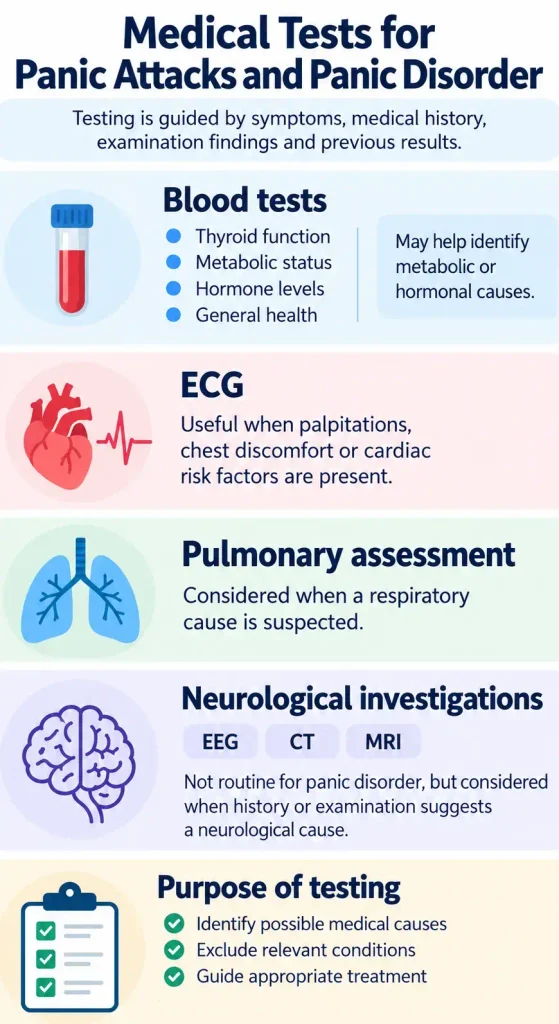
Medical Tests for Panic Attacks and Panic Disorder
Not every patient with panic attacks requires extensive medical testing. Investigations should be guided by the patient’s age, symptoms, medical history, physical findings and previous examinations. When indicated, blood tests can help identify metabolic or hormonal abnormalities, including thyroid dysfunction. An ECG may be appropriate when cardiac symptoms or relevant risk factors are present. Pulmonary assessment can be considered when respiratory disease is suspected.
Neurological investigations such as EEG or brain imaging are not routine tests for panic disorder but may be considered when the history or examination suggests a neurological cause. The purpose of these investigations is not to “prove” panic disorder. It is to identify or exclude relevant medical explanations when the clinical situation indicates that this is necessary.
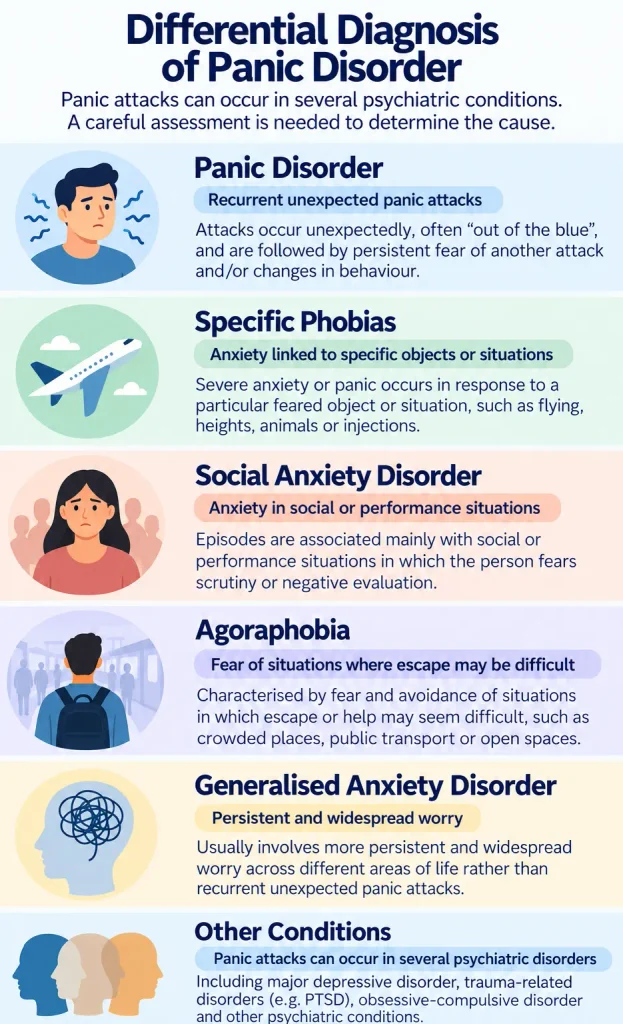
Differential Diagnosis of Panic Disorder
Because panic attacks can occur in several psychiatric conditions, their presence alone does not establish a diagnosis of panic disorder. The psychiatrist therefore evaluates the circumstances in which the attacks occur and whether another disorder better explains them.
In specific phobias, severe anxiety or panic typically occurs in response to a particular feared object or situation. In social anxiety disorder, episodes are associated primarily with social or performance situations in which the person fears scrutiny or negative evaluation. Agoraphobia is characterised by fear and avoidance of situations in which escape or obtaining help may seem difficult.
Generalised anxiety disorder usually involves more persistent and widespread worry across different areas of life rather than recurrent unexpected panic attacks as the central feature. Panic attacks may also occur in depressive and trauma-related disorders and other psychiatric conditions.
The purpose of differential diagnosis is therefore to determine whether recurrent unexpected panic attacks and their subsequent consequences form the primary clinical pattern, or whether the panic symptoms are better understood as part of another psychiatric disorder.
Why Accurate Diagnosis Matters
An accurate diagnosis is essential because panic attacks can resemble serious medical conditions and occur in several psychiatric disorders. Without appropriate assessment, patients may undergo repeated investigations for symptoms that are actually caused by panic disorder. Conversely, attributing chest pain, breathlessness or palpitations to anxiety too quickly may delay the recognition of an underlying medical condition.
The correct diagnosis also influences treatment. Recurrent unexpected panic attacks require a different clinical approach from anxiety occurring primarily in specific phobias, social anxiety disorder or other psychiatric conditions. Identifying panic disorder, possible agoraphobia and co-existing disorders helps the psychiatrist recommend treatment that addresses the underlying difficulties rather than only the immediate symptoms.
For information about the therapeutic approach, read more about treatment for panic attacks in Dubai.
Diagnosis of Panic Disorder at CHMC Dubai
At CHMC German Clinic for Psychiatry and Psychology in Dubai, patients with suspected panic disorder receive an individualised psychiatric assessment under the care of Dr. Gregor Kowal, German Board-Certified Consultant Psychiatrist and Psychotherapist.
The consultation provides sufficient time to discuss the patient’s experiences, including panic attacks, fear of further episodes, avoidance behaviours and their impact on everyday life. Previous treatment, medical history and possible co-existing psychiatric conditions are considered to develop a comprehensive understanding of the patient’s difficulties.
The aim is to establish an accurate diagnosis and explain the findings clearly to the patient. When panic disorder is diagnosed, Dr. Kowal discusses the available treatment options and recommends the appropriate next steps according to the individual clinical situation.
Patients experiencing recurrent panic attacks, anticipatory anxiety or increasing avoidance can arrange a psychiatric assessment at CHMC Dubai.
Book a Panic Disorder Assessment at CHMC Dubai
Read More About Panic Attacks
- Treatment for Panic Attacks
- Symptoms of Panic Attacks
- Medication for Panic Disorder
- Psychotherapy for Panic Disorder
- History of Panic Attacks
- Causes of Panic Attacks