

Dr. Gregor Kowal is a German Board-Certified Consultant Psychiatrist and Psychotherapist with three decades of clinical experience. After graduating from the University of Heidelberg, Germany, he held senior leadership positions as Head of Department and Medical Director at psychiatric hospitals in Germany. Since 2010, he has been the Medical Director of CHMC German Clinic for Psychiatry and Psychology in Dubai. He specialises in the diagnosis and treatment of ADHD, and other psychiatric conditions in adults, using evidence-based treatment tailored to each patient’s individual needs.
There are three main ADHD types: predominantly inattentive, predominantly hyperactive-impulsive and combined ADHD. More precisely, the DSM-5 refers to these as ADHD presentations because the pattern of symptoms can change over time.
At CHMC, the German Psychiatric Clinic in Dubai, we diagnose attention-deficit/hyperactivity disorder (ADHD) according to internationally recognised diagnostic criteria. The DSM-5, developed by the American Psychiatric Association (APA), classifies ADHD according to the predominance of inattention, hyperactivity and impulsivity.
Some people mainly struggle with concentration, organisation and forgetfulness. Others experience pronounced restlessness and impulsivity. Many have clinically significant symptoms from both groups.
Understanding the different ADHD types helps describe a person’s pattern of symptoms, but the presentation alone does not determine treatment. Diagnosis must also consider symptom severity, functional impairment, age, developmental history and co-existing psychiatric conditions.
For ADHD Treatment in Dubai Make an Appointment with Our Leading Psychiatrist Dr.Kowal
What Are the 3 Types of ADHD?
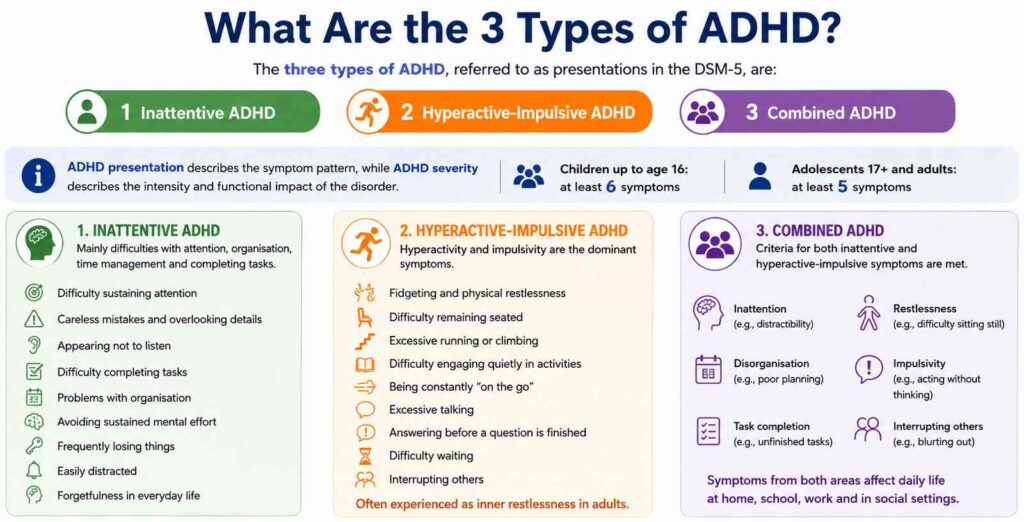
The three types of ADHD, referred to as presentations in the DSM-5, are predominantly
- inattentive ADHD
- predominantly hyperactive-impulsive ADHD
- combined ADHD
ADHD presentation describes the symptom pattern, while ADHD severity describes the intensity and functional impact of the disorder.
The presentation depends on which symptoms have been present during the preceding six months. For children up to age 16, at least six symptoms from the relevant symptom group are required. For adolescents aged 17 and older and adults, at least five symptoms are required.
However, symptom numbers alone are not sufficient for an ADHD diagnosis. Several symptoms must have been present before age 12, occur in more than one setting and interfere with social, academic or occupational functioning. They must also not be better explained by another psychiatric disorder.
Inattentive ADHD Type
Predominantly inattentive ADHD is characterised mainly by difficulties with attention, organisation, time management and completing tasks. Hyperactivity and impulsivity may occur, but not sufficiently to meet the criteria for the hyperactive-impulsive presentation.
Difficulty Sustaining Attention
People with inattentive ADHD may struggle to maintain concentration, particularly during repetitive, lengthy or mentally demanding activities. Their attention may drift during conversations, meetings, lectures or reading.
Careless Mistakes and Overlooking Details
A person may understand a task correctly but still overlook important details or make avoidable mistakes. In adults, this can affect paperwork, emails, calculations or professional tasks requiring sustained concentration.
Appearing Not to Listen
People with inattentive ADHD may appear not to listen even when someone is speaking directly to them. Their attention may shift internally or toward external distractions despite an intention to concentrate.
Difficulty Completing Tasks
Starting a task may be easier than completing it. A person may move from one activity to another, leave projects unfinished or lose track of the steps required to reach a goal.
Problems with Organisation
Planning, prioritising and time management can be particularly difficult. Appointments, deadlines, paperwork and multiple responsibilities may become difficult to coordinate.
Avoiding Sustained Mental Effort
Tasks requiring prolonged concentration may be repeatedly postponed. This often appears as procrastination with studying, administrative work, paperwork or other activities that provide little immediate stimulation.
Frequently Losing Things
Keys, phones, documents, school materials and other important objects may frequently be misplaced, often because consistent organisational routines are difficult to maintain.
Easily Distracted
External noises, conversations, notifications or unrelated thoughts can interrupt concentration. Returning to the original task may then require considerable effort.
Forgetfulness in Everyday Life
Appointments, deadlines, errands and routine responsibilities may be forgotten despite the person’s intention to remember them.
Why Inattentive ADHD Can Be Overlooked
Inattentive ADHD can remain unnoticed because the person may not appear visibly restless or disruptive. This is particularly relevant in children and adults who compensate through intelligence, strong external structure or considerable personal effort.
Difficulties may become more apparent when demands increase, for example after entering university, starting a demanding job or living independently. However, inattentiveness is not specific to ADHD. Depression, anxiety, chronic stress, sleep deprivation and other conditions can also cause concentration problems. This makes differential diagnosis particularly important.
Hyperactive-Impulsive ADHD Type
In predominantly hyperactive-impulsive ADHD, hyperactivity and impulsivity are the dominant symptoms, while the threshold for predominantly inattentive ADHD is not met. Hyperactivity is often most obvious during childhood, but its expression usually changes with age.
Fidgeting and Physical Restlessness
Children may frequently move their hands or feet, squirm in their chairs or manipulate objects. Adults may show subtler restlessness, such as constantly changing position or feeling uncomfortable when required to remain still.
Difficulty Remaining Seated
Children may repeatedly leave their seats when remaining seated is expected. Adults may instead experience marked discomfort during long meetings, lectures, journeys or other periods of inactivity.
Excessive Running or Climbing
In younger children, hyperactivity may involve inappropriate running or climbing. With increasing age, this often becomes less visible and may be replaced by subjective inner restlessness.
Difficulty Engaging Quietly in Activities
People with hyperactive ADHD may find quiet leisure activities difficult and experience a persistent need to move, speak or remain actively engaged.
Being Constantly “On the Go”
Some individuals appear continuously active and find it difficult to slow down. Adults may describe a persistent feeling that they need to be doing something.
Excessive Talking
A person may speak more than the social situation requires and have difficulty regulating how often or how long they talk.
Answering Before a Question Is Finished
Impulsivity can lead to responding before another person has completed a question or statement.
Difficulty Waiting
Waiting in queues, conversations or situations requiring turn-taking may produce pronounced impatience and frustration.
Interrupting Others
Children may interrupt games or conversations. Adults may frequently speak over others, complete their sentences or enter discussions before an appropriate opportunity arises.
Hyperactive ADHD in Adults
In adults, ADHD hyperactivity does not necessarily involve obvious excessive movement. It may appear primarily as internal restlessness, impatience, difficulty relaxing or a constant need for stimulation.
Impulsivity may manifest as interrupting conversations, making decisions too quickly or acting before considering consequences.
Combined ADHD Type
Combined ADHD is diagnosed when the criteria for both inattentive and hyperactive-impulsive symptoms are fulfilled. People with combined ADHD therefore experience clinically significant symptoms from both major ADHD domains. They may struggle with concentration, organisation and task completion while simultaneously experiencing restlessness and impulsivity.
A child may have difficulty remaining seated, frequently interrupt others, lose school materials and struggle to complete assignments. An adult may experience poor time management, procrastination and distractibility together with internal restlessness and impulsive decision-making. Combined ADHD does not automatically mean severe ADHD.
Can ADHD Types Change Over Time?
ADHD types or presentations can change over time. This is one reason the DSM-5 uses the term presentation rather than describing ADHD as several permanently separate disorders. Hyperactivity is often particularly visible during childhood. With increasing age, obvious motor hyperactivity may decrease and be replaced by internal restlessness. Inattention, organisation problems and difficulties with time management may persist and become more prominent as responsibilities increase.
Someone who met the criteria for combined ADHD during childhood may therefore meet the criteria for predominantly inattentive ADHD later in life.
ADHD in Partial Remission
The DSM-5 allows ADHD to be specified as “in partial remission.” This applies when a person previously met the full diagnostic criteria but, during the previous six months, no longer meets all criteria while some symptoms remain and continue to cause impairment. Partial remission does not necessarily mean that ADHD has disappeared. Clinically relevant difficulties may persist even when the full diagnostic threshold is no longer met.
Is Residual ADHD Still an ADHD Type?
The term residual ADHD can still be found in older literature, particularly when describing adults who had more extensive ADHD symptoms during childhood but continue to experience some symptoms later in life. However, residual ADHD is not one of the three current DSM-5 ADHD presentations. The DSM-5 specification in partial remission more accurately describes individuals who previously fulfilled the full diagnostic criteria but subsequently experienced a reduction in symptoms.
ADHD Types in Children, Adults and Women
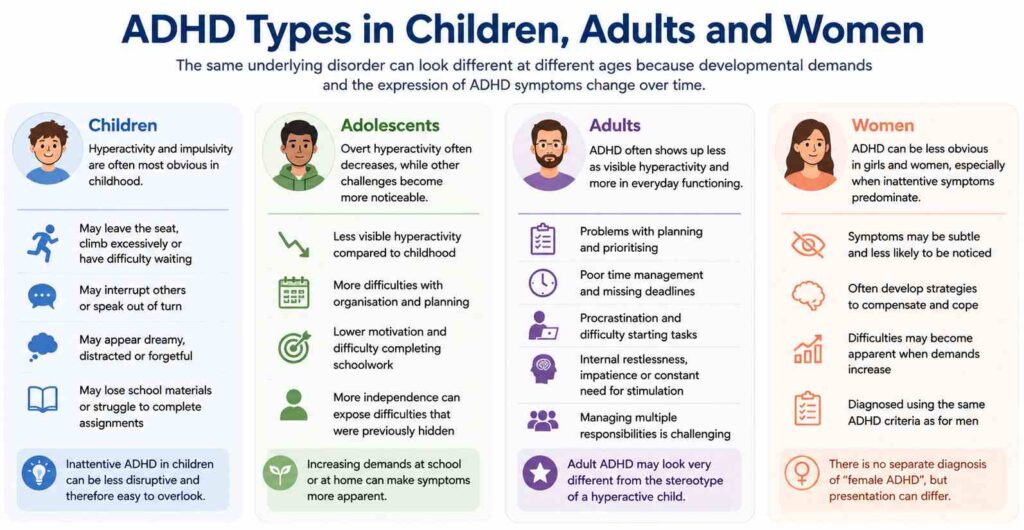
The same underlying disorder can look different at different ages because developmental demands and the expression of ADHD symptoms change over time.
ADHD Types in Children
In childhood, hyperactivity and impulsivity can be particularly obvious. A child may repeatedly leave the seat, climb excessively, interrupt others or have difficulty waiting. Children with predominantly inattentive ADHD may be less disruptive. They may appear dreamy, forget instructions, lose school materials or struggle to complete assignments.
ADHD Types in Adolescents
During adolescence, overt hyperactivity often becomes less pronounced while difficulties with organisation, procrastination, motivation and schoolwork may become more important. Increasing independence also reduces the external structure provided by parents and teachers, sometimes exposing ADHD difficulties that were previously compensated for.
ADHD Types in Adults
In adults, ADHD often becomes particularly noticeable through problems with planning, prioritising, procrastination, time management and managing multiple responsibilities. Visible hyperactivity may be replaced by internal restlessness, impatience or a persistent need for stimulation. For this reason, adult ADHD may look quite different from the stereotypical image of a hyperactive child.
ADHD Types in Women
ADHD can be less obvious in some girls and women, particularly when inattentive symptoms predominate. A quiet child who is distracted, forgetful or disorganised may attract less attention than someone who is visibly hyperactive. Some individuals also develop compensatory strategies that conceal difficulties until academic, professional or family demands increase.
However, there is no separate diagnostic category of “female ADHD.” Women are diagnosed according to the same ADHD criteria, although the clinical presentation and recognition of symptoms may differ between individuals.
ADHD Types and Executive Dysfunction
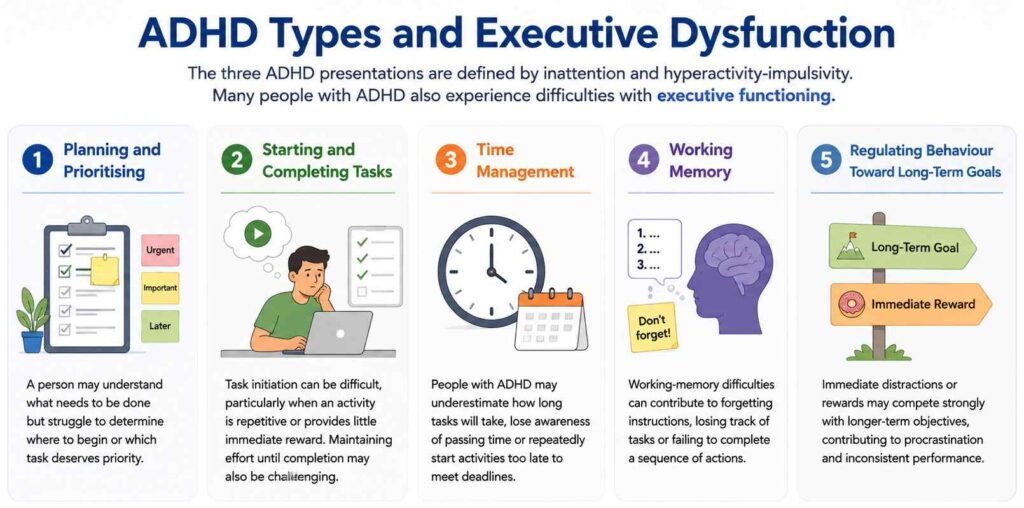
The three ADHD presentations are defined by inattention and hyperactivity-impulsivity. Many people with ADHD also experience difficulties with executive functioning.
Planning and Prioritising
A person may understand what needs to be done but struggle to determine where to begin or which task deserves priority.
Starting and Completing Tasks
Task initiation can be difficult, particularly when an activity is repetitive or provides little immediate reward. Maintaining effort until completion may also be challenging.
Time Management
People with ADHD may underestimate how long tasks will take, lose awareness of passing time or repeatedly start activities too late to meet deadlines.
Working Memory
Working-memory difficulties can contribute to forgetting instructions, losing track of tasks or failing to complete a sequence of actions.
Regulating Behaviour Toward Long-Term Goals
Immediate distractions or rewards may compete strongly with longer-term objectives, contributing to procrastination and inconsistent performance. Executive dysfunction is not a separate ADHD type and can also occur in other psychiatric and neurological conditions.
ADHD Types and Emotional Dysregulation
Some people with ADHD experience impatience, low frustration tolerance, rapid emotional reactions or difficulty calming down after becoming upset. These difficulties can affect relationships and everyday functioning, but emotional dysregulation is not one of the three DSM-5 ADHD presentations. Pronounced mood instability also requires careful differential diagnosis because emotional symptoms and impulsivity can occur in depression, anxiety disorders, bipolar disorder, borderline personality disorder and other conditions.
ADHD Severity: Mild, Moderate and Severe
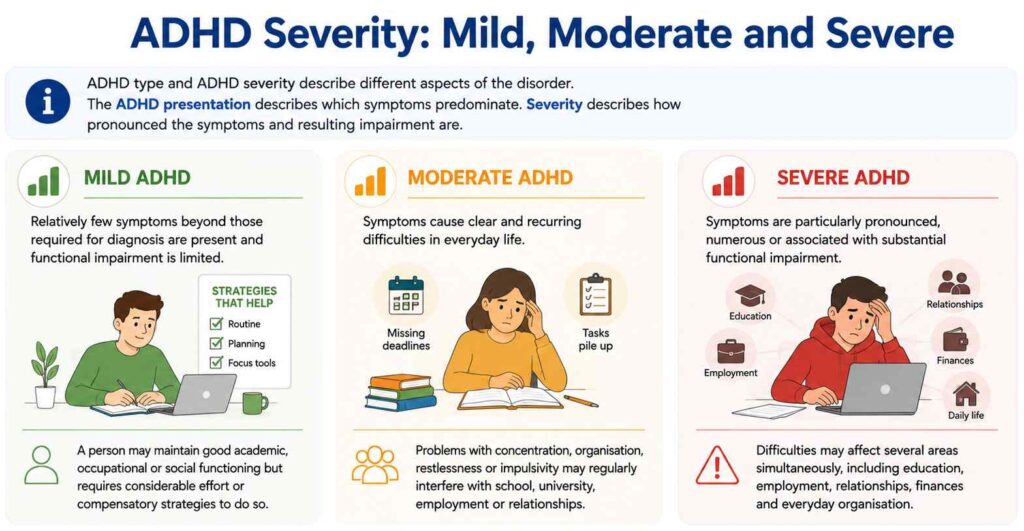
ADHD type and ADHD severity describe different aspects of the disorder. The ADHD presentation describes which symptoms predominate. Severity describes how pronounced the symptoms and resulting impairment are.
Mild ADHD
In mild ADHD, relatively few symptoms beyond those required for diagnosis are present and functional impairment is limited. A person may maintain good academic, occupational or social functioning but require considerable effort or compensatory strategies to do so.
Moderate ADHD
In moderate ADHD, symptoms cause clear and recurring difficulties in everyday life. Problems with concentration, organisation, restlessness or impulsivity may regularly interfere with school, university, employment or relationships.
Severe ADHD
In severe ADHD, symptoms are particularly pronounced, numerous or associated with substantial functional impairment. Difficulties may affect several areas simultaneously, including education, employment, relationships, finances and everyday organisation.
Is ADD a Type of ADHD?
The term ADD (attention deficit disorder) is still commonly used to describe attention difficulties without obvious hyperactivity. However, ADD is not a separate diagnosis in the current DSM-5 classification. What was previously commonly called ADD generally corresponds to ADHD, predominantly inattentive presentation. The term ADHD is therefore used even when a person has little or no obvious hyperactivity.
Can You Have ADHD Without Hyperactivity?
A person can have predominantly inattentive ADHD without meeting the criteria for hyperactive-impulsive ADHD. This presentation may remain undiagnosed for longer because the person does not display the disruptive or highly active behaviour commonly associated with ADHD. An adult may therefore have substantial difficulties with concentration, procrastination, organisation and time management without appearing physically hyperactive.
Can You Have Hyperactive ADHD Without Inattention?
Yes. In the predominantly hyperactive-impulsive presentation, the person meets the required threshold for hyperactive and impulsive symptoms but not for inattentive symptoms. Some attention difficulties may nevertheless occur. The classification means that there are not enough inattentive symptoms to meet the criteria for combined ADHD.
Which ADHD Type Is the Most Severe?
There is no ADHD type that is automatically the most severe. Combined ADHD involves symptoms from both major domains, but this does not necessarily mean greater impairment. Predominantly inattentive ADHD can also be severe. Significant problems with organisation, time management and sustained attention can seriously affect education, professional performance and everyday functioning even when hyperactivity is absent.
Severity must therefore be assessed independently from ADHD presentation.
Does ADHD Type Determine Treatment?
The ADHD presentation helps describe the person’s difficulties, but treatment should not be selected solely according to ADHD type. Treatment planning considers symptom severity, functional impairment, age, medical history, co-existing psychiatric conditions and previous treatment response.
Two people with predominantly inattentive ADHD may therefore require different treatment approaches depending on their individual symptoms and circumstances. Depending on the clinical situation, ADHD treatment may include psychoeducation, psychotherapy or behavioural interventions, strategies targeting organisation and executive functioning, and ADHD medication when clinically indicated.
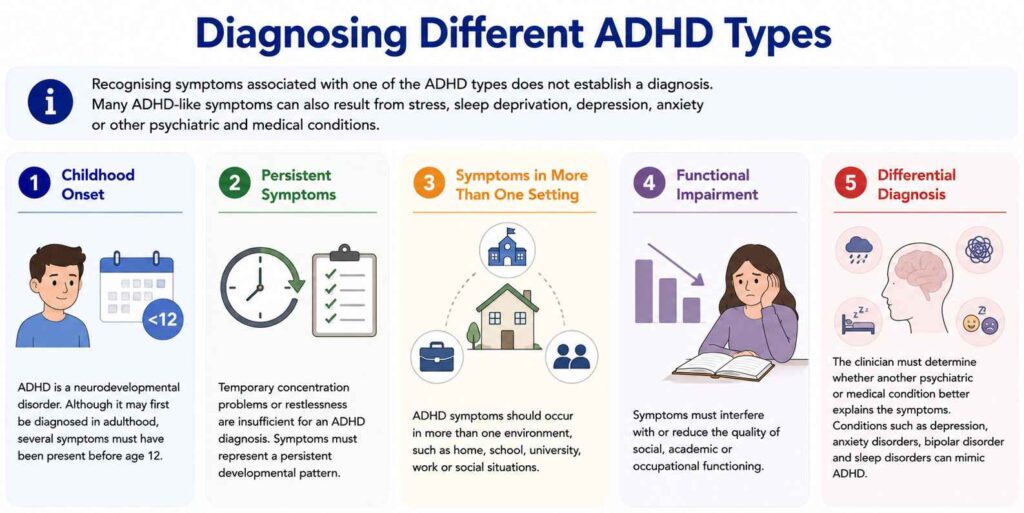
Diagnosing Different ADHD Types
Recognising symptoms associated with one of the ADHD types does not establish a diagnosis. Many ADHD-like symptoms can also result from stress, sleep deprivation, depression, anxiety or other psychiatric and medical conditions.
Childhood Onset
ADHD is a neurodevelopmental disorder. Although it may first be diagnosed in adulthood, several symptoms must have been present before age 12.
Persistent Symptoms
Temporary concentration problems or restlessness are insufficient for an ADHD diagnosis. Symptoms must represent a persistent developmental pattern.
Symptoms in More Than One Setting
ADHD symptoms should occur in more than one environment, such as home, school, university, work or social situations.
Functional Impairment
Symptoms must interfere with or reduce the quality of social, academic or occupational functioning.
Differential Diagnosis
The clinician must determine whether another psychiatric or medical condition better explains the symptoms. Depression, anxiety disorders, bipolar disorder and sleep disorders can all cause difficulties resembling ADHD.
ADHD Diagnosis at CHMC Dubai
At CHMC Dubai, an ADHD diagnosis considers current symptoms together with developmental history, school and occupational functioning, relationships, previous psychiatric history and possible co-existing conditions. The purpose of the assessment is not simply to identify whether someone has inattentive, hyperactive-impulsive or combined ADHD.
The assessment is also necessary to determine whether the symptoms actually represent ADHD, how severe they are and how strongly they affect everyday functioning. Careful differential diagnosis is particularly important because anxiety, depression, bipolar disorder, sleep problems and other conditions can resemble ADHD or coexist with it.
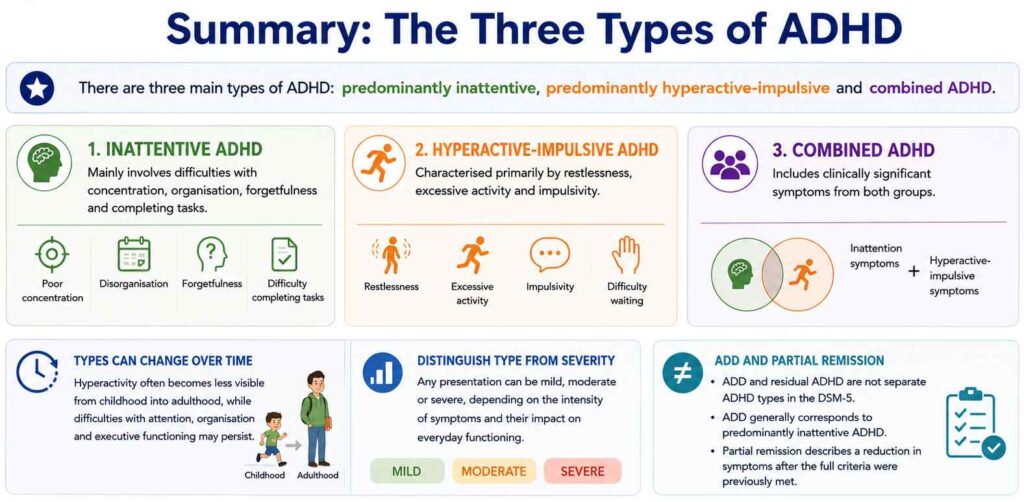
Summary: The Three Types of ADHD
There are three main types of ADHD: predominantly inattentive, predominantly hyperactive-impulsive and combined ADHD.
Inattentive ADHD mainly involves difficulties with concentration, organisation, forgetfulness and completing tasks.
Hyperactive-impulsive ADHD is characterised primarily by restlessness, excessive activity and impulsivity.
Combined ADHD includes clinically significant symptoms from both groups.
ADHD types can change over time. Hyperactivity often becomes less visible from childhood into adulthood, while difficulties with attention, organisation and executive functioning may persist.
ADHD type should also be distinguished from severity. Any presentation can be mild, moderate or severe, depending on the intensity of symptoms and their impact on everyday functioning.
Terms such as ADD and residual ADHD are still frequently encountered but are not separate ADHD types in the current DSM-5 classification. ADD generally corresponds to predominantly inattentive ADHD, while partial remission describes a reduction in symptoms after the full diagnostic criteria were previously met.
Identifying with one of these ADHD types does not establish a diagnosis. A professional assessment must evaluate developmental history, persistence of symptoms, impairment across different settings and alternative explanations for the symptoms.
At CHMC Dubai, ADHD assessment therefore aims to determine whether ADHD is present, which presentation best describes the current symptoms, how severe the disorder is and how it affects the individual patient’s life.
For ADHD diagnosis and treatment in Dubai, an appointment can be arranged with Dr. Gregor Kowal, Consultant Psychiatrist and Medical Director at CHMC Dubai.
If you’re concerned about your mental health condition, feel free to contact us on WhatsApp