

Attention Deficit Hyperactivity Disorder (ADHD) is a common neurodevelopmental condition. The symptoms of ADHD usually begin during childhood, but many people continue to experience difficulties throughout adult life.
In fact, many adults are diagnosed with ADHD only after years of struggling with poor concentration, forgetfulness, impulsive decisions, or persistent inner restlessness without understanding the underlying cause.
The symptoms of adult ADHD vary from person to person. Some individuals are mainly inattentive and have difficulty focusing, completing tasks, or staying organised. Others are hyperactive and impulsive, while many have a combination of all three core symptom groups.
Because ADHD symptoms can present differently, the condition is often overlooked or mistaken for anxiety, depression, or personality disorder. Therefore, recognising the symptoms of adult ADHD is the first step towards an accurate diagnosis and effective treatment.
Without appropriate care, adult ADHD can affect academic performance, work, relationships, emotional wellbeing, and overall quality of life. However, a comprehensive psychiatric assessment can identify ADHD and distinguish it from other conditions, with similar symptoms.
In this article, you will learn about the symptoms of adult ADHD, how the condition changes with age, and when it is advisable to seek a professional assessment.
For adult ADHD assessment, contact our Consultant psychiatrist Dr Kowal
What Are the Symptoms of Adult ADHD?
Adult ADHD is characterised by three core symptom groups: inattention, hyperactivity, and impulsivity. Every person with ADHD experiences these symptoms differently. Some predominantly struggle with attention and organisation, while others are mainly hyperactive or impulsive. Many people experience symptoms from all three groups.
An important feature of ADHD is that these symptoms are not occasional. Everyone becomes distracted, impatient, or forgetful from time to time. In ADHD, however, the symptoms are persistent, have usually been present since childhood, occur in more than one area of life, and significantly interfere with everyday functioning.
For this reason, ADHD is diagnosed not simply because symptoms exist but because they have a major impact on academic performance, work, and social interactions.
The Three Core Symptoms of Adult ADHD
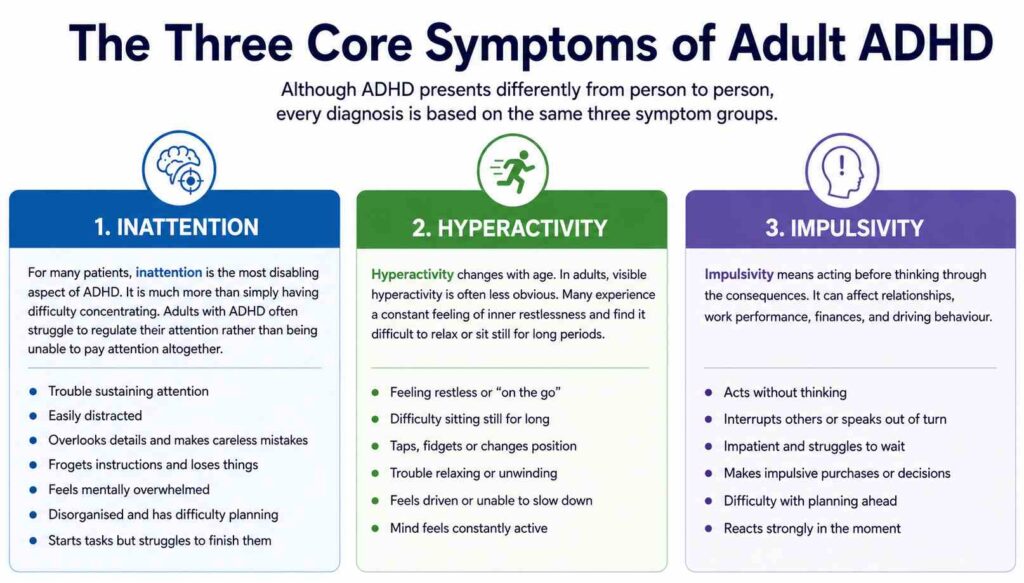
Although ADHD presents differently from person to person, every diagnosis is based on the same three symptom groups.
Inattention
For many patients, inattention is the most disabling aspect of ADHD. It is much more than simply having difficulty concentrating. Adults with ADHD often struggle to regulate their attention rather than being unable to pay attention altogether. Their brain has difficulty filtering unimportant information.
People with ADHD often begin tasks enthusiastically but become distracted before finishing them. They may overlook details, make careless mistakes, forget instructions, lose everyday objects, or appear disorganised. Many describe feeling mentally overwhelmed because everything seems equally important. At work, adults with ADHD can make the impression that they are careless or unmotivated. In reality, many individuals with ADHD work considerably harder than their peers simply to maintain the same level of concentration.
Hyperactivity
Hyperactivity is commonly associated with ADHD, but it changes significantly with age. In children, hyperactivity usually appears as constant movement. Children may run, climb, fidget, leave their seats repeatedly, or seem unable to remain still for more than a few moments. Parents often describe them as being “constantly on the go.”
In adults with ADHD, visible hyperactivity often becomes less obvious. Instead of running around, many experience a constant feeling of inner restlessness. Sitting through a long meeting, watching a film, or waiting in a queue may feel surprisingly difficult. Some continually tap their feet, drum their fingers, or change sitting positions without noticing. Many adults describe this experience as feeling permanently driven, unable to relax, or having a mind that never truly switches off.
Impulsivity
Impulsivity means acting before thinking through the consequences. Adults with ADHD often interrupt conversations, answer questions before they have been completed, or struggle to wait for their turn during games. They may make impulsive purchases, interrupt colleagues during meetings, speak excessively, or make important decisions without sufficient planning.
Many people with ADHD also find waiting particularly frustrating. Whether standing in a supermarket queue or waiting for another person to finish speaking, patience can feel extremely difficult. Impulsivity can affect relationships, work performance, finances, and driving behaviour.
Types of Adult ADHD
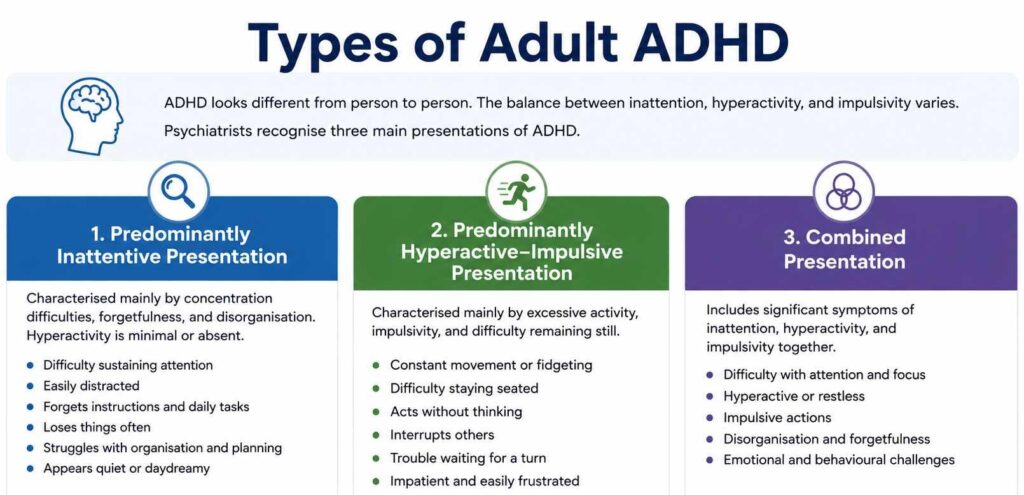
One reason ADHD is frequently misunderstood is that no two people present in exactly the same way. Some individuals appear energetic and impulsive, while others seem quiet, absent-minded, and easily overwhelmed. The balance between inattention, hyperactivity, and impulsivity varies considerably from one person to another.
For this reason, psychiatrists distinguish three recognised presentations of ADHD:
The predominantly inattentive presentation is characterised mainly by concentration problems, forgetfulness, and disorganisation. Hyperactivity is minimal or absent. This presentation was previously known as ADD (Attention Deficit Disorder) and is more commonly recognised in girls and women.
The predominantly hyperactive-impulsive presentation is characterised mainly by excessive activity, impulsive behaviour, impatience, and difficulty remaining still.
The combined presentation includes significant symptoms of inattention, hyperactivity, and impulsivity together. This is the most common presentation seen in clinical practice.
Because symptoms differ so much, ADHD cannot be diagnosed simply by observing whether someone appears hyperactive. A detailed psychiatric assessment is required to understand how symptoms have developed over time and how they affect everyday functioning.
Executive Dysfunction: The Hidden Symptom of Adult ADHD
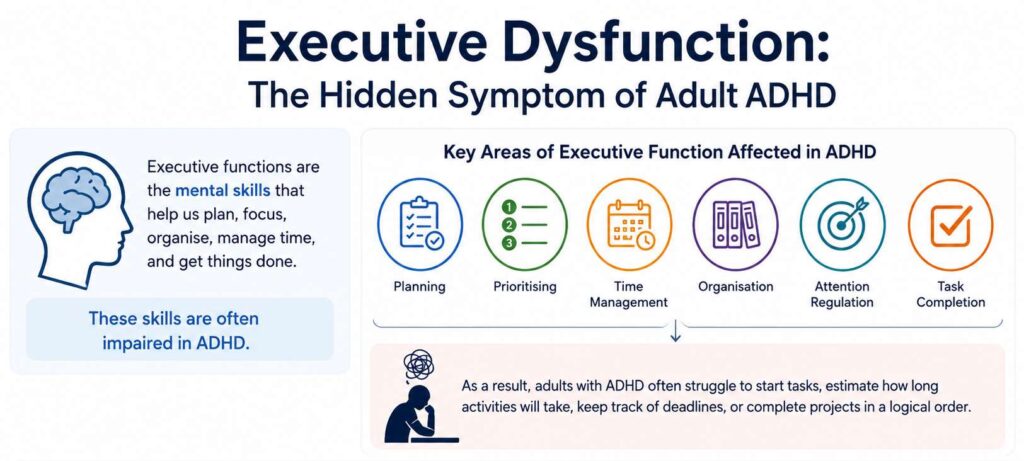
Many difficulties associated with adult ADHD involve executive functioning. Executive functions are the mental processes that help people plan, prioritise, organise, manage time, regulate attention, and complete tasks efficiently. These functions are impaired in ADHD. As a result, people with ADHD often struggle to start tasks, estimate how long activities will take, keep track of deadlines, or complete projects in a logical order.
Procrastination is common, even when the individual fully understands the importance of the task. Many patients describe feeling as though they know exactly what they should do but cannot consistently translate those intentions into action. This often leads to frustration, guilt, and unnecessary self-criticism.
Hyperfocus: The Adult ADHD Paradox
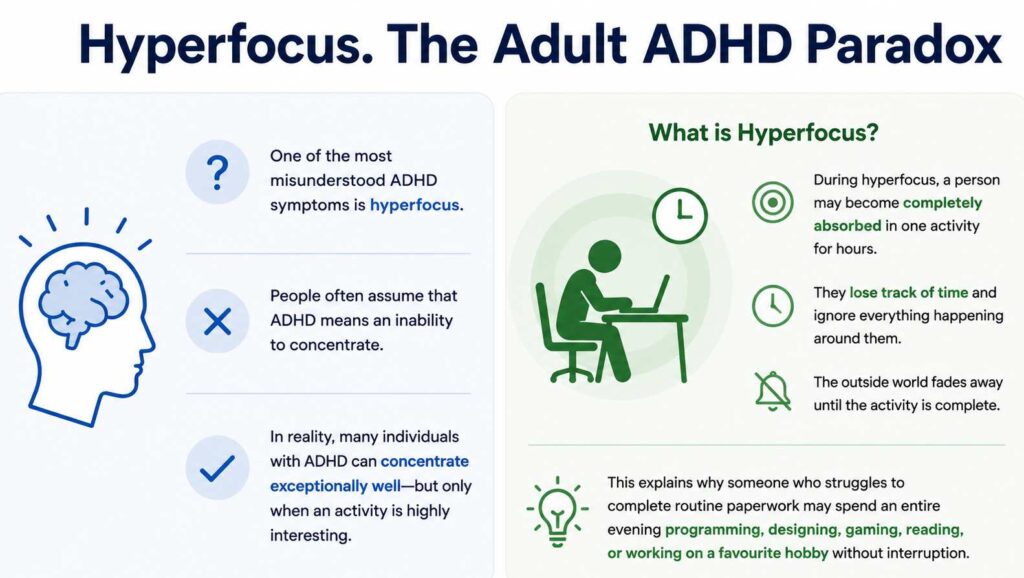
One of the most misunderstood ADHD symptoms is hyperfocus. People often assume that ADHD means an inability to concentrate. In reality, many individuals with ADHD can concentrate exceptionally well—but only when an activity is highly interesting.
During hyperfocus, a person may become completely absorbed in one activity for hours, losing track of time and ignoring everything happening around them. This explains why someone who struggles to complete routine paperwork may spend an entire evening programming, designing, gaming, reading, or working on a favourite hobby without interruption. Hyperfocus demonstrates that ADHD is primarily a disorder of attention regulation, not simply a lack of attention.
Emotional Dysregulation in Adult ADHD
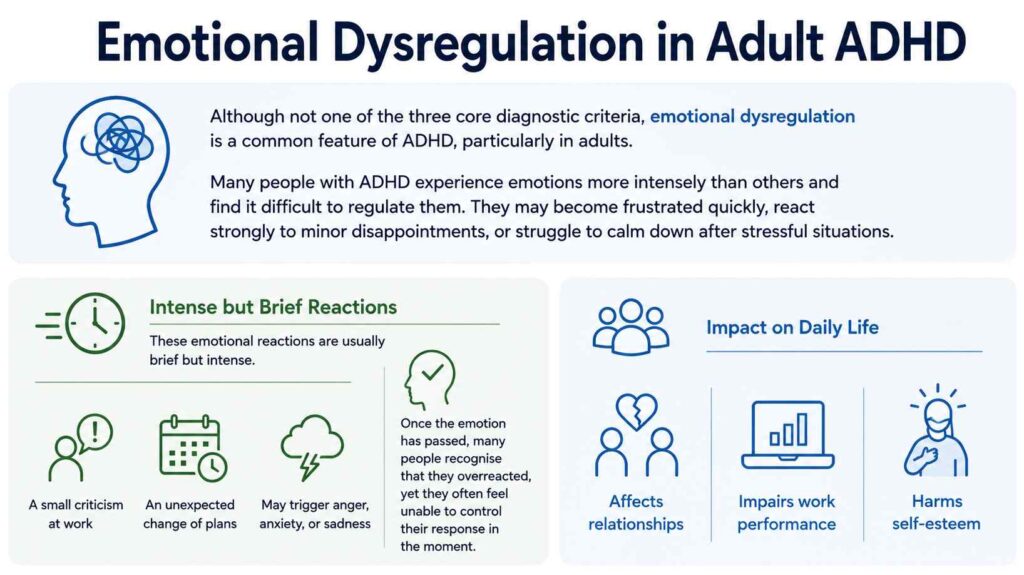
Although not one of the three core diagnostic criteria, emotional dysregulation is a common feature of ADHD, particularly in adults. Many people with ADHD experience emotions more intensely than others and find it difficult to regulate them. They may become frustrated quickly, react strongly to minor disappointments, or struggle to calm down after stressful situations.
These emotional reactions are usually brief but intense. A small criticism at work or an unexpected change of plans may trigger anger, anxiety, or sadness that seems disproportionate to the situation. Once the emotion has passed, many people recognise that they overreacted, yet they often feel unable to control their response in the moment. Emotional dysregulation affects relationships, work performance, and self-esteem. It is also one reason why ADHD is sometimes mistaken for anxiety, depression, bipolar disorder, or certain personality disorders.
How ADHD Symptoms Change in Adults
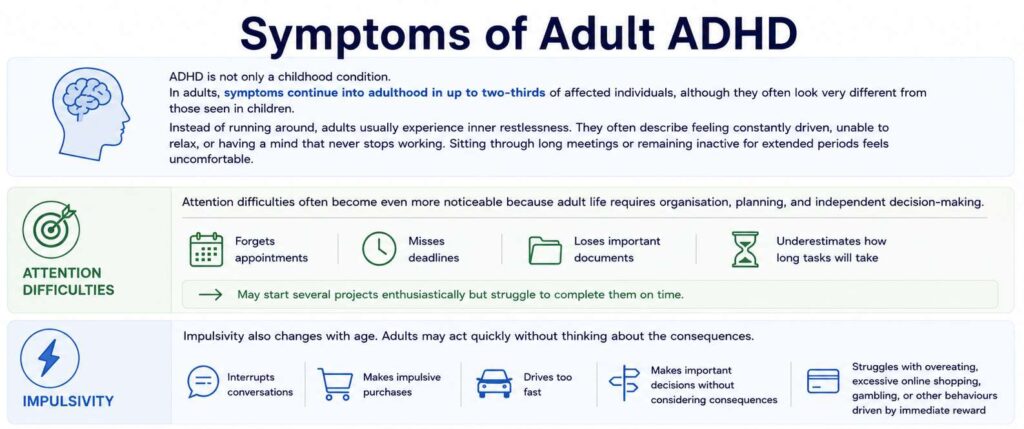
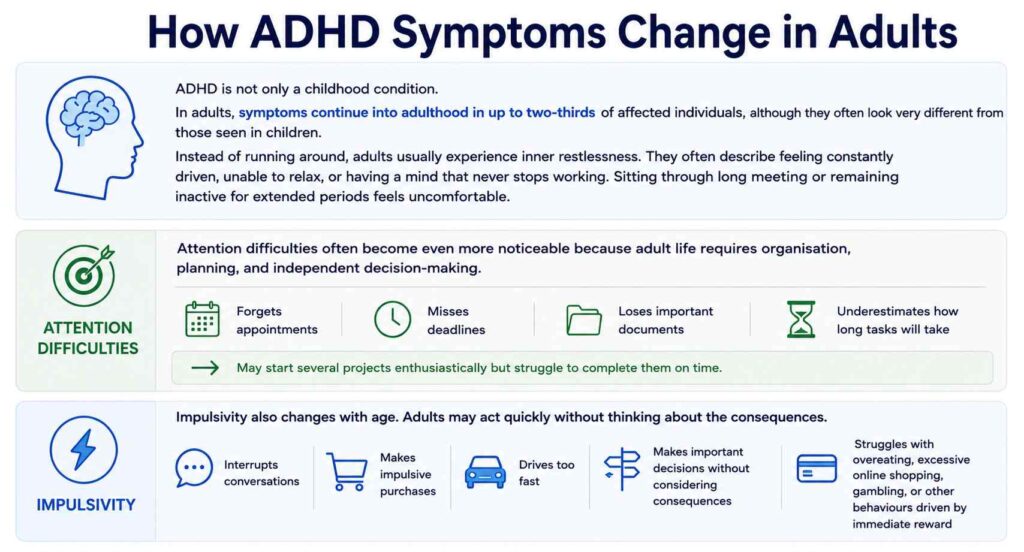
Many people still think of ADHD as a childhood condition. In reality, symptoms continue into adulthood in up to two-thirds of affected individuals, although they often look very different from those seen in children. Instead of running around, adults usually experience inner restlessness. They often describe feeling constantly driven, unable to relax, or having a mind that never stops working. Sitting through long meetings or remaining inactive for extended periods feels uncomfortable.
Attention difficulties often become even more noticeable because adult life requires organisation, planning, and independent decision-making. Many adults with ADHD frequently forget appointments, miss deadlines, lose important documents, or underestimate how long tasks will take. They may start several projects enthusiastically but struggle to complete them on time.
Impulsivity also changes with age. Adults may interrupt conversations, make impulsive purchases, drive too fast, or make important decisions without considering the consequences. Some struggle with overeating, excessive online shopping, gambling, or other behaviours driven by the desire for immediate reward.
These symptoms affect careers and relationships. Many adults with undiagnosed ADHD report changing jobs repeatedly, feeling unable to fulfil their potential despite being intelligent and motivated, or experiencing ongoing conflict with partners because of forgetfulness, poor organisation, or impulsive behaviour.
ADHD Symptoms in Men
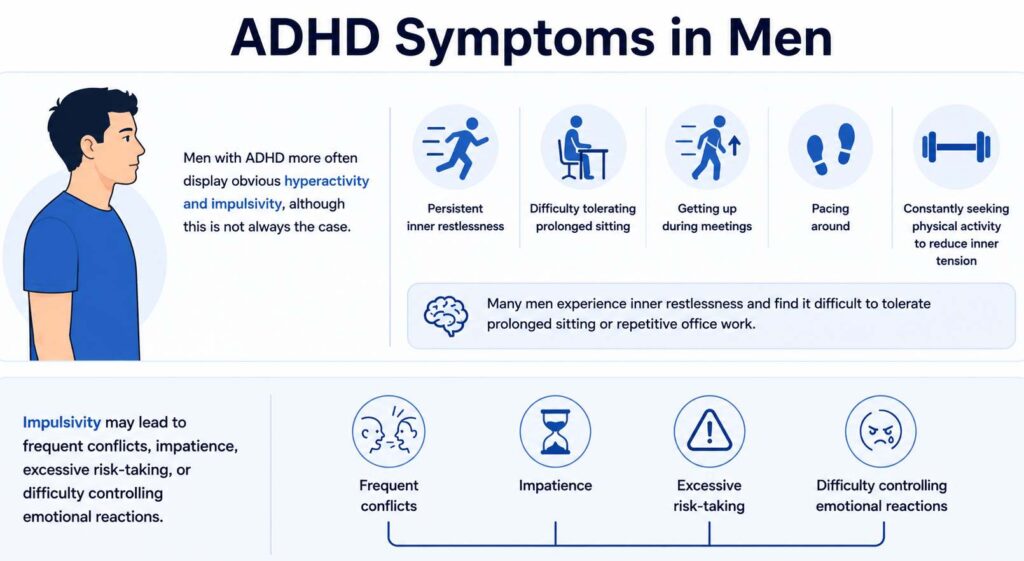
Men with ADHD more often display obvious hyperactivity and impulsivity, although this is not always the case.. Many experience persistent inner restlessness and find it difficult to tolerate prolonged sitting or repetitive office work. They may frequently get up during meetings, pace around, or constantly seek physical activity to reduce inner tension.
ADHD in men is often recognised earlier than in women because hyperactivity and impulsive behaviour tend to be more noticeable during childhood. However, not all men with ADHD are physically hyperactive. Many primarily experience persistent inner restlessness, difficulty relaxing, and a constant feeling of needing to stay busy. Sitting through long meetings, performing repetitive office work, or waiting patiently can feel surprisingly difficult.
Impulsivity can have a significant impact at work. Some men interrupt conversations, become impatient in everyday situations, make impulsive financial decisions, or take unnecessary risks while driving, investing, or participating in sports. Others experience emotional impulsivity, reacting quickly with frustration or anger before later regretting their response. These behaviours can affect relationships, workplace performance, and financial stability.
Because ADHD often remains undiagnosed, many men spend years believing they are simply disorganised or not trying hard enough. Some develop anxiety, depression, burnout, or substance misuse while attempting to cope with the constant demands of everyday life.
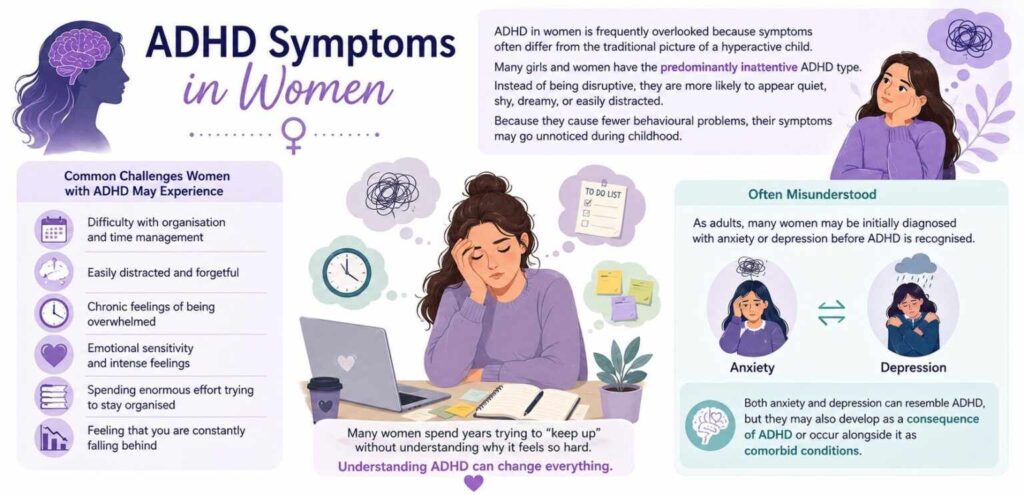
ADHD Symptoms in Women
ADHD in women is frequently overlooked because symptoms often differ from the traditional picture of a hyperactive child. Many girls and women have the predominantly inattentive ADHD type. Instead of being disruptive, they are more likely to appear quiet, shy, dreamy, or easily distracted. Because they cause fewer behavioural problems, their symptoms may go unnoticed during childhood.
Women with ADHD often struggle with organisation, time management, forgetfulness, emotional sensitivity, and chronic feelings of being overwhelmed. They may spend enormous effort trying to stay organised while feeling that they are constantly falling behind. As adults, many women may be initially diagnosed with anxiety or depression before ADHD is recognised. Both anxiety and depression can resemble ADHD, but they may also develop as a consequence of ADHD or occur alongside it as comorbid conditions.
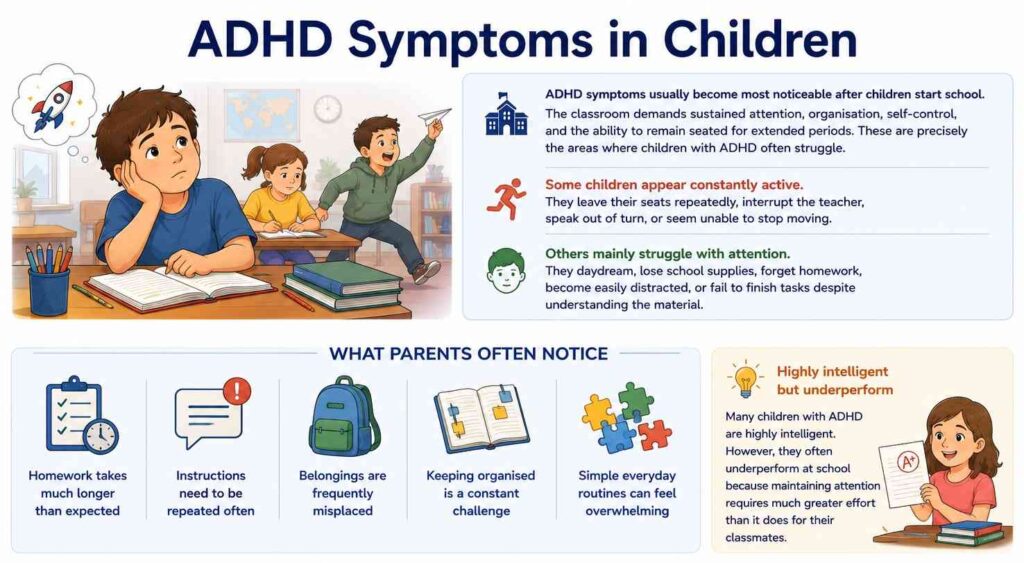
ADHD Symptoms in Children
ADHD symptoms usually become most noticeable after children start school. The classroom demands sustained attention, organisation, self-control, and the ability to remain seated for extended periods. These are precisely the areas where children with ADHD often struggle.
Some children appear constantly active. They leave their seats repeatedly, interrupt the teacher, speak out of turn, or seem unable to stop moving. Others mainly struggle with attention. They daydream, lose school supplies, forget homework, become easily distracted, or fail to finish tasks despite understanding the material.
Many children with ADHD are highly intelligent. However, they often underperform at school because maintaining attention requires much greater effort than it does for their classmates. Parents notice that everyday routines become difficult. Homework takes much longer than expected, instructions need to be repeated, belongings are frequently misplaced, and simple organisational tasks become ongoing challenges.
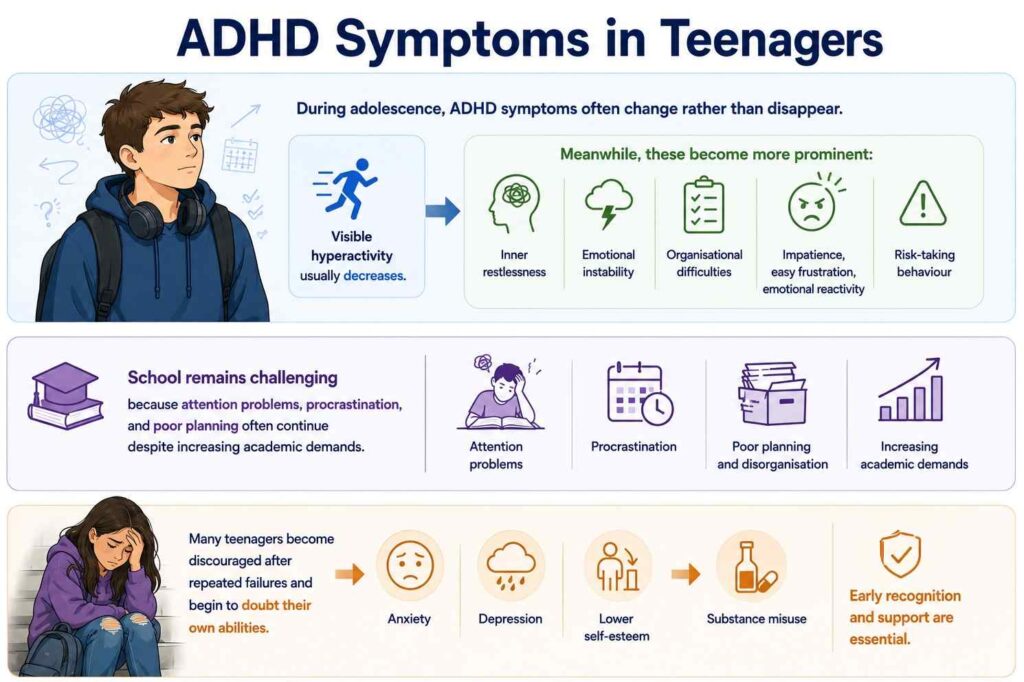
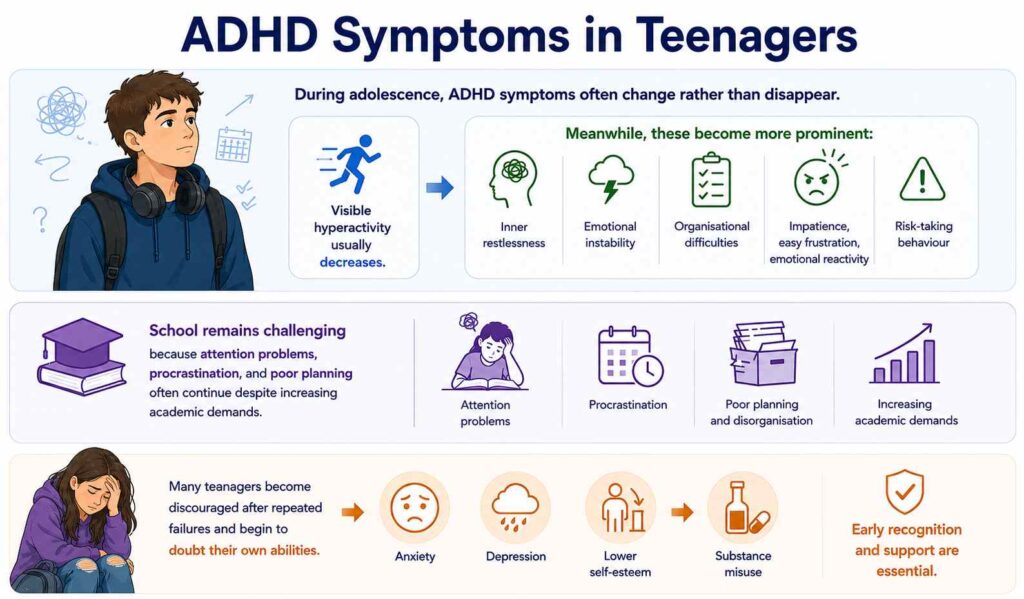
ADHD Symptoms in Teenagers
During adolescence, ADHD symptoms often change rather than disappear. Visible hyperactivity usually decreases, while inner restlessness, emotional instability, and organisational difficulties become more prominent. Teenagers may appear impatient, easily frustrated, or emotionally reactive. Risk-taking behaviour also becomes more common.
School remains challenging because attention problems, procrastination, and poor planning often continue despite increasing academic demands. Many teenagers become discouraged after repeated failures and begin to doubt their own abilities. This can trigger anxiety, depression, and lower self-esteem and can lead to substance misuse, making early recognition particularly important.
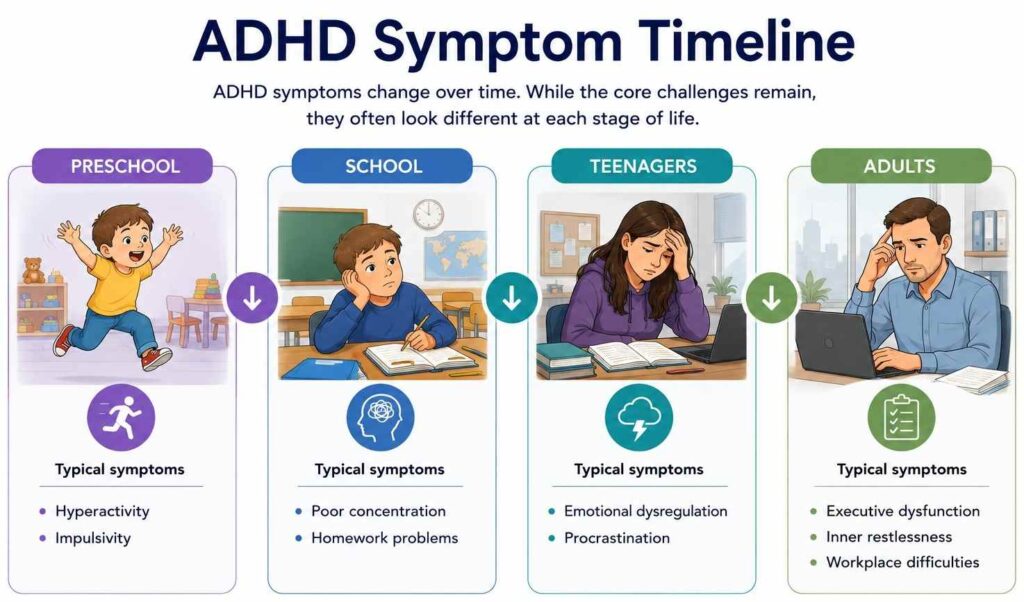
ADHD Symptom Timeline
ADHD symptoms change throughout life, but they rarely disappear completely. Instead, the way they are expressed evolves as the demands of everyday life change.
In preschool children, hyperactivity and impulsivity are usually the most noticeable features. Children may be constantly on the move, have difficulty waiting their turn, and act without thinking.
After starting school, difficulties with attention become more apparent. As classroom activities require sustained concentration and organisation, children may struggle to stay focused, complete homework, follow instructions, and keep track of school materials.
During the teenage years, visible hyperactivity often decreases, while emotional dysregulation, procrastination, and organisational difficulties become more prominent. Increasing academic expectations and greater independence can make these challenges more noticeable.
In adulthood, ADHD typically presents as executive dysfunction rather than obvious hyperactivity. Many adults experience persistent inner restlessness, difficulty planning and organising tasks, poor time management, and challenges meeting workplace responsibilities. Although the symptoms change over time, the underlying difficulty with regulating attention and behaviour remains the same. Early recognition and appropriate treatment can significantly improve functioning at every stage of life.
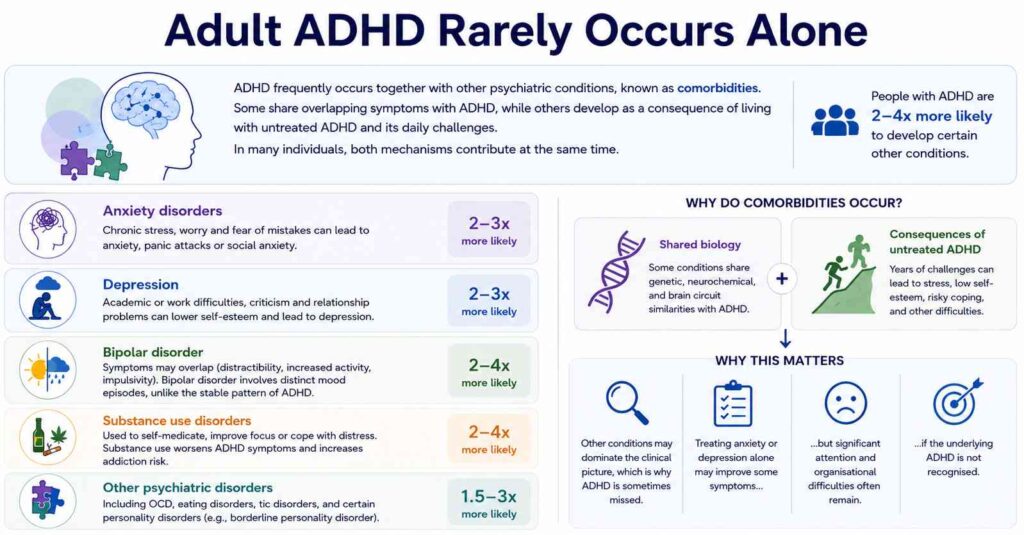
ADHD Rarely Occurs Alone
ADHD frequently occurs together with other psychiatric conditions. These are known as comorbidities. Some share overlapping symptoms with ADHD because they arise from similar biological mechanisms, while others develop as a consequence of living for years with untreated ADHD and its daily challenges. In many individuals, both mechanisms contribute simultaneously. People with ADHD are more likely than the general population to develop:
Anxiety disorders are among the most common comorbid conditions. Constantly forgetting appointments, missing deadlines, struggling to stay organised, or worrying about making mistakes can create persistent stress. Over time, this may develop into generalized anxiety, panic attacks, or social anxiety. At the same time, anxiety itself can impair concentration and restlessness, making it difficult to distinguish from ADHD.
Depression is also common. Many adults with undiagnosed ADHD have experienced years of academic underachievement, workplace difficulties, criticism, or relationship problems despite being intelligent and motivated. Repeated experiences of failure can gradually reduce self-confidence and eventually lead to depressive symptoms. However, depression can also occur independently of ADHD, and both disorders often require treatment.
Bipolar disorder deserves particular attention because some symptoms overlap with ADHD. Both conditions may involve distractibility, increased activity, impulsive behaviour, and reduced concentration. The crucial difference is that bipolar disorder is characterised by distinct episodes of mania or hypomania alternating with periods of depression, whereas ADHD symptoms are relatively stable and have usually been present since childhood.
Substance use disorders are significantly more common in people with ADHD. Some individuals begin using alcohol, cannabis, nicotine, or other substances in an attempt to reduce restlessness, improve concentration, or cope with emotional distress. Unfortunately, substance use usually worsens ADHD symptoms over time and increases the risk of addiction.
Other psychiatric disorders that frequently occur alongside ADHD include obsessive-compulsive disorder (OCD), eating disorders, and certain personality disorders. Emotional dysregulation associated with ADHD can sometimes resemble borderline personality disorder.
These additional conditions may dominate the clinical picture, which is one reason why ADHD is sometimes missed during psychiatric assessment. Treating anxiety or depression alone may improve some symptoms, but significant attention and organisational difficulties often remain if the underlying ADHD is not recognised.
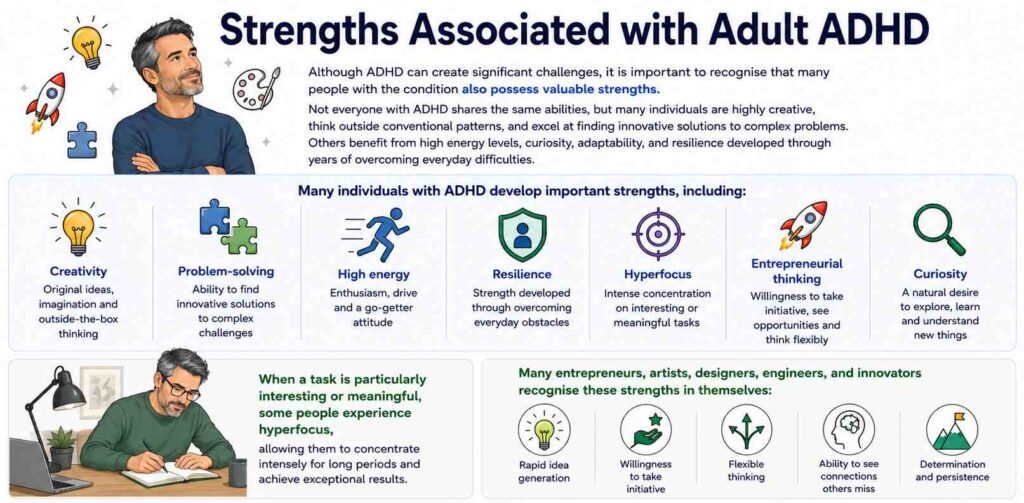
Strengths Associated with Adult ADHD
Although adult ADHD can create significant challenges, it is important to recognise that many people with the condition also possess valuable strengths. Not everyone with ADHD shares the same abilities, but many individuals are highly creative, think outside conventional patterns, and excel at finding innovative solutions to complex problems. Others benefit from high energy levels, curiosity, adaptability, and resilience developed through years of overcoming everyday difficulties.
When a task is particularly interesting or meaningful, some people experience hyperfocus, allowing them to concentrate intensely for long periods and achieve exceptional results. Many entrepreneurs, artists, designers, engineers, and innovators describe characteristics such as rapid idea generation, willingness to take initiative, and flexible thinking as personal strengths associated with ADHD.
These positive traits, however, do not outweigh the difficulties caused by untreated ADHD. Problems with attention, organisation, impulsivity, and emotional regulation can still interfere with education, work, relationships, and overall quality of life.
The goal of treatment is not to change a person’s personality or reduce their creativity, but to minimise the impairments caused by ADHD while allowing their strengths and talents to flourish.
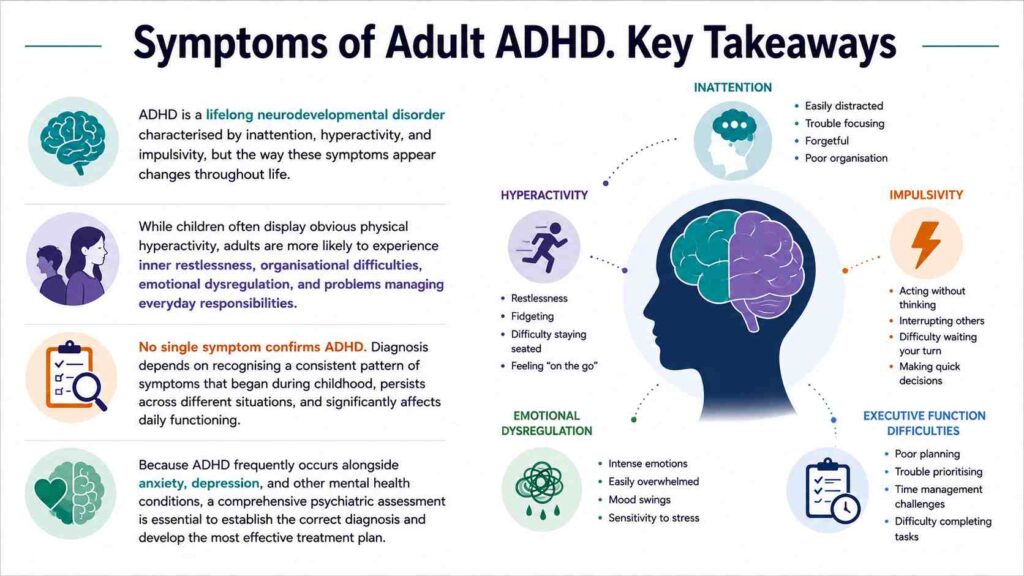
Symptoms of ADHD. Key Takeaways
ADHD is a lifelong neurodevelopmental disorder characterised by inattention, hyperactivity, and impulsivity, but the way these symptoms appear changes throughout life.
While children often display obvious physical hyperactivity, adults are more likely to experience inner restlessness, organisational difficulties, emotional dysregulation, and problems managing everyday responsibilities.
No single symptom confirms ADHD. Diagnosis depends on recognising a consistent pattern of symptoms that began during childhood, persists across different situations, and significantly affects daily functioning.
Because ADHD frequently occurs alongside anxiety, depression, and other mental health conditions, a comprehensive psychiatric assessment is essential to establish the correct diagnosis and develop the most effective treatment plan.
When Should Adults Seek an ADHD Assessment?
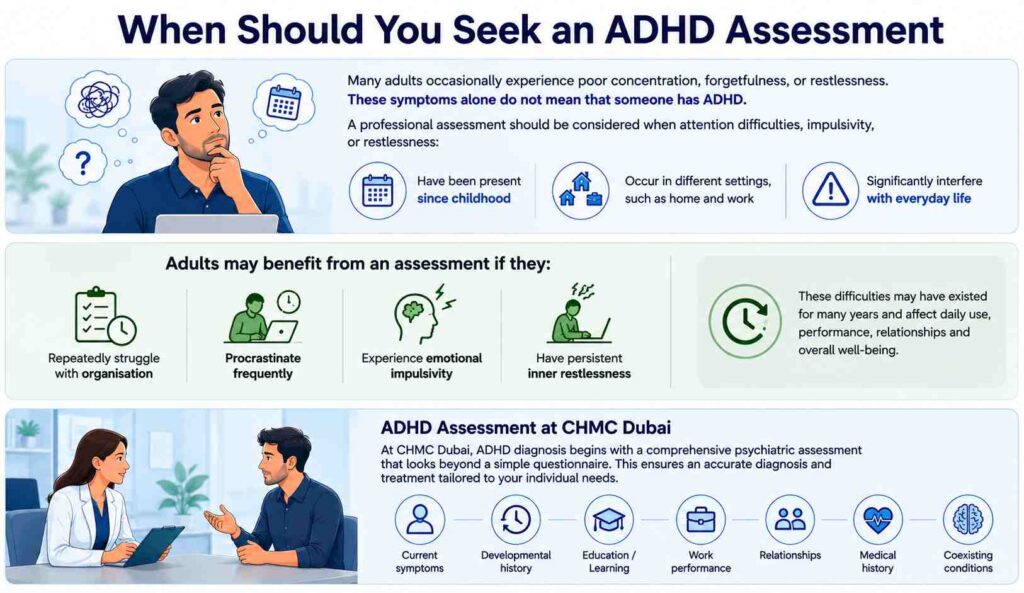
Adults in Dubai often seek an ADHD assessment only after workplace demands make lifelong symptoms more noticeable. A professional assessment should be considered when attention difficulties, impulsivity, or hyperactivity have been present since childhood, occur in different settings such as home, school, or work, and significantly interfere with everyday life.
Adults who repeatedly struggle with organisation, procrastination, emotional impulsivity, or persistent inner restlessness may also benefit from an assessment, particularly if these difficulties have existed for many years.
At CHMC Dubai, ADHD diagnosis begins with a comprehensive psychiatric assessment rather than a simple questionnaire. The evaluation explores current symptoms, childhood history, education, work performance, relationships, medical history, and possible coexisting psychiatric conditions. This thorough approach helps ensure an accurate diagnosis and allows treatment to be tailored to each patient’s individual needs.
For Comprehensive Adult ADHD Assessment, Contact Dr. Kowal
What People with ADHD Often Say
Many adults with ADHD do not immediately recognise that their lifelong difficulties are caused by ADHD. Instead, they describe the way they experience everyday life. During an ADHD assessment, psychiatrists frequently hear similar statements from patients who have struggled for years without understanding why. While these experiences do not confirm ADHD on their own, they often provide important clues that an assessment may be appropriate.
“I know exactly what I should do, but I just can’t get started.”
Many people with ADHD understand what needs to be done and genuinely want to do it. The difficulty is not a lack of motivation but a problem initiating and organising tasks, often referred to as executive dysfunction.
“My mind never switches off.”
Instead of feeling physically hyperactive, many adults experience constant mental activity. Thoughts race from one topic to another, making it difficult to relax, fall asleep, or fully concentrate on one task.
“I forget everything unless I write it down.”
Appointments, deadlines, conversations, and everyday tasks are easily forgotten. Many people rely heavily on reminders, calendars, alarms, or notes simply to manage daily life.
“I always finish projects at the last minute.”
Many individuals procrastinate despite knowing the importance of a task. Work is often delayed until the deadline creates enough urgency to trigger intense concentration or hyperfocus.
“My whole life feels disorganised.”
Keeping track of paperwork, emails, finances, appointments, and household responsibilities can feel overwhelming. Many people describe constantly trying to catch up but never feeling fully organised.
“I lose things every day.”
Keys, mobile phones, wallets, glasses, and important documents are frequently misplaced. Time is often wasted searching for everyday items, even when they were used only a short time earlier.
“I interrupt people without meaning to.”
Many adults know they should wait for others to finish speaking but find it difficult to hold back a thought before it disappears. This can unintentionally affect conversations and relationships.
“I can spend six hours on something I enjoy, but I can’t focus for ten minutes on paperwork.”
This reflects the paradox of ADHD. Attention is not absent—it is difficult to regulate. Activities that are interesting may trigger intense hyperfocus, while routine or repetitive tasks can feel almost impossible to start or sustain.
“People think I’m lazy, but I’m exhausted from trying to keep up.”
People with ADHD work often much harder than those around them simply to stay organised, meet deadlines, or maintain concentration. The constant mental effort often leads to frustration, self-doubt, and emotional exhaustion.
“I’ve always felt different, but I never knew why.”
Many adults receive an ADHD diagnosis only after years of struggling at school, work, or in relationships. Understanding the cause of these lifelong difficulties is often the first step towards effective treatment and significant improvements in daily functioning.
FAQs about ADHD Symptoms
What are the main symptoms of ADHD?
ADHD is characterised by three core symptom groups: inattention, hyperactivity, and impulsivity. Every person experiences these symptoms differently. Some mainly struggle with concentration and organisation, while others are more affected by restlessness or impulsive behaviour.
Can you have ADHD without being hyperactive?
Yes. Many people have the predominantly inattentive presentation of ADHD, previously known as ADD. They may appear quiet, dreamy, forgetful, and easily distracted rather than physically restless. This presentation is particularly common in girls and women.
What are the symptoms of ADHD in adults?
Adults with ADHD often experience poor concentration, forgetfulness, disorganisation, procrastination, inner restlessness, impulsive decision-making, and difficulty managing time. Many also struggle to complete tasks, keep appointments, or stay focused during long meetings.
How do ADHD symptoms differ in children and adults?
Children often show obvious hyperactivity, such as running, climbing, and difficulty sitting still. In adults, physical hyperactivity usually becomes less noticeable and is replaced by inner restlessness, racing thoughts, and organisational difficulties. Problems with attention and impulsivity often continue throughout life.
What does inattention look like in ADHD?
People with ADHD may become easily distracted, overlook details, forget instructions, lose everyday items, and struggle to complete tasks. They often find it difficult to organise activities or maintain attention, particularly when work is repetitive or uninteresting.
What is hyperfocus in ADHD?
Hyperfocus is a state of extremely intense concentration on activities that are particularly interesting or rewarding. Although people with ADHD often struggle to focus on routine tasks, they may spend hours completely absorbed in hobbies or projects they enjoy.
Are mood swings a symptom of ADHD?
Many people with ADHD experience emotional dysregulation. They may react more intensely to frustration, criticism, or stress and find it difficult to regulate their emotions. Although emotional instability is common, persistent mood swings should always be evaluated by a psychiatrist to exclude other mental health conditions.
Can ADHD symptoms change with age?
Yes. ADHD symptoms often evolve throughout life. Hyperactivity usually decreases with age, while difficulties with attention, organisation, emotional regulation, and time management often become more prominent during adulthood.
How do ADHD symptoms affect daily life?
ADHD can interfere with education, work, relationships, and everyday responsibilities. People may struggle with organisation, meeting deadlines, managing finances, maintaining routines, or completing long-term projects despite having normal or above-average intelligence.
Are ADHD symptoms the same in women and men?
Not always. Women are more likely to have the predominantly inattentive presentation and may appear quiet, forgetful, or overwhelmed rather than hyperactive. Men often show more obvious hyperactivity and impulsivity, although symptoms vary greatly between individuals.
Can ADHD symptoms be mistaken for anxiety or depression?
Yes. Difficulty concentrating, restlessness, emotional distress, and poor motivation may resemble anxiety or depression. Many adults receive treatment for these conditions before underlying ADHD is recognised. A comprehensive psychiatric assessment helps distinguish between them.
Does everyone with ADHD have poor concentration all the time?
No. ADHD is a disorder of attention regulation, not simply a lack of attention. Many people with ADHD can concentrate exceptionally well on activities they find interesting while struggling with routine or repetitive tasks.
When should I seek an ADHD assessment?
You should consider a professional assessment if symptoms such as inattention, impulsivity, or hyperactivity have been present since childhood, occur in different areas of life, and significantly affect your work, education, relationships, or daily functioning.
Can ADHD symptoms appear for the first time in adulthood?
ADHD begins in childhood, although many people are not diagnosed until adulthood. Adults often recognise their symptoms only after increasing work or family responsibilities expose long-standing difficulties with organisation, attention, and self-management.
Can ADHD symptoms improve with treatment?
Yes. With an accurate diagnosis and appropriate treatment, many people experience significant improvement in attention, impulse control, organisation, and daily functioning. Treatment may include medication, psychological interventions, education about ADHD, and practical strategies for managing everyday challenges.
Can ADHD Symptoms Change With Age?
Yes. ADHD symptoms often change throughout life, but they usually do not disappear completely. In young children, hyperactivity and impulsivity are often the most noticeable features. After starting school, difficulties with attention, organisation, and completing tasks become more apparent because academic demands increase. During adolescence, visible hyperactivity often decreases, while emotional dysregulation, procrastination, and poor time management become more prominent. In adults, ADHD commonly presents as executive dysfunction, persistent inner restlessness, forgetfulness, and difficulties organising work and daily responsibilities rather than obvious physical hyperactivity. Although the expression of ADHD changes with age, the underlying difficulty regulating attention, behaviour, and emotions remains the same.
Can ADHD Symptoms Get Worse Under Stress?
Stress does not cause ADHD, but it can make existing symptoms much more noticeable. During periods of increased pressure, such as examinations, demanding work projects, family responsibilities, sleep deprivation, or major life changes, people with ADHD find it more difficult to concentrate, stay organised, regulate their emotions, and control impulsive behaviour. Executive functioning often becomes less efficient under stress, making procrastination, forgetfulness, and disorganisation even more pronounced. Anxiety and depression, which commonly occur alongside ADHD, may further worsen attention and emotional regulation.
Read More About ADHD
- ADHD Treatment
- Diagnosis of ADHD
- Psychiatrist for ADHD
- Psychotherapy for ADHD
- Medication for ADHD
- Causes of ADHD
- ADHD in Children
- ADHD Types
Medically reviewed by Dr. Gregor Kowal

DR. GREGOR KOWAL
Dr. Gregor Kowal is a German-certified consultant in Psychiatry and Psychotherapy. Since 2010, Dr. Kowal has been the Medical Director of CHMC, a psychiatric clinic located in Dubai. Dr. Kowal graduated from the prestigious University of Heidelberg. After completing his specialty training, he held leadership and teaching positions, serving as Head of Department and later as Medical Director at renowned psychiatric hospitals across Germany. In addition to his expertise in psychiatry, Dr. Kowal is trained as a psychotherapist with a foundation in psychoanalytical psychotherapy.