

An ADHD self-assessment test is a screening questionnaire designed to help adults identify symptoms commonly associated with Attention-Deficit/Hyperactivity Disorder (ADHD).
An online ADHD self-assessment test cannot establish an ADHD diagnosis. Its purpose is to identify whether reported symptoms suggest that further professional evaluation may be appropriate.
For Professional ADHD Assessment Contact Our Specialists:
Scope of Self-Assessment Test
Self-assessment questionnaires can be particularly useful for adults who have experienced longstanding difficulties with attention, time management or organisation without understanding their possible causes.
The test examines difficulties with concentration, organisation, procrastination, forgetfulness, task completion, impulsivity and restlessness. By answering questions about their behaviour and everyday experiences, individuals can recognise patterns they may not previously have associated with ADHD.
However, these symptoms are not specific to ADHD. Similar problems may occur in people without the disorder and can also result from anxiety, depression, sleep disturbances, stress or other psychiatric and medical conditions.
A positive screening result indicates that ADHD should be considered as a possible explanation, but it does not confirm the disorder or distinguish it from other conditions.
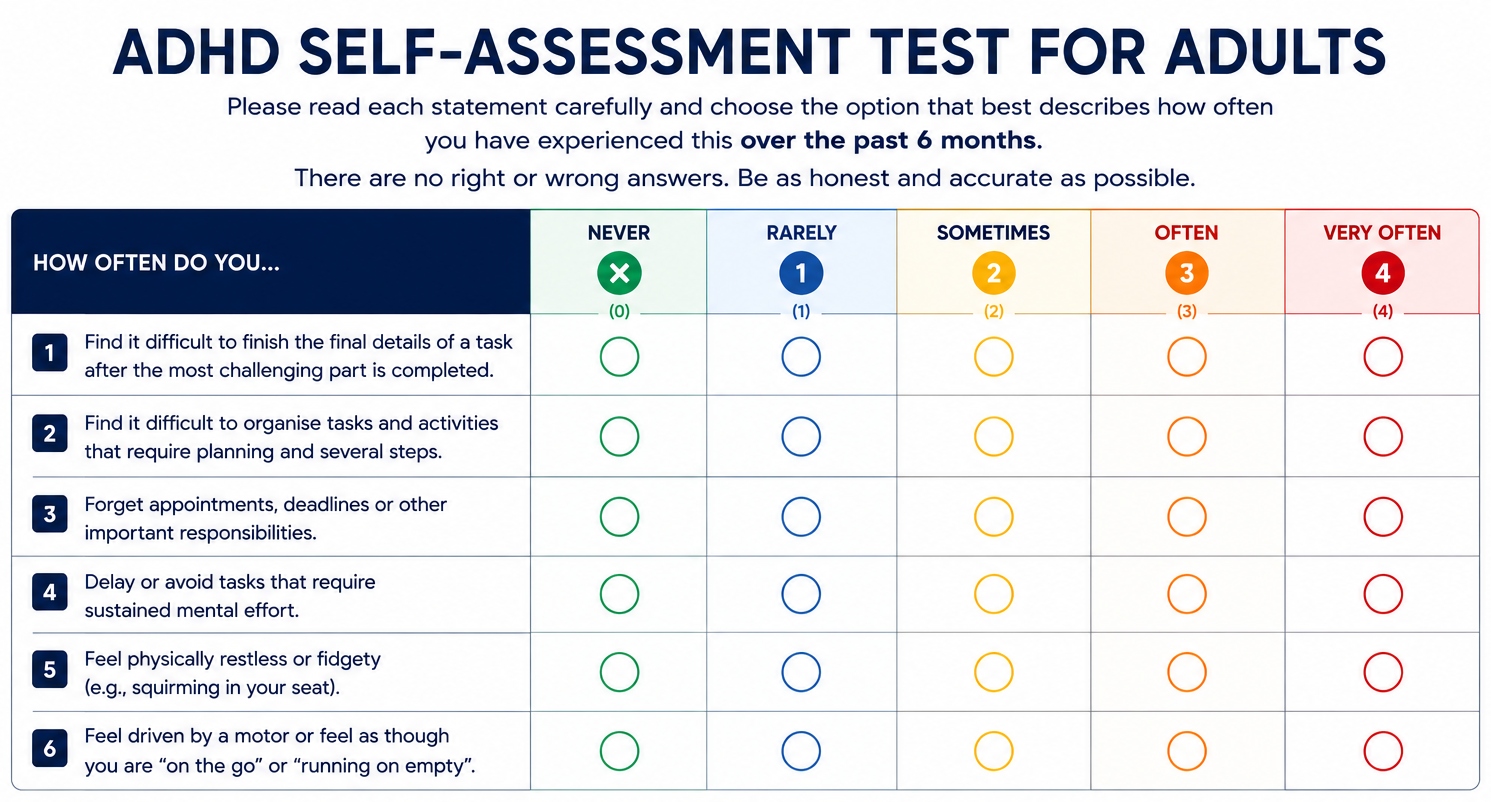
How to Interpret Your ADHD Self-Assessment Results
Look at the overall pattern of your answers rather than calculating a total score.
Mostly “Never” or “Rarely”
ADHD-related difficulties appear to be less prominent.
Several “Sometimes” responses
Occasional difficulties with attention, organisation, impulsivity or restlessness are common and do not necessarily indicate ADHD.
Several “Often” or “Very Often” responses
Frequent symptoms across several areas may suggest that a professional ADHD assessment is appropriate, especially when they interfere with everyday life.
ADHD is more likely when symptoms are persistent, occur in different settings, cause significant impairment and can be traced back to childhood or adolescence.
This symptom check cannot diagnose ADHD. Similar symptoms can occur with anxiety, depression, bipolar disorder, sleep problems, stress and other conditions. An ADHD diagnosis requires a comprehensive clinical evaluation.
Who Can Use an Adult ADHD Test?
An adult ADHD test may be useful for people who repeatedly experience difficulties with concentration, organisation, time management or completing tasks and are wondering whether ADHD could contribute to these problems.
Some adults begin considering ADHD after difficulties become more apparent at university, in professional life or when managing multiple responsibilities independently. Others recognise similarities between their own experiences and ADHD after a family member has been diagnosed.
The fact that symptoms become more noticeable in adulthood does not necessarily mean that ADHD began at that time. ADHD is a neurodevelopmental disorder, so a diagnostic assessment also considers whether characteristic difficulties were present during childhood or adolescence.
What Does an ADHD Screening Test Measure?
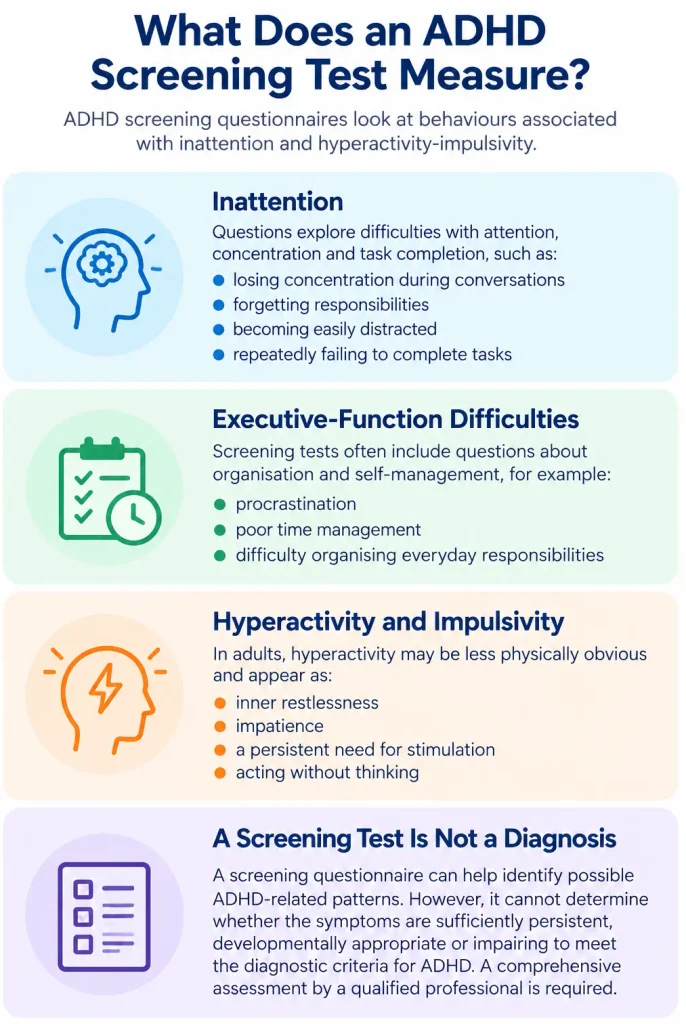
ADHD screening questionnaires typically examine behaviours associated with inattention and hyperactivity-impulsivity. In adults, these difficulties may appear differently from the stereotypical picture of a highly active child.
Inattention may manifest as losing concentration during conversations, forgetting responsibilities, becoming distracted while working or repeatedly failing to complete tasks. Executive-function difficulties may contribute to procrastination, poor time management and problems organising everyday responsibilities. Hyperactivity may become less physically obvious with age and instead appear as inner restlessness, impatience or a persistent need for stimulation.
A screening questionnaire can help identify these patterns, but it cannot establish whether they are sufficiently persistent, developmentally appropriate or impairing to meet the diagnostic criteria for ADHD.
Can an Online ADHD Test Diagnose ADHD?
An online ADHD test cannot establish an ADHD diagnosis. ADHD is a clinical diagnosis rather than a diagnosis based on a single questionnaire, laboratory test, genetic test or brain scan. A questionnaire provides only one source of information.
An accurate professional ADHD assessment considers the nature and severity of current symptoms, their impact on everyday functioning and their developmental history. It also examines whether difficulties occur in more than one area of life and whether another psychiatric, medical or situational factor could provide a better explanation.
This distinction is particularly important because many symptoms associated with ADHD are not specific to the disorder.
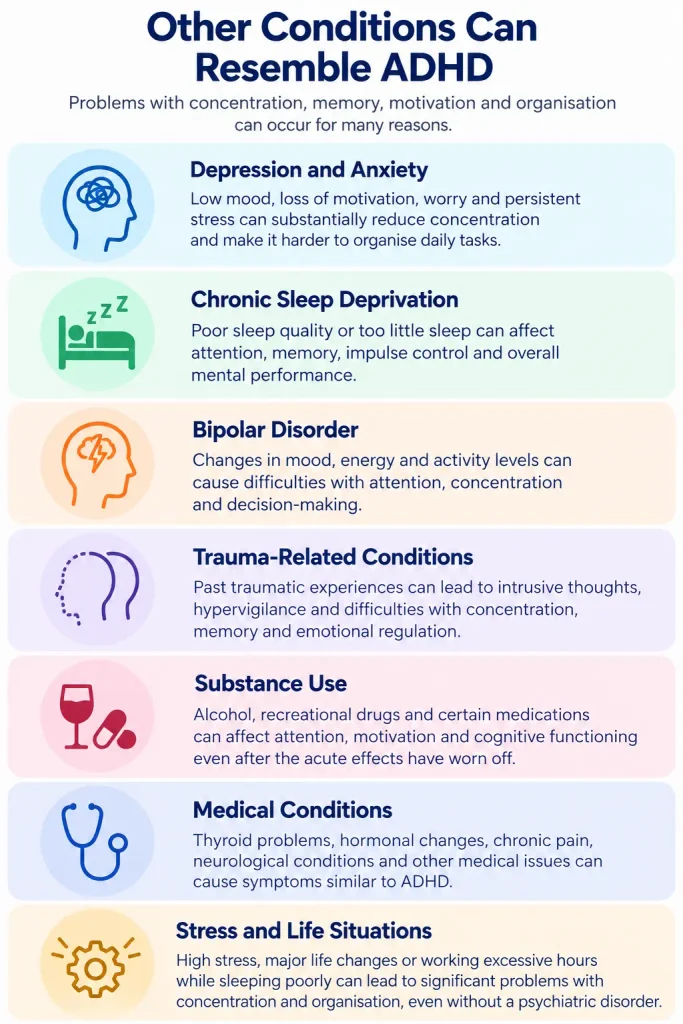
Other Conditions Can Resemble ADHD
Problems with concentration, memory, motivation and organisation can occur for many reasons. Depression and anxiety can substantially reduce concentration, while chronic sleep deprivation can affect attention, memory and impulse control. Bipolar disorder, trauma-related conditions, substance use and several medical conditions can also produce symptoms that overlap with ADHD.
Stress can create similar difficulties even without a psychiatric disorder. Someone working excessive hours while sleeping poorly may experience considerable problems with concentration and organisation without having ADHD. A self-assessment questionnaire cannot reliably distinguish between these possibilities. This is one of the main reasons why screening and diagnosis should not be regarded as the same thing.
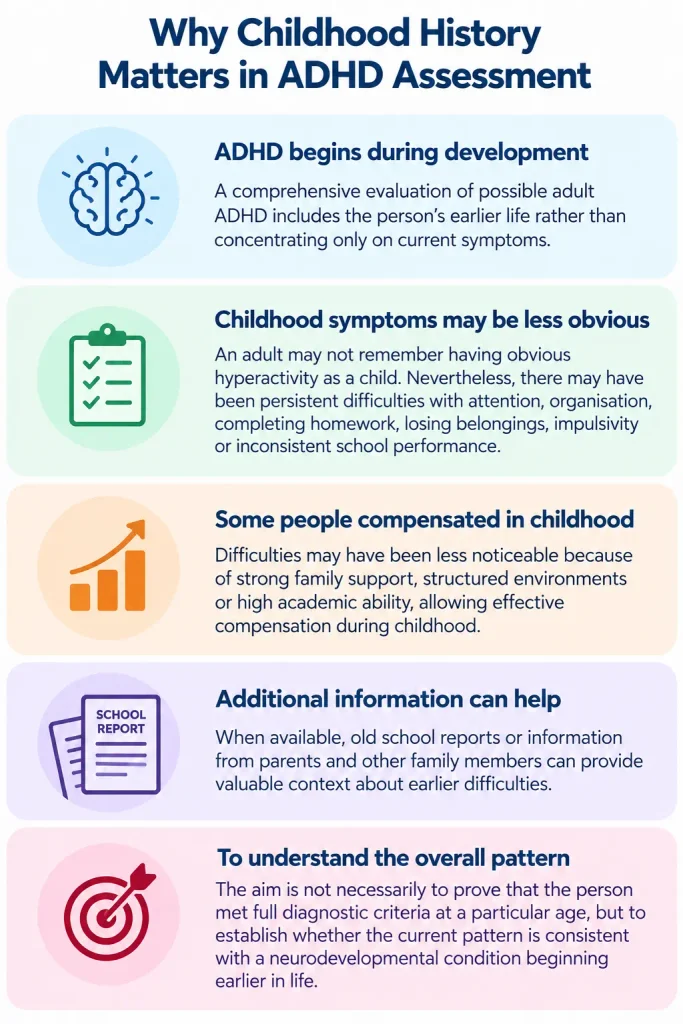
Why Childhood History Matters
ADHD begins during development. Therefore, a comprehensive evaluation of possible adult ADHD includes the person’s earlier life rather than concentrating only on current symptoms.
An adult may not remember having obvious hyperactivity as a child. Nevertheless, there may have been persistent difficulties with attention, organisation, completing homework, losing belongings, impulsivity or inconsistent school performance. Some people compensated effectively during childhood because they had strong family support, structured environments or high academic ability.
When appropriate and available, old school reports or information from parents and other family members can provide additional context. The purpose is not necessarily to prove that the person would have met full diagnostic criteria at a particular age, but to establish whether the current pattern is consistent with a neurodevelopmental condition beginning earlier in life.
What Does a Positive ADHD Self-Assessment Mean?
A positive screening result means that the person reports a sufficient number or frequency of ADHD-related symptoms to make further evaluation reasonable. It does not mean that the person definitely has ADHD.
The significance of the result depends on the broader clinical picture. Symptoms need to be persistent and associated with meaningful impairment rather than occurring only occasionally. Their developmental history and possible alternative explanations also need to be considered.
Similarly, a screening result that does not indicate a high probability of ADHD does not necessarily explain why someone is experiencing concentration or organisational difficulties. If those problems are substantial, assessment may still be appropriate regardless of the questionnaire score.
Why Self-Assessment Can Still Be Useful
The limitations of an ADHD self-assessment do not make screening questionnaires useless. Their value lies in helping people recognise patterns that may otherwise remain difficult to describe.
A questionnaire can encourage someone to consider how frequently particular difficulties occur and whether they affect several areas of life. It can also provide useful information to discuss during a subsequent clinical assessment.
The important distinction is between screening and diagnosis. Screening asks whether ADHD might be worth investigating. Diagnosis asks whether the complete clinical evidence supports ADHD and whether alternative explanations have been adequately considered.
ADHD Self-Assessment Test: Summary
An ADHD self-assessment test is a screening tool that can help adults recognise symptoms associated with ADHD, including difficulties with attention, organisation, procrastination, impulsivity and restlessness. It can provide useful orientation when someone is uncertain whether their experiences resemble ADHD.
However, no self-assessment questionnaire can diagnose ADHD. Similar symptoms can result from anxiety, depression, sleep problems, bipolar disorder and other psychiatric or medical conditions. ADHD diagnosis also requires consideration of developmental history because the disorder begins during childhood.
A screening result should therefore be understood as a starting point rather than a conclusion. When symptoms are persistent and interfere significantly with education, work, relationships or everyday responsibilities, a comprehensive clinical assessment can determine whether ADHD or another condition provides the most appropriate explanation.