

Obsessive-Compulsive Disorder (OCD) can take remarkably different forms. One person may spend hours washing, while another repeatedly checks doors, or electrical appliances. Someone else may experience disturbing intrusive thoughts about harming a loved one, question their relationship repeatedly, or become trapped in doubts about morality.
The different forms of OCD are connected not primarily by the subject of the obsession, but by the underlying pattern. An intrusive thought, image, impulse, becomes associated with anxiety, guilt, or disgust. The person then feels compelled to do something to resolve the discomfort.
This response may involve a visible action such as washing or checking, but it can also consist of mental reviewing, analysing, counting, or avoiding particular situations. The relief obtained through these responses is usually temporary. Doubt eventually returns, sometimes in a slightly different form, and the person feels compelled to repeat the process.
For Assessment and Therapy Contact our Specialists at CHMC:
Are There Different Types of OCD?
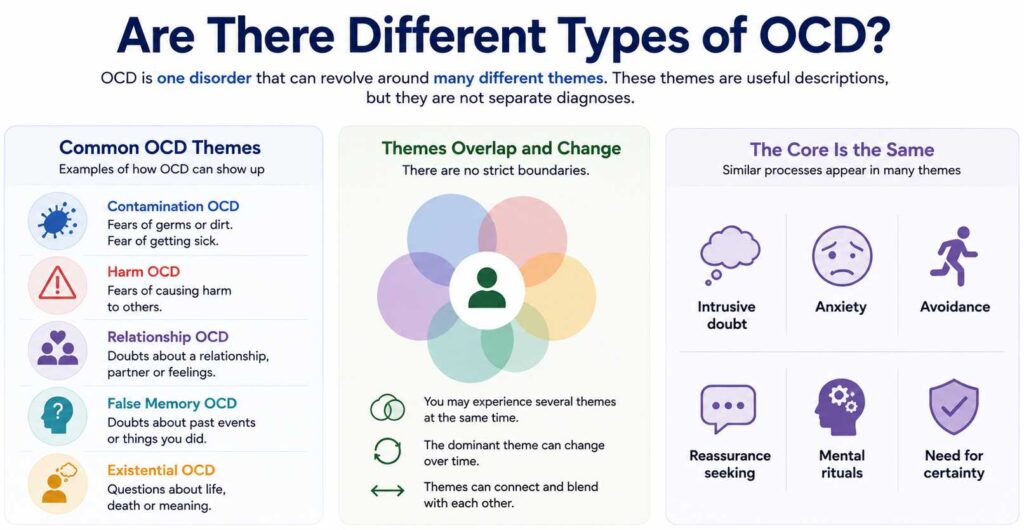
Terms such as Contamination OCD, Harm OCD, Relationship OCD, False Memory OCD and Existential OCD is commonly used to describe recognisable patterns of OCD symptoms. They are useful descriptions, but they are not separate psychiatric diagnoses.
OCD is a disorder that can become organised around many different themes. The boundaries between these forms of OCD are not rigid. A person may experience several themes at the same time, and the dominant theme can change over time. Contamination fears may be linked to responsibility for harming others; checking can merge with false-memory doubts; religious obsessions may overlap with moral scrupulosity; and relationship OCD can involve sexual, moral, or identity-related concerns.
For this reason, it is more accurate to think in terms of OCD themes or presentations rather than fixed subtypes. The content varies, while recurring processes such as intrusive doubt, anxiety, reassurance seeking, mental rituals, and attempts to achieve complete certainty can appear across many types of OCD.
How Different Forms of OCD Overlap
The categories in this article are not mutually exclusive. Harm OCD can become connected with moral scrupulosity when an aggressive thought is interpreted as evidence of bad character. Sexual OCD may overlap with Relationship OCD when doubts about attraction are treated as proof that a relationship is wrong. Perinatal OCD can include contamination, checking, harm and sexual themes at the same time.
Descriptive labels can help people recognise patterns that might otherwise be missed, especially when symptoms do not resemble the familiar stereotypes of washing or checking. However, identifying a theme is not the same as establishing a diagnosis. Similar thoughts and behaviours can occur for different reasons, and diagnosis depends on the broader clinical picture, including the intrusiveness of the experiences, the presence of compulsions or avoidance, the distress they cause and their impact on everyday functioning. The purpose of describing the different forms of OCD is therefore to show how varied the disorder can appear.
Assessment, differential diagnosis and treatment are separate clinical questions and are better addressed in dedicated articles on OCD Diagnosis, Psychotherapy, Exposure and Response Prevention (ERP), Medication and overall OCD Treatment.
Contamination OCD: Washing and Cleaning Compulsions
Contamination OCD is one of the best-known forms of OCD. It is commonly associated with excessive handwashing, but the condition can be considerably more complex than simply being afraid of germs or wanting things to be clean.
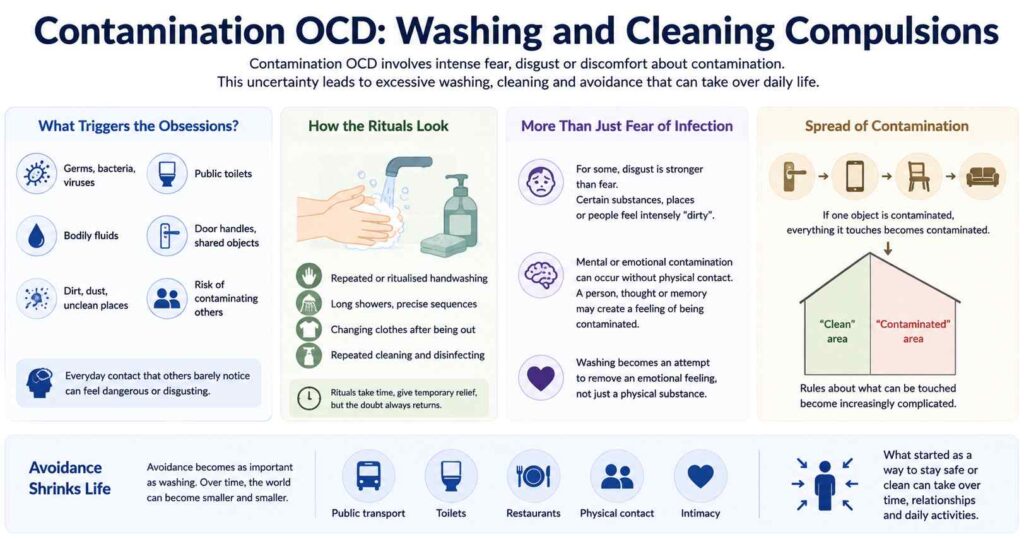
A person with contamination OCD may experience intense fear, disgust or discomfort in response to bacteria, viruses, bodily fluids, dirt, public toilets, or objects perceived as contaminated. Everyday contact that other people barely notice can trigger an overwhelming feeling of danger or disgust. The obsessive concern may involve becoming ill, but it can also centre on the possibility of contaminating another person. Someone may fear that touching a door handle and later touching someone else could transmit an infection.
This uncertainty can lead to extensive washing and cleaning rituals. Hands may be washed repeatedly or according to a precise sequence. Showering may take an unusually long time; clothes may need to be changed after returning home, while door handles or other objects may repeatedly be disinfected.
The rituals can become increasingly elaborate. If the washing sequence is interrupted or does not feel complete, the person may feel compelled to begin again. Even after extensive cleaning, there may be no lasting sense of cleanliness. The hands can visibly be clean while still feeling contaminated.
Contamination OCD Is Not Always About Infection
Not everyone with contamination OCD is primarily frightened of bacteria or disease. For some people, disgust is more important than fear. Particular substances, places or people may produce an intense sensation of dirtiness even when the person recognises that there is no realistic danger.
Contamination can also be experienced in less obvious ways. Some people describe a form of mental or emotional contamination, in which the feeling of being contaminated appears without direct physical contact with something dirty. A person, memory, thought or situation may create an internal sense of contamination. Someone may feel “unclean” after thinking about a disturbing event or after encountering a person associated with a painful experience. Washing can then become an attempt to remove an emotional feeling rather than a physical substance.
Another characteristic of severe contamination OCD is the perceived spread of contamination. An object considered contaminated touches another object, which then also feels contaminated. That object touches something else, and the contaminated area gradually expands. The person may begin dividing the home into “clean” and “contaminated” areas and develop increasingly complicated rules about what can be touched.
Avoidance can eventually become as important as washing itself. Public transport, toilets, restaurants, physical contact, or intimacy can be avoided. In severe cases, the person’s world becomes progressively smaller. What began as an attempt to remain safe or clean can consume substantial amounts of time and affect a person’s relationships and daily activities.
Checking OCD and Fear of Responsibility
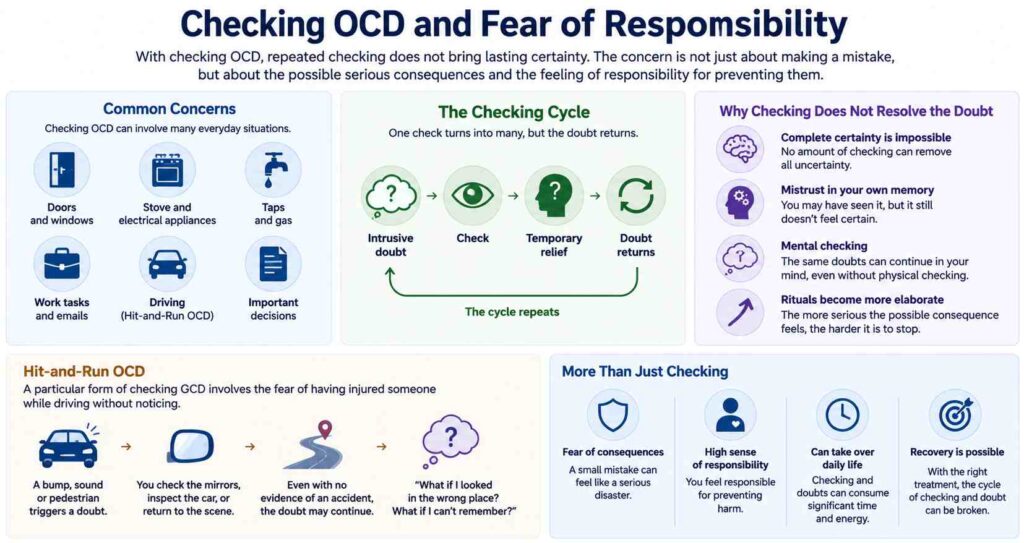
Checking OCD is another common form of OCD. Most people occasionally return to check whether a door is locked or wonder whether they switched off an appliance. With checking OCD, the problem is that checking does not produce a lasting sense of certainty. The person may look directly at a locked door and know intellectually that it is locked, yet shortly afterwards experience another intrusive doubt: Did I really check it properly?
Common concerns involve doors, windows, electrical appliances, taps, gas, or work tasks. Behind the checking is often a fear that a small mistake or moment of inattention could cause a serious consequence. A person may worry that an appliance left switched on will cause a fire or that a mistake at work will result in serious financial or professional consequences. The feared event may be unlikely, but the person feels an unusually strong responsibility to make certain that it cannot happen.
Why Repeated Checking Does Not Resolve the Doubt
The difficulty is that complete certainty cannot be achieved. One check therefore becomes two, then five, then ten. Some people develop elaborate routines before leaving home. They may repeatedly inspect the stove, pull door handles, or check windows. The more important the potential consequence feels, the harder it can become to stop.
A striking feature of checking OCD is the increasing mistrust of one’s own perception and memory. The person has often seen that the stove is switched off or felt that the door is locked. The problem is not necessarily that the information was never registered. Instead, the person cannot obtain the internal feeling of certainty that they expect to accompany that information.
Checking can also become mental rather than physical. Someone may repeatedly reconstruct an event in their mind:
Did I definitely turn the appliance off? Did I see the switch? Was I paying enough attention when I looked at it?
The same process can occur at work. A person may reread an email many times because of the fear of accidentally including something offensive, confidential or incorrect. After sending it, they may reopen the message repeatedly to make sure nothing inappropriate was written.
Hit-and-Run OCD
One particular presentation of checking OCD is commonly called Hit-and-Run OCD. The person becomes preoccupied with the possibility that they may have injured someone while driving without noticing. A bump in the road, an unexpected sound or seeing a pedestrian in the rear-view mirror may trigger the thought that an accident could have occurred. The driver may then look repeatedly in the mirrors, inspect the car for damage or return along the same route to check whether someone has been injured. Even finding no evidence of an accident may not settle the doubt. Instead, another question appears:
What if I looked in the wrong place? What if the person had already been taken away? What if I simply cannot remember what happened?
Some people search local news reports or repeatedly ask passengers whether they noticed anything unusual. In this way, Hit-and-Run OCD illustrates a broader feature of checking OCD: the search is not merely for information but for a degree of certainty that ordinary checking cannot provide.
Repeating and Counting OCD
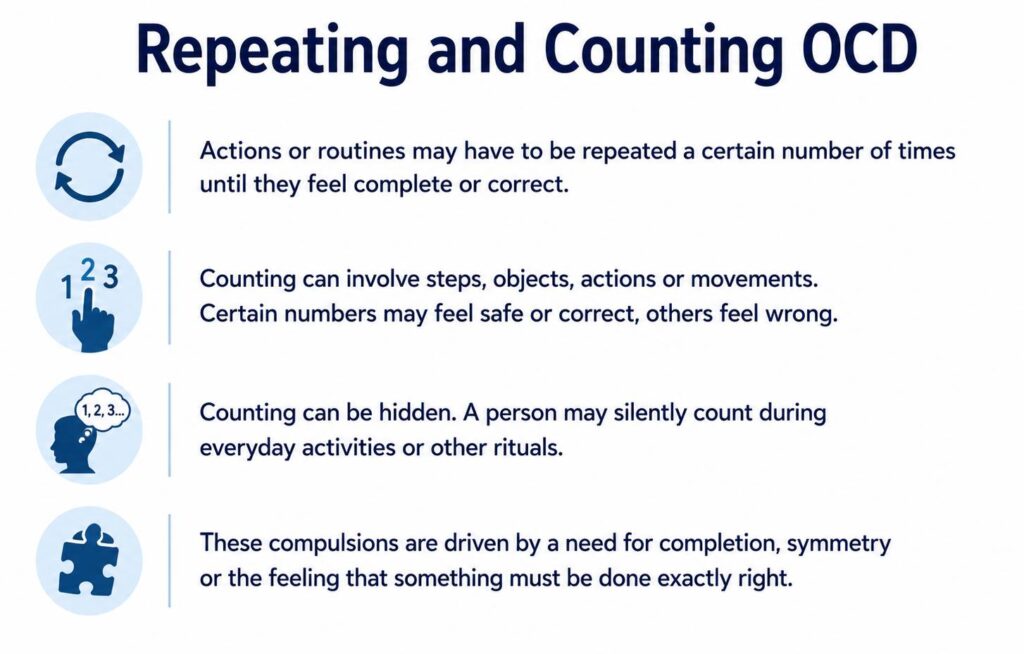
In repeating OCD, ordinary actions may have to be performed a particular number of times or repeated until they feel complete. A person may reread a sentence, touch an object several times, redo part of a morning routine or perform an everyday action again because the first attempt did not feel correct.
Sometimes the repetition is connected with a feared consequence. A person may feel that an action must be repeated three, five or seven times to prevent something bad from happening to themselves or someone they love. The person may recognise that there is no logical connection between repeating the action and preventing the feared event, but resisting the ritual can nevertheless produce considerable anxiety or tension.
Counting OCD can follow a similar pattern. People may count steps, tiles, objects, movements or everyday actions. Numbers may acquire particular significance, with some numbers experienced as safe or correct and others as uncomfortable or threatening.
Counting can also remain entirely hidden. A person may silently count while walking, washing, reading or completing another ritual. To other people, nothing unusual is visible even though a substantial amount of mental attention is being consumed by the compulsion.
Repeating and counting therefore demonstrate an important characteristic of the different forms of OCD: compulsions are not always performed to prevent a clearly defined danger. Sometimes they are driven by an intense need for completion, symmetry or the feeling that something has finally been done correctly.
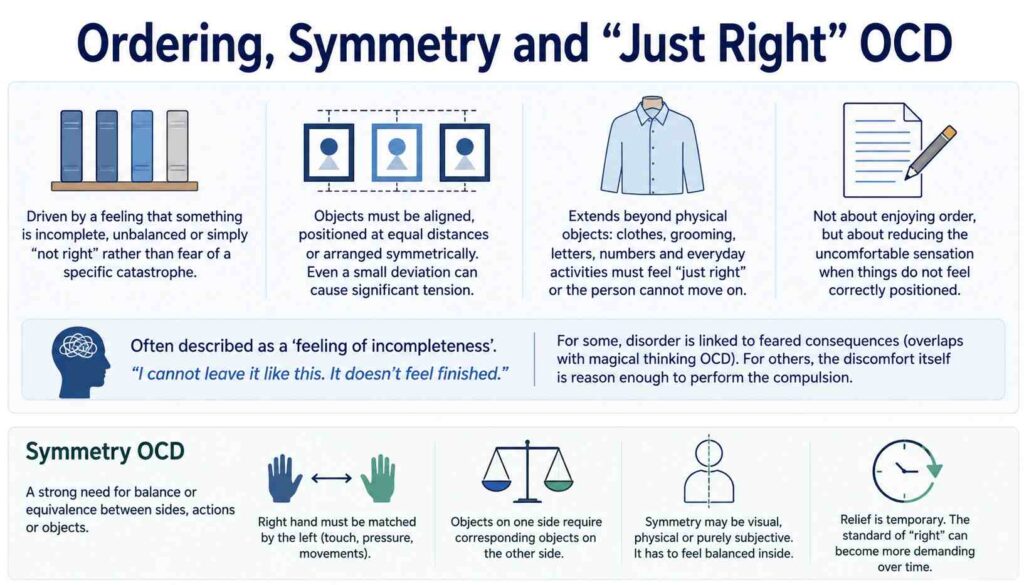
Ordering, Symmetry and “Just Right” OCD
Ordering, Symmetry and Just Right OCD is driven less by fear of a specific catastrophe and more by an intense feeling that something is incomplete, unbalanced or simply “not right”. A person may feel compelled to arrange books, clothes, furniture, and objects on a desk according to precise rules. Objects may need to be perfectly aligned, positioned at equal distances or arranged symmetrically. Even a small deviation can produce considerable internal tension.
To someone observing from the outside, this behaviour can resemble extreme neatness or perfectionism. The internal experience, however, is different. The person is not necessarily arranging things because they enjoy order. They may spend considerable time adjusting the same object because they cannot tolerate the uncomfortable sensation produced when it does not feel correctly positioned.
The same experience can extend beyond physical objects. Written letters may have to look uniform. A sentence may need to be rewritten because one word or character does not look right. Everyday activities can become prolonged because the person feels unable to continue until a particular sense of completion has been achieved. This experience is called a ‘feeling of incompleteness’. Instead of thinking, Something terrible will happen if I don’t correct this, the person may experience something closer to:
I cannot leave it like this. It doesn’t feel finished.
The distinction is not absolute. Some people with ordering OCD do associate asymmetry or disorder with feared consequences. In such cases, ordering OCD overlaps with magical thinking OCD. For others, no particular catastrophe is anticipated; the discomfort itself becomes sufficient to drive the compulsion.
Symmetry OCD
Symmetry OCD involves an especially strong need for balance or equivalence. An object touched with the right hand may need to be touched with the left. Pressure experienced on one side of the body may need to be reproduced on the other side. Objects positioned on one side of a table may require corresponding objects on the opposite side. The desired symmetry may be visual, physical or purely subjective.
What matters is not necessarily whether the arrangement appears symmetrical to another person. It has to produce the internal sensation of being balanced or correct. As with other forms of OCD, achieving the desired feeling may provide temporary relief. The difficulty is that the standard of what feels “right” can become increasingly demanding. Small imperfections that previously went unnoticed begin to attract attention, and progressively more time may be spent correcting them.
Magical Thinking OCD
In Magical Thinking OCD, a person experiences an irrational connection between a thought or action and an unrelated event. For example, someone may feel compelled to touch an object five times because otherwise something terrible could happen to him and or a family member. Another person may believe that having a particular thought, saying a particular word or performing an action in the “wrong” way could increase the likelihood of illness, an accident or another catastrophe.
The person may recognise intellectually that there is no realistic causal relationship between the ritual and the feared event. Nevertheless, resisting the ritual can produce considerable anxiety. The problem is reinforced by uncertainty. If the person performs the ritual and nothing bad happens, OCD can suggest that the ritual may have prevented the catastrophe.
Magical thinking can occur as a distinct OCD theme, but it frequently appears within other forms of OCD. Counting, repeating and ordering rituals may all acquire a magical function. Contamination rituals can also become connected with preventing unrelated harm, while religious OCD may involve fears that particular thoughts or actions could provoke punishment.
Intrusive Thoughts and Mental Compulsions in OCD
Not all forms of OCD involve obvious physical rituals. Some of the most distressing presentations are dominated by intrusive thoughts, images, impulses or doubts. These may involve violence, sexuality, morality, religion, relationships, identity or other subjects that the person finds deeply disturbing.
Historically, presentations dominated by intrusive thoughts were sometimes described as “Pure O”, meaning “purely obsessional OCD.” The expression can be misleading because people who appear to have only obsessions frequently have compulsions as well. The difference is that these compulsions may take place predominantly in the mind.
A person may repeatedly analyse what a thought means, reconstruct past events, check their emotional reaction, compare one thought with another, silently reassure themselves or attempt to replace an unacceptable thought with a “safe” one. They may also repeatedly search the internet or ask other people questions in an attempt to obtain reassurance.
From the outside, the person may appear to be doing nothing. Internally, however, they may spend hours engaged in mental rituals. Recognising these hidden compulsions is particularly important in forms of OCD involving aggressive, sexual or morally disturbing thoughts. The person may believe that the content of the thought itself is the problem, while much of the obsessive-compulsive cycle is occurring through repeated attempts to determine what the thought means.
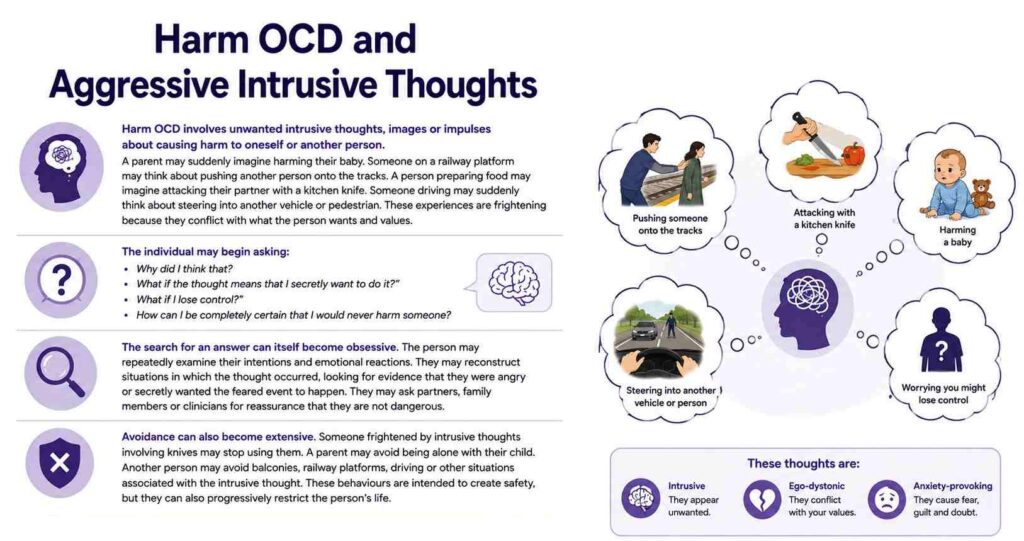
Harm OCD and Aggressive Intrusive Thoughts
Harm OCD involves unwanted intrusive thoughts, images, or impulses about causing harm to oneself or another person. A parent may suddenly experience an image of harming their baby. Someone standing on a railway platform may have an intrusive thought about pushing another person onto the tracks. A person preparing food may imagine attacking their partner with a kitchen knife. Someone driving may suddenly think about deliberately steering into another vehicle or pedestrian. These experiences can be extremely frightening precisely because they conflict with what the person wants and values.
The individual may begin asking:
Why did I think that?
What if the thought means that I secretly want to do it?
What if I lose control?
How can I be completely certain that I would never harm someone?
The search for an answer can itself become obsessive. The person may repeatedly examine their intentions and emotional reactions. They may reconstruct situations in which the thought occurred, looking for evidence that they were angry or secretly wanted the feared event to happen. They may ask partners, family members or clinicians for reassurance that they are not dangerous.
Avoidance can also become extensive. Someone frightened by intrusive thoughts involving knives may stop using them. A parent may avoid being alone with their child. Another person may avoid balconies, railway platforms, driving or other situations associated with the intrusive thought. These behaviours are intended to create safety, but they can also progressively restrict person’s life.
Why Harm OCD Can Be So Frightening
Intrusive aggressive thoughts are particularly distressing because they often concern people who are extremely important to the individual. A parent who strongly values protecting their child may become preoccupied with the possibility of harming the child. Someone who considers themselves peaceful may become obsessed with the possibility of committing an act of violence.
The thought therefore threatens not only another person’s safety but also the individual’s understanding of who they are. This can lead to repeated attempts to determine whether the thought was “really” unwanted. The person may monitor their body, emotions and impulses for evidence of aggression. Even the absence of anxiety can become frightening:
Why didn’t that thought upset me as much today? Does that mean I am beginning to like it?
OCD can therefore shift the question repeatedly. Once one doubt has been answered, another appears. Harm OCD can also overlap with checking OCD, False Memory OCD and Moral Scrupulosity. Someone may become concerned not only about what they could do but about whether they may already have harmed someone without noticing or remembering it.
Sexual OCD and Unwanted Sexual Intrusive Thoughts
Sexual OCD involves recurrent and unwanted sexual thoughts, images, impulses or doubts causing significant distress. The specific content varies considerably. Intrusive thoughts may involve inappropriate sexual behaviour, or such related to family members, children, or sexual acts that the person finds disturbing and incompatible with their values.
The presence of sexual content can make these obsessions especially difficult to disclose. People may feel intense shame and fear that describing the thoughts will cause others to misunderstand them. As with Harm OCD, much of the distress comes from the meaning assigned to the thought:
Why would I have this thought if I didn’t want it?
What does this say about me?
Could I secretly be attracted to this?
What if I eventually act on it?
The person may then begin checking their thoughts, emotions and bodily sensations for an answer. This checking can itself become a compulsion. Normal bodily sensations may then be interpreted as evidence supporting the obsession, producing further anxiety and further checking. Others repeatedly reconstruct previous interactions to determine whether their behaviour had a sexual meaning. They may search online for information, compare themselves with other people or repeatedly ask for reassurance. As in other forms of OCD, however, the repeated attempt to establish certainty can generate further doubt.
Sexual Orientation OCD
Another form of sexual OCD involves persistent doubts about sexual orientation. It is often called Sexual Orientation OCD (SO-OCD). A heterosexual person may become preoccupied with the possibility of being gay or bisexual despite previously experiencing their sexual orientation as clear.
The central problem is therefore not any particular sexual orientation. It is the obsessive need to determine one’s orientation with absolute certainty. A person may repeatedly monitor who they notice in public, analyse physical reactions, compare attraction to men and women, and reconstruct previous relationships.
The more closely the person monitors attraction, the less spontaneous their emotional and sexual responses may feel. This can create an exhausting cycle in which every thought, glance or bodily sensation appears to require interpretation. Sexual Orientation OCD illustrates particularly clearly how OCD can attach itself to questions of identity.
Intrusive Thoughts Are Not the Same as Intentions
Harm OCD and sexual OCD can be especially frightening because the content may involve behaviour the person finds morally unacceptable. An intrusive thought, image or impulse is not the same as an intention. In OCD, distress often grows because the person treats the presence of the thought as potentially meaningful. Repeated reassurance rarely settles this question for long. The recurring problem is the demand for complete certainty about what an unwanted mental event means.
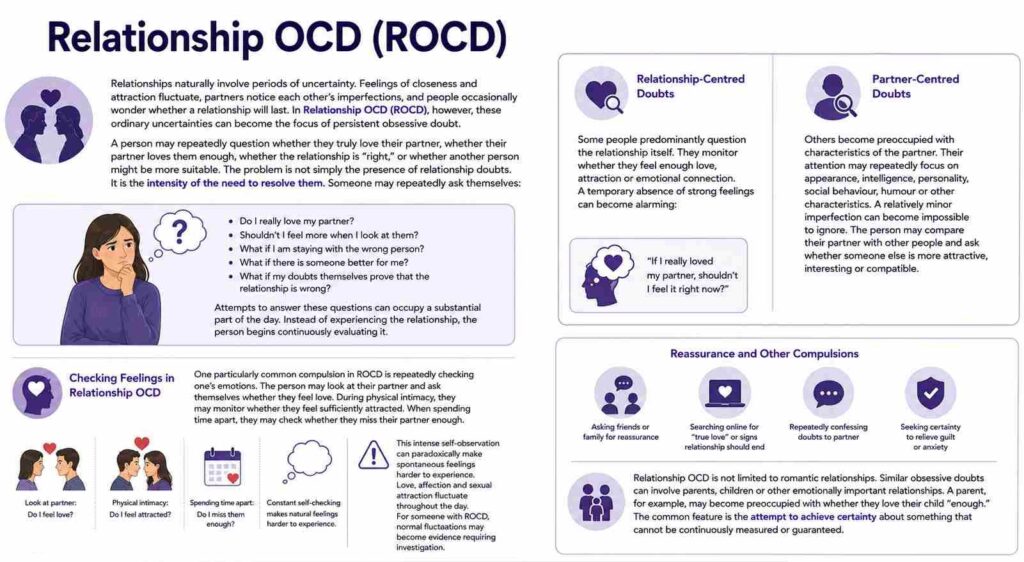
Relationship OCD (ROCD)
Relationships naturally involve periods of uncertainty. Feelings of closeness and attraction fluctuate, partners notice each other’s imperfections, and people occasionally wonder whether a relationship will last. In Relationship OCD (ROCD), however, these ordinary uncertainties can become the focus of persistent obsessive doubt.
A person may repeatedly question whether they truly love their partner, whether their partner loves them enough, whether the relationship is “right,” or whether another person might be more suitable. The problem is not simply the presence of relationship doubts. It is the intensity of the need to resolve them. Someone may repeatedly ask themselves:
Do I really love my partner?
Shouldn’t I feel more when I look at them?
What if I am staying with the wrong person?
What if there is someone better for me?
What if my doubts themselves prove that the relationship is wrong?
Attempts to answer these questions can occupy a substantial part of the day. Instead of experiencing the relationship, the person begins continuously evaluating it.
Relationship-Centred and Partner-Centred Doubts
Relationship OCD can become organised around different kinds of uncertainty. Some people predominantly question the relationship itself. They monitor whether they feel enough love, attraction or emotional connection. A temporary absence of strong feelings can become alarming:
If I really loved my partner, shouldn’t I feel it right now?
Others become preoccupied with characteristics of the partner. Their attention may repeatedly focus on appearance, intelligence, personality, social behaviour, humour or other characteristics. A relatively minor imperfection can become impossible to ignore. The person may compare their partner with other people and ask whether someone else is more attractive, interesting or compatible.
Checking Feelings in Relationship OCD
One particularly common compulsion in ROCD is repeatedly checking one’s emotions. The person may look at their partner and ask themselves whether they feel love. During physical intimacy, they may monitor whether they feel sufficiently attracted. When spending time apart, they may check whether they miss their partner enough.
This intense self-observation can paradoxically make spontaneous feelings harder to experience. Love, affection and sexual attraction do not remain at a constant intensity throughout the day. Stress, tiredness, conflict and many other factors influence emotional experience. For someone with ROCD, however, a normal fluctuation may become evidence requiring investigation.
Reassurance can also become part of the cycle. Friends or family may repeatedly be asked whether the relationship appears healthy or whether they believe the couple is compatible. The person may search online for descriptions of “true love” or signs that a relationship should end. Another compulsion can involve repeatedly confessing doubts to the partner in an attempt to relieve guilt or establish certainty.
Relationship OCD is not limited to romantic relationships. Similar obsessive doubts can involve parents, children or other emotionally important relationships. A parent, for example, may become preoccupied with whether they love their child “enough.” The common feature is the attempt to achieve certainty about something that cannot be continuously measured or guaranteed.
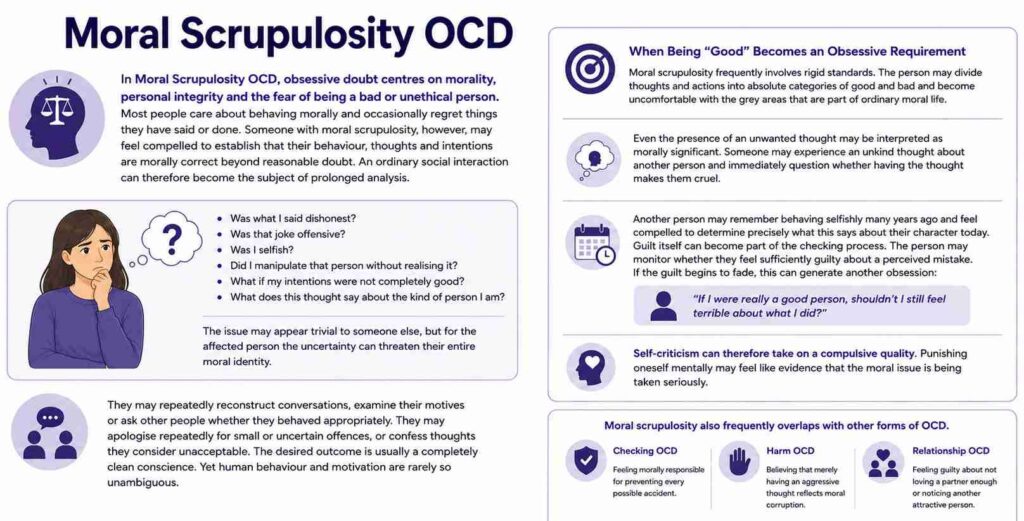
Moral Scrupulosity OCD
In Moral Scrupulosity OCD, obsessive doubt centres on morality, personal integrity and the fear of being a bad or unethical person. Most people care about behaving morally and occasionally regret things they have said or done. Someone with moral scrupulosity, however, may feel compelled to establish that their behaviour, thoughts and intentions are morally correct beyond reasonable doubt. An ordinary social interaction can therefore become the subject of prolonged analysis.
Was what I said dishonest?
Was that joke offensive?
Was I selfish?
Did I manipulate that person without realising it?
What if my intentions were not completely good?
What does this thought say about the kind of person I am?
The issue may appear trivial to someone else, but for the affected person the uncertainty can threaten their entire moral identity. They may repeatedly reconstruct conversations, examine their motives or ask other people whether they behaved appropriately. They may apologise repeatedly for small or uncertain offences, or confess thoughts they consider unacceptable. The desired outcome is usually a completely clean conscience. Yet human behaviour and motivation are rarely so unambiguous.
When Being “Good” Becomes an Obsessive Requirement
Moral scrupulosity frequently involves rigid standards. The person may divide thoughts and actions into absolute categories of good and bad and become uncomfortable with the grey areas that are part of ordinary moral life. Even the presence of an unwanted thought may be interpreted as morally significant. Someone may experience an unkind thought about another person and immediately question whether having the thought makes them cruel.
Another person may remember behaving selfishly many years ago and feel compelled to determine precisely what this says about their character today. Guilt itself can become part of the checking process. The person may monitor whether they feel sufficiently guilty about a perceived mistake. If the guilt begins to fade, this can generate another obsession:
If I were really a good person, shouldn’t I still feel terrible about what I did?
Self-criticism can therefore take on a compulsive quality. Punishing oneself mentally may feel like evidence that the moral issue is being taken seriously. Moral scrupulosity also frequently overlaps with other forms of OCD. Someone with checking OCD may feel morally responsible for preventing every possible accident. A person with Harm OCD may believe that merely having an aggressive thought reflects moral corruption. Relationship OCD can become connected with guilt about not loving a partner enough or noticing another attractive person. The surface theme changes, but underneath it lies the demand to establish moral certainty.
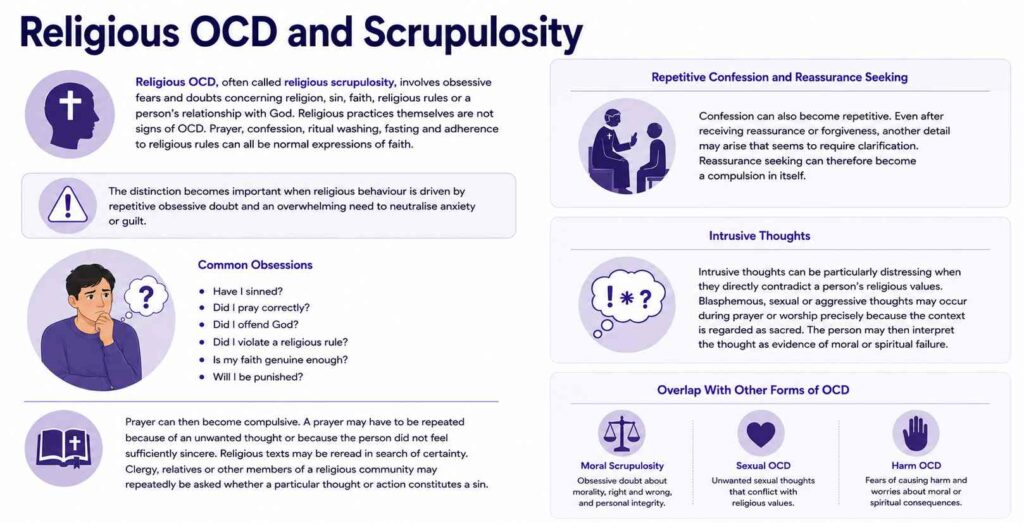
Religious OCD and Scrupulosity
Religious OCD, often called religious scrupulosity, involves obsessive fears and doubts concerning religion, sin, faith, religious rules or a person’s relationship with God. Religious practices themselves are not signs of OCD. Prayer, confession, ritual washing, fasting and adherence to religious rules can all be normal expressions of faith. The distinction becomes important when religious behaviour is driven by repetitive obsessive doubt and an overwhelming need to neutralise anxiety or guilt.
A person may become preoccupied with whether they have sinned, prayed correctly, offended God or violated a religious rule. They may fear punishment or repeatedly question whether their faith is genuine enough. Prayer can then become compulsive. Religious texts may be reread in search of certainty. Clergy, relatives or other members of a religious community may repeatedly be asked whether a particular thought or action constitutes a sin.
Confession can also become repetitive. Even after receiving reassurance or forgiveness, another detail may arise that seems to require clarification. Intrusive thoughts are particularly distressing when they directly contradict a person’s religious values. Blasphemous, sexual or aggressive thoughts may occur during prayer or worship precisely because the individual regards the context as sacred. The person may then interpret the thought as evidence of moral or spiritual failure. Religious OCD can therefore overlap considerably with moral scrupulosity, sexual OCD and Harm OCD.
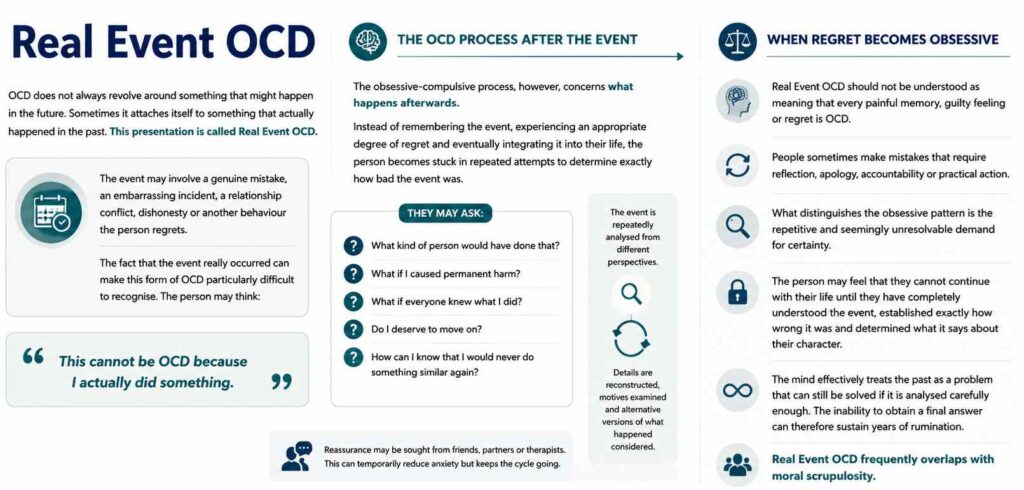
Real Event OCD
OCD does not always revolve around something that might happen in the future. Sometimes it attaches itself to something that actually happened in the past. This presentation is called Real Event OCD. The event may involve a genuine mistake, an embarrassing incident, a relationship conflict, dishonesty or another behaviour the person regrets. The fact that the event really occurred can make this form of OCD particularly difficult to recognise. The person may think:
This cannot be OCD because I actually did something.
The obsessive-compulsive process, however, concerns what happens afterwards. Instead of remembering the event, experiencing an appropriate degree of regret and eventually integrating it into their life, the person becomes stuck in repeated attempts to determine exactly how bad the event was.
They may ask:
What kind of person would have done that?
What if I caused permanent harm?
What if everyone knew what I did?
Do I deserve to move on?
How can I know that I would never do something similar again?
The event is repeatedly analysed from different perspectives. Details are reconstructed, motives examined and alternative versions of what happened considered. Reassurance may be sought from friends, partners, or therapists.
When Regret Becomes Obsessive
Real Event OCD should not be understood as meaning that every painful memory, guilty feeling or regret is OCD. People sometimes make mistakes that require reflection, apology, accountability or practical action. What distinguishes the obsessive pattern is the repetitive and seemingly unresolvable demand for certainty.
The person may feel that they cannot continue with their life until they have completely understood the event, established exactly how wrong it was and determined what it says about their character. The mind effectively treats the past as a problem that can still be solved if it is analysed carefully enough. The inability to obtain a final answer can therefore sustain years of rumination. Real Event OCD frequently overlaps with moral scrupulosity.
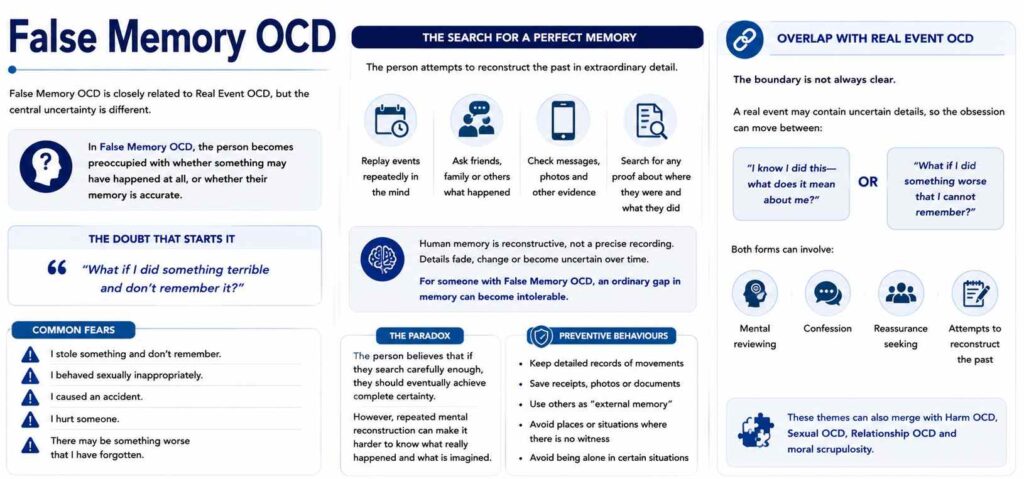
False Memory OCD
False Memory OCD is closely related to Real Event OCD, but the central uncertainty is different. In Real Event OCD, the person generally knows that an event occurred but becomes obsessed with its meaning, seriousness or consequences. In False Memory OCD, the person becomes preoccupied with whether something may have happened at all, or whether their memory is accurate. A doubt may begin with a question such as:
What if I did something terrible and don’t remember it?
The person may then attempt to reconstruct the past in extraordinary detail. They may replay an evening repeatedly to determine whether they behaved inappropriately. They may ask friends what happened, inspect messages and photographs, or search for other evidence that could establish where they were and what they did. Someone may become frightened that they stole something without noticing, behaved sexually inappropriately, caused an accident or hurt someone.
The Search for a Perfect Memory
Human memory is reconstructive rather than a precise recording of events. Details disappear, change or become uncertain over time. Most people tolerate these imperfections without needing to resolve them. For someone with False Memory OCD, an ordinary gap in memory can become intolerable.
The person may believe that if they search their memory carefully enough, they should eventually achieve complete certainty. However, repeated reconstruction can have the opposite effect. The more often an event is mentally replayed, the more difficult it may become to distinguish what was originally remembered from what has subsequently been imagined.
False Memory OCD can also lead to preventive behaviours. Someone may keep unusually detailed records of their movements, retain receipts, take photographs or document everyday activities. Other people may be used as a form of external memory. The person may avoid going somewhere alone because having a companion provides a witness who can later confirm what happened.
How Real Event OCD and False Memory OCD Can Overlap
The boundary between Real Event OCD and False Memory OCD is not always clear. A real event may contain uncertain details, so the obsession can move between “I know I did this—what does it mean about me?” and “What if I did something worse that I cannot remember?” Both forms can involve mental reviewing, confession, reassurance seeking and attempts to reconstruct the past. These themes can also merge with Harm OCD, Sexual OCD, Relationship OCD and moral scrupulosity.
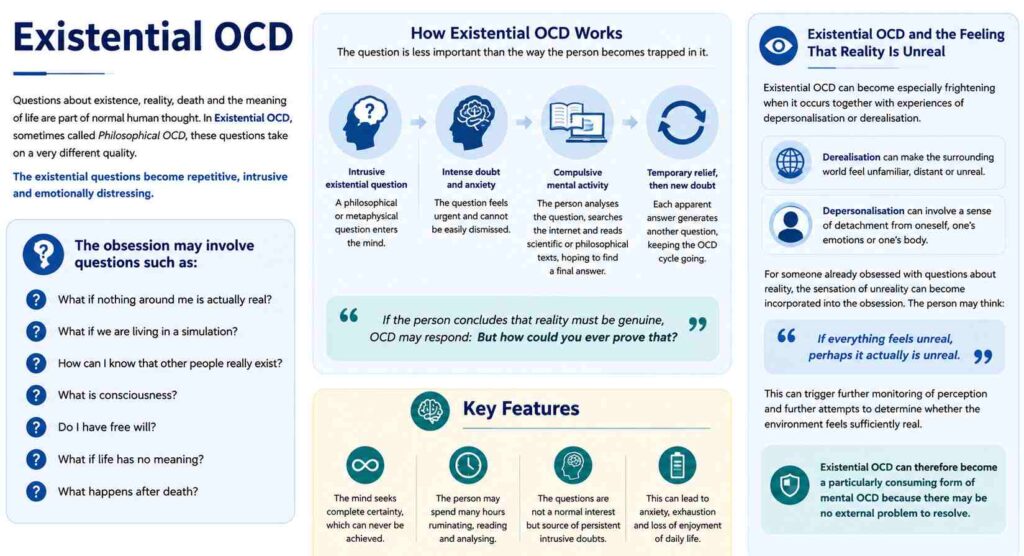
Existential OCD
Questions about existence, reality, death and the meaning of life are part of normal human thought. People may wonder whether life has a purpose, what happens after death or how we can know that our perception of reality is accurate. In Existential OCD, sometimes called Philosophical OCD, these questions take on a very different quality. The existential questions become repetitive, intrusive and emotionally distressing.
The obsession may involve questions such as:
What if nothing around me is actually real?
What if we are living in a simulation?
How can I know that other people really exist?
What is consciousness?
Do I have free will?
What if life has no meaning?
What happens after death?
The particular question is less important than the way the person becomes trapped in trying to resolve it. Someone without OCD may find such questions interesting and think about them occasionally without expecting a final answer. A person with Existential OCD may spend hours analysing philosophical questions, searching the internet, reading scientific or philosophical texts.
Each apparent answer generates another question. If the person concludes that reality must be genuine, OCD may respond: But how could you ever prove that?
Existential OCD and the Feeling That Reality Is Unreal
Existential OCD can become especially frightening when it occurs together with experiences of depersonalisation or derealisation. Derealisation can make the surrounding world feel unfamiliar, distant or unreal, while depersonalisation can involve a sense of detachment from oneself, one’s emotions or one’s body. For someone already obsessed with questions about reality, however, the sensation of unreality can become incorporated into the obsession. The person may think:
If everything feels unreal, perhaps it actually is unreal.
This can trigger further monitoring of perception and further attempts to determine whether the environment feels sufficiently real. The distinction is clinically important because the subjective sensation becomes interpreted as evidence for the obsession. Instead of allowing the unusual sensation to pass, the person begins investigating what it means. Existential OCD can therefore become a particularly consuming form of mental OCD because there may be no external problem to resolve.
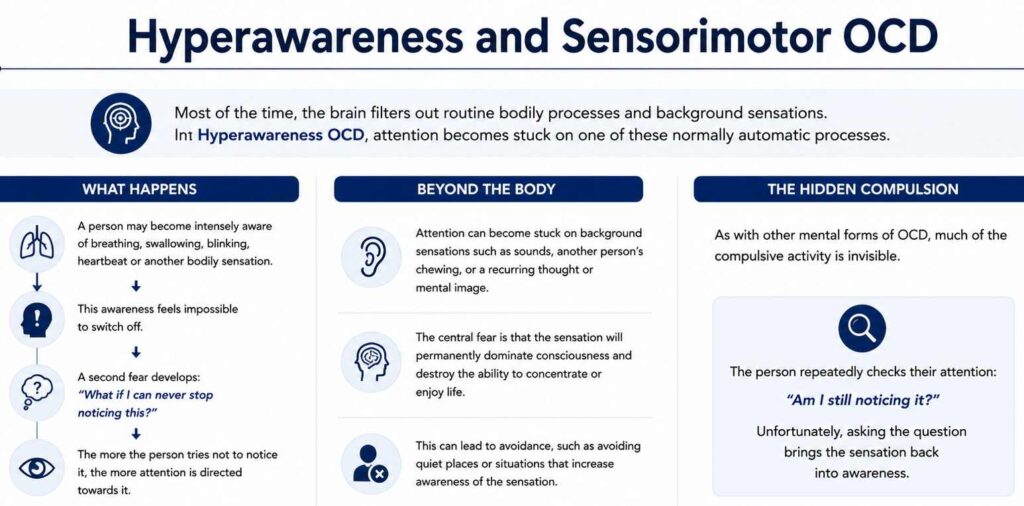
Hyperawareness and Sensorimotor OCD
Most of the time, the brain allows routine bodily processes and background sensations to remain outside conscious attention. We breathe, blink and swallow without continuously thinking about these actions. In Hyperawareness OCD, sometimes described as Sensorimotor OCD, attention becomes unusually fixed on one of these normally automatic processes. A person may become intensely aware of breathing, swallowing, blinking, heartbeat, or another bodily sensation. Once attention has become focused on the process, it can seem impossible to stop noticing it. The person may then develop a second fear:
What if I can never stop noticing this?
The original bodily process is usually harmless. The distress comes from the persistent awareness of it and the fear that this awareness will never disappear. Someone may begin monitoring whether they are still thinking about their breathing. This creates a particularly frustrating paradox. The more urgently the person tries not to notice something, the more attention is directed towards it.
Hyperawareness Can Extend Beyond the Body
Hyperawareness OCD does not necessarily involve bodily processes. Attention may become stuck on background sensations. Someone may become excessively aware of another person’s chewing, particular sounds or the presence of a recurring thought or mental image. The central fear may be that the sensation will permanently dominate consciousness and destroy the person’s ability to concentrate or enjoy life. This can lead to avoidance. Someone focused on swallowing may avoid eating with other people. Another person may avoid quiet environments because silence makes breathing or heartbeat more noticeable. As with other predominantly mental forms of OCD, much of the compulsive activity may be invisible. The person repeatedly checks their attention:
Am I still noticing it?
Unfortunately, asking the question itself brings the sensation back into awareness.
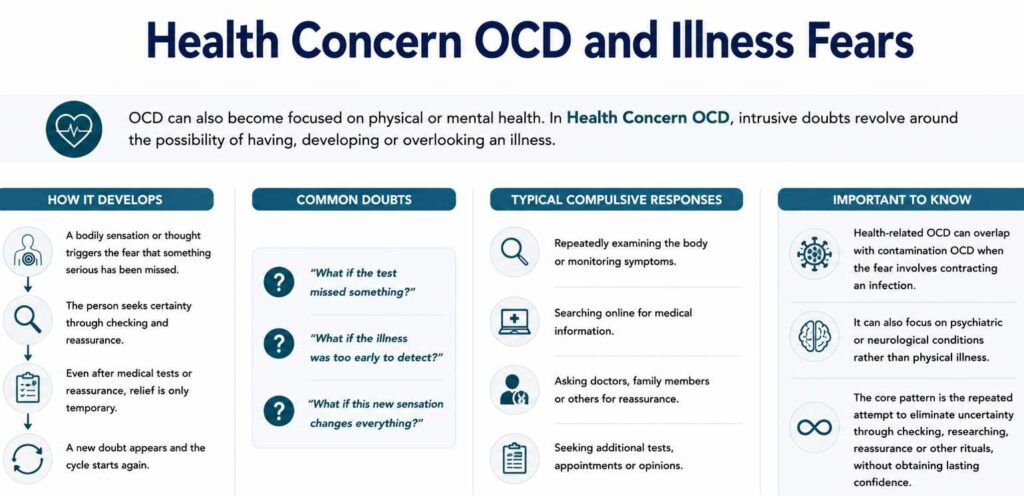
Health Concern OCD and Illness Fears
OCD can also become focused on physical or mental health. In Health Concern OCD, intrusive doubts revolve around the possibility of having, developing or overlooking an illness. A bodily sensation may trigger the fear that something serious has been missed. The person may repeatedly examine their body, monitor symptoms, search online for medical information or ask doctors and family members for reassurance. Even after a medical assessment provides reassuring results, the relief may be temporary. A new question appears:
What if the test missed something?
What if the illness was too early to detect?
What if this new sensation changes everything?
The person may then seek another examination or return to researching the symptoms. Health-related OCD can overlap with contamination OCD when the fear involves contracting an infection. It can also focus on psychiatric or neurological conditions rather than physical illness. The characteristic pattern is the repeated attempt to eliminate uncertainty through checking, researching, reassurance or other rituals, without obtaining lasting confidence.
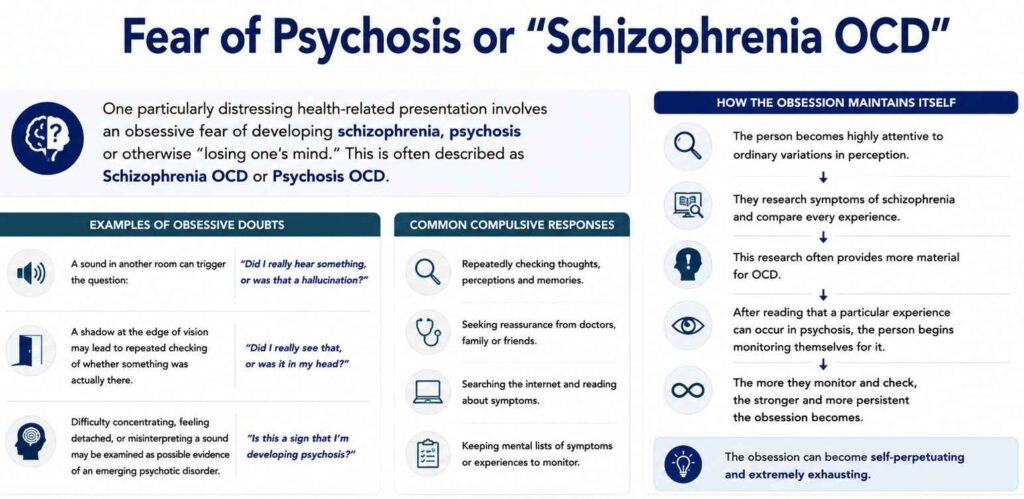
Fear of Psychosis or “Schizophrenia OCD”
One particularly distressing health-related presentation involves an obsessive fear of developing schizophrenia, psychosis or otherwise “losing one’s mind.” This is often described as Schizophrenia OCD or Psychosis OCD. The person may become highly attentive to ordinary variations in perception. A sound in another room can trigger the question:
Did I really hear something, or was that a hallucination?
A shadow at the edge of vision may lead to repeated checking of whether something was actually there. Difficulty concentrating, feeling detached from one’s surroundings or momentarily misinterpreting a sound may be examined as possible evidence of an emerging psychotic disorder.
The person may then begin researching symptoms of schizophrenia and comparing every experience with what they have read. This research often creates additional material for OCD. After reading that a particular experience can occur in psychosis, the person begins monitoring themselves for that experience. The obsession can become self-perpetuating.
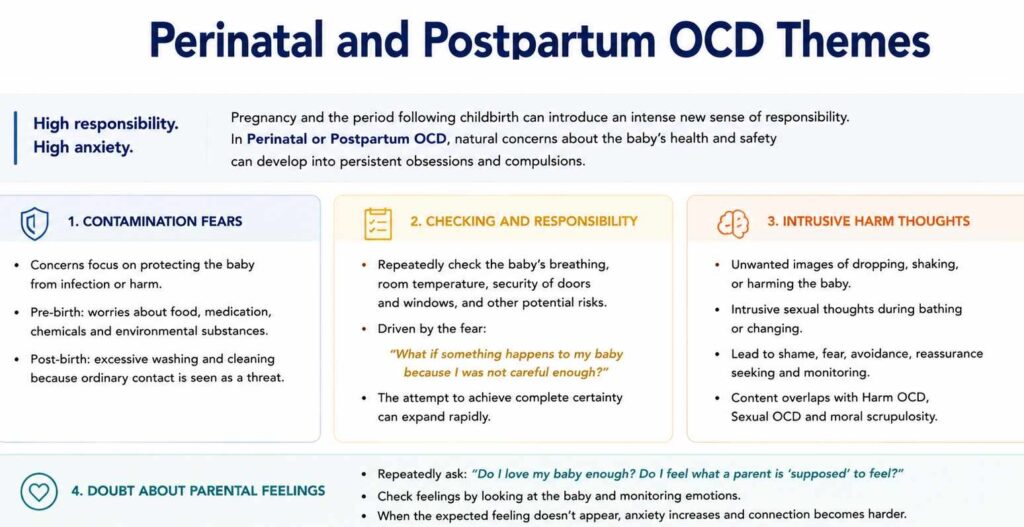
Perinatal and Postpartum OCD Themes
Pregnancy and the period following childbirth can introduce an intense new sense of responsibility. Parents naturally become concerned about the health and safety of their baby, but in Perinatal or Postpartum OCD, these concerns can develop into persistent obsessions and compulsions.
Contamination fears may centre on protecting the baby from infection. A pregnant woman may become increasingly concerned about food, medication, chemicals or environmental substances that could potentially harm the unborn child. After birth, washing and cleaning may become excessive because ordinary contact with the outside world is experienced as a threat to the baby.
Checking can also become prominent. A parent may repeatedly check whether the baby is breathing, whether the room temperature is correct, whether windows and doors are secure or whether something potentially dangerous has been left near the child. The underlying concern is frequently responsibility:
What if something happens to my baby because I was not careful enough?
Because no parent can eliminate every possible risk, the attempt to achieve complete certainty can expand rapidly.
Intrusive Harm Thoughts After Childbirth
Perinatal and postpartum OCD can also involve aggressive intrusive thoughts concerning the baby. A parent may experience an unwanted image of dropping, shaking or otherwise harming the child. Another may become frightened by an intrusive sexual thought during bathing or changing. These thoughts can produce intense shame and fear. The parent may conclude:
What kind of mother or father would have a thought like this?
They may begin avoiding being alone with the baby, ask another person to perform routine care or repeatedly monitor their emotional and physical reactions around the child. The content can therefore overlap with Harm OCD, Sexual OCD and moral scrupulosity.
Another presentation involves obsessive doubt about parental feelings. A mother or father may repeatedly ask whether they love the baby enough or whether they feel what a parent is “supposed” to feel. Fatigue, stress and the enormous adjustment associated with having a child can naturally influence emotions. In OCD, however, the absence of a particular feeling can itself become something that must be investigated. The parent may repeatedly look at the baby and check:
Do I feel love now?
If the expected emotion does not immediately appear, anxiety increases, making spontaneous emotional connection even harder to experience. Perinatal OCD can coexist with depression, anxiety or other postpartum psychiatric conditions.
OCD Themes Can Change Over Time
A person does not necessarily experience the same form of OCD throughout life. Contamination fears may later give way to checking; Harm OCD may develop into false-memory doubts, and relationship concerns may shift toward morality or responsibility. Several themes can also occur at the same time.
The content may change, but the underlying pattern often remains recognisable: an intrusive doubt or sensation becomes associated with anxiety, guilt, disgust, tension or incompleteness; the person responds by washing, checking, analysing, avoiding, repeating or seeking reassurance; relief follows temporarily; and uncertainty returns. The theme determines what the person fears, but the structure of the obsessive-compulsive cycle remains the same.