

An accurate OCD diagnosis in Dubai requires a comprehensive psychiatric assessment rather than relying on individual symptoms alone.
The psychiatrist evaluates the nature of the patient’s obsessive thoughts and compulsive behaviours, how much time they consume, the distress they cause, and their impact on everyday functioning.
Obsessive-compulsive disorder (OCD) is often misunderstood. Although it is commonly associated with excessive cleaning, repeated checking or a need for order, OCD can involve many different obsessions, compulsions, avoidance behaviours and mental rituals. Some symptoms may remain hidden or unrecognised for years.
An important part of diagnosing OCD is determining whether the symptoms are best explained by OCD or by another psychiatric or medical condition. Similar symptoms can occur in several disorders, making careful differential diagnosis essential.
At CHMC Dubai, the assessment considers OCD symptoms alongside the patient’s psychiatric and medical history, medications and possible co-existing conditions. This comprehensive approach supports an accurate diagnosis and appropriate treatment recommendations.
For OCD Diagnosis, Contact Our Consultant Psychiatrist
What Is Obsessive-Compulsive Disorder?
Obsessive-compulsive disorder (OCD) is a psychiatric condition characterised by obsessions, compulsions, or both. Obsessions are recurrent and unwanted thoughts, images, impulses, or urges that cause anxiety or distress. The person may try to suppress, ignore, or neutralise them, but they tend to return.
Compulsions are repetitive behaviours or mental acts that a person feels driven to perform, usually to reduce anxiety or prevent a feared event. Common examples include washing, checking, arranging, counting, praying, repeating words mentally, and seeking reassurance. Although compulsions may provide temporary relief, they are often excessive or not realistically connected to the event they are intended to prevent.
For example, someone may repeatedly check whether the front door is locked because of persistent fear that somebody could enter the home or wash their hands repeatedly because of contamination fears. Compulsions are not always visible: they can also involve mental rituals, such as counting, reviewing past events, repeating phrases internally, or mentally checking whether harm may have occurred.
OCD Diagnosis According to DSM-5-TR
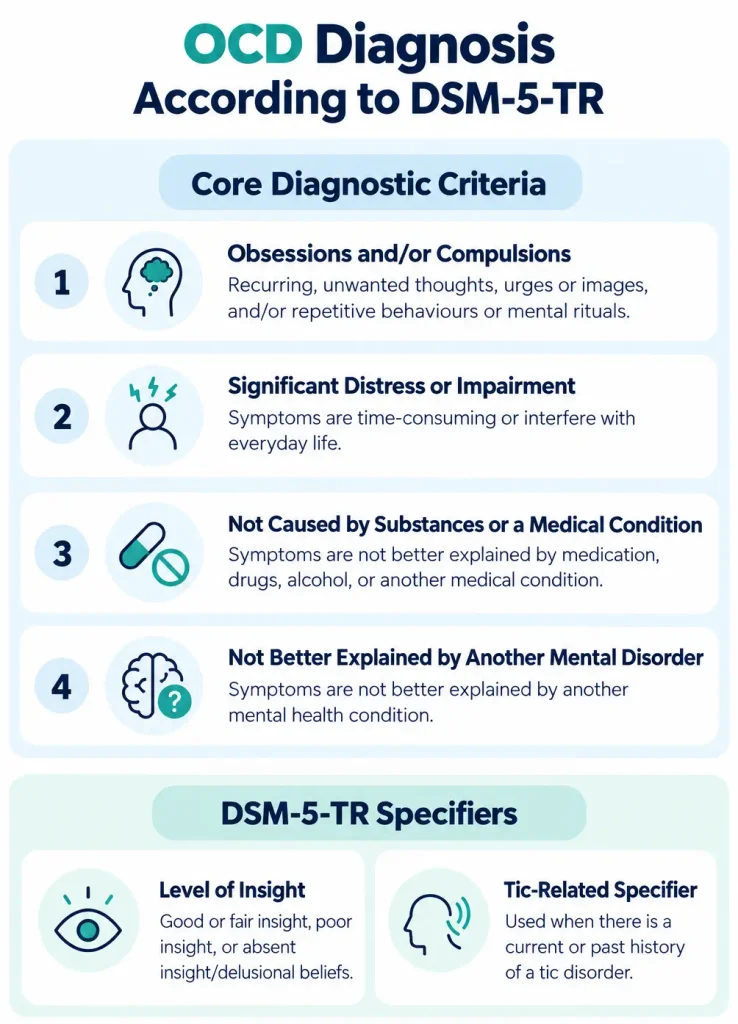
Obsessive-compulsive disorder (OCD) is diagnosed according to specific criteria outlined in the Diagnostic and Statistical Manual of Mental Disorders, Fifth Edition, Text Revision (DSM-5-TR).
OCD involves more than occasional unwanted thoughts or repetitive habits. For a diagnosis, obsessions, compulsions, or both must be present and must be time-consuming or cause clinically significant distress or impairment.
Criterion A: Obsessions, Compulsions, or Both
The first criterion requires the presence of obsessions, compulsions, or both. Obsessions are recurrent and unwanted thoughts, urges, or images that cause anxiety or distress. Compulsions are repetitive behaviours or mental acts that a person feels driven to perform, often in response to an obsession or according to rigid rules.
Compulsions are typically performed to reduce distress or prevent a feared event, although they may be excessive or not realistically connected to what they are intended to prevent.
Criterion B: Significant Distress, Impairment or Time Consumption
Obsessions or compulsions must be time-consuming or cause clinically significant distress or impairment. They may interfere with work, education, relationships, social activities, or other important areas of everyday functioning. DSM-5-TR uses more than one hour per day as an example of symptoms being time-consuming.
This criterion helps distinguish OCD from occasional intrusive thoughts or repetitive behaviours that can occur in everyday life.
Criterion C: Not Caused by a Substance or Medical Condition
The symptoms must not be attributable to the physiological effects of a substance, medication, or another medical condition. During the assessment, the psychiatrist therefore considers medications, substance use, medical history, and physical health when clinically relevant.
Criterion D: Not Better Explained by Another Mental Disorder
The symptoms must not be better explained by another mental disorder. Several psychiatric conditions can involve intrusive thoughts, repetitive behaviours, excessive fears, or persistent preoccupations. Differential diagnosis is therefore an important part of the psychiatric assessment.
DSM-5-TR Specifiers for OCD
The DSM-5-TR also specifies the person’s level of insight. OCD may occur:
- with good or fair insight,
- with poor insight, or
- with absent insight/delusional beliefs.
The DSM-5-TR also includes a tic-related specifier when the person has a current or past history of a tic disorder.
Overall, an OCD diagnosis is based on more than identifying obsessive thoughts or repetitive behaviours. The psychiatrist considers the nature of the symptoms, their severity, the distress or impairment they cause, and whether another condition could better explain them.
How Is OCD Diagnosed by a Psychiatrist?
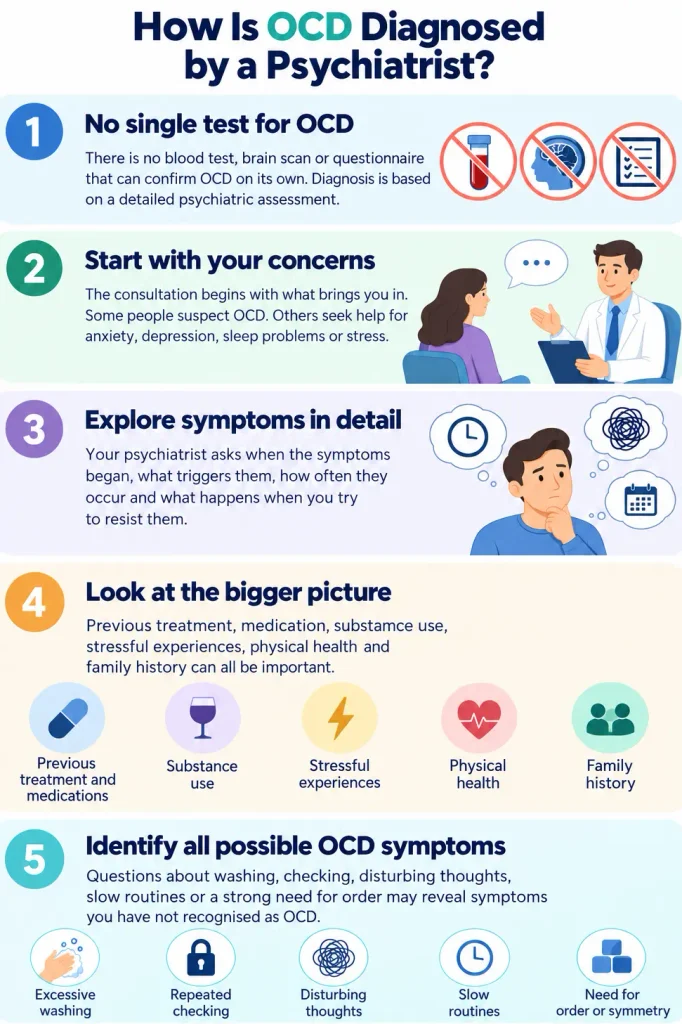
OCD is diagnosed through a comprehensive psychiatric assessment, rather than a single blood test, brain scan or questionnaire. The diagnosis is based on a detailed clinical interview, an evaluation of obsessive thoughts and compulsive behaviours, and established diagnostic criteria.
The psychiatrist explores when the symptoms first appeared, how they developed, what triggers them and how frequently they occur. Particular attention is given to intrusive thoughts, repetitive behaviours, mental rituals, avoidance and reassurance seeking. The assessment also examines how much time these symptoms consume, how difficult they are to resist and whether they interfere with work, relationships or everyday activities.
The diagnosis is made according to recognised clinical criteria, such as those outlined in the DSM-5-TR. These require the presence of obsessions, compulsions or both, accompanied by significant distress, impairment or excessive time consumption. The psychiatrist also evaluates the patient’s level of insight and determines whether the symptoms could be better explained by another psychiatric disorder, medication, substance use or a medical condition.
Differential diagnosis is an essential part of the assessment, as anxiety disorders, depression, obsessive-compulsive personality disorder and other conditions can sometimes produce similar symptoms. A careful evaluation helps establish whether OCD is present, identify co-existing conditions and determine the most appropriate direction for treatment.
What Happens During the First Consultation at CHMC Dubai?
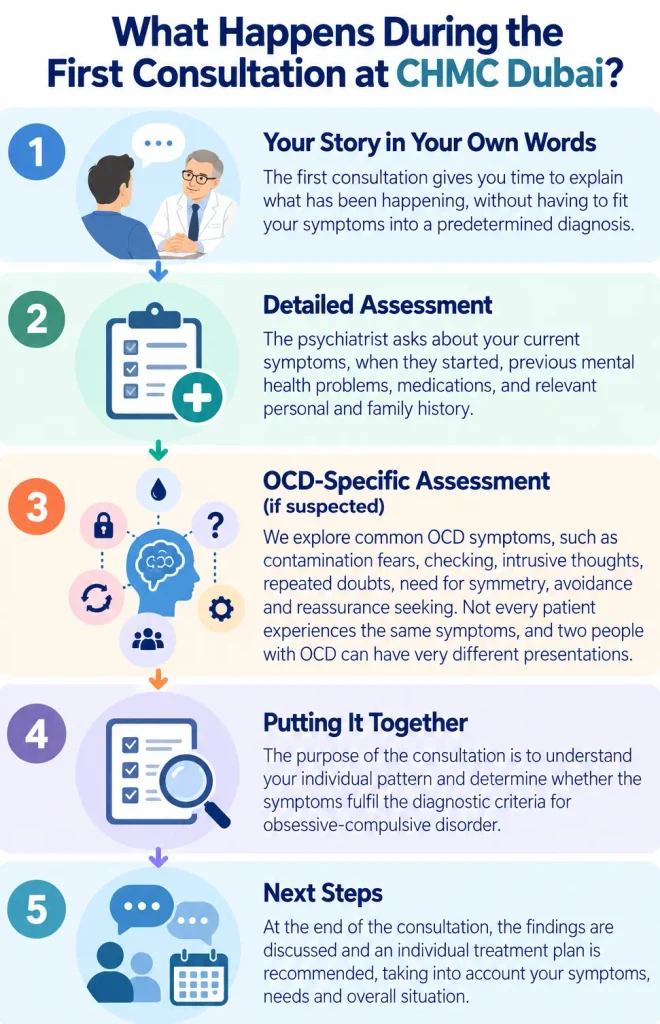
The first psychiatric consultation at CHMC German Clinic for Psychiatry and Psychology in Dubai provides patients with sufficient time to describe their difficulties in their own words. Some patients already suspect that they have OCD, while others seek help because of persistent anxiety, distressing thoughts, sleep problems or difficulties in everyday life without recognising an underlying obsessive-compulsive disorder.
The psychiatrist begins by discussing the patient’s current concerns, previous psychiatric or psychological treatment, medical history, medications and relevant personal and family circumstances. Patients are encouraged to describe their symptoms openly, including experiences they may find embarrassing, disturbing or difficult to explain.
When OCD is suspected, particular attention is given to intrusive aggressive, sexual or religious thoughts, repeated doubts, checking, washing, mental rituals, avoidance and reassurance seeking. These experiences are explored without assuming that unwanted thoughts represent the patient’s actual wishes or intentions. Patients do not need to feel ashamed of their symptoms, as understanding their individual experiences is an important part of the assessment.
Towards the end of the consultation, the psychiatrist discusses the initial findings and explains whether the symptoms suggest OCD or whether further assessment may be necessary. When the diagnosis can be established, the available treatment options and next steps are discussed with the patient. Recommendations are individualised and may include psychotherapy, medication or a combination of both, depending on the clinical situation.
When Do OCD Symptoms Become a Disorder?
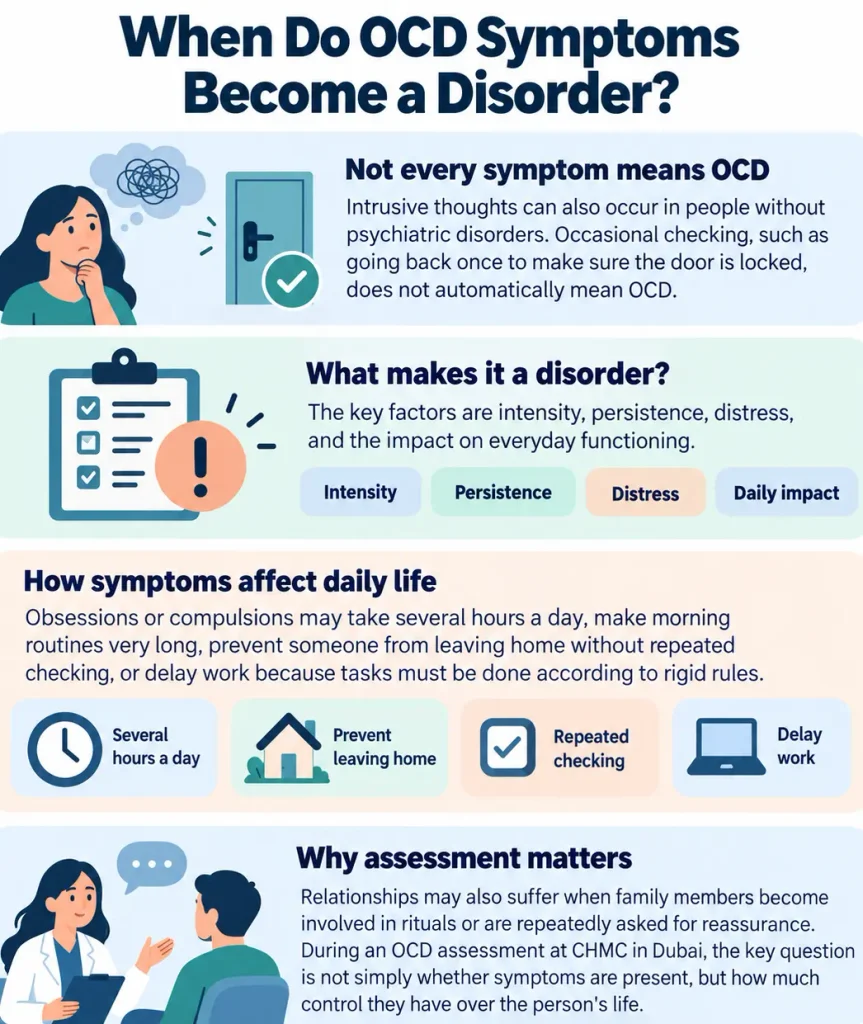
Intrusive thoughts alone do not necessarily mean that someone has OCD, as unwanted thoughts also occur in people without psychiatric disorders. The same applies to occasional checking. Returning once to make sure that the door is locked does not automatically indicate OCD.
The distinction depends on the intensity, persistence, distress, and impact of the symptoms on everyday functioning. Obsessions or compulsions may occupy several hours each day, make morning routines extremely long, prevent someone from leaving home without repeated checking, or delay work because tasks must be completed according to rigid rules.
Relationships can also suffer because partners or family members may become involved in rituals or be repeatedly asked for reassurance. The important question during an OCD assessment at CHMC in Dubai is therefore not simply whether obsessive thoughts or repetitive behaviours are present, but how much control they have over the person’s life.
The OCD Cycle
OCD often follows a characteristic cycle. An intrusive thought, image, or doubt appears and produces anxiety, guilt, disgust, or a feeling that something is wrong. The person then performs a compulsion or seeks reassurance, which temporarily reduces the anxiety.
However, this relief can reinforce the ritual. When the obsession returns, the urge to perform the compulsion becomes strong again, and over time the person may become trapped in a cycle of obsession → anxiety → compulsion → temporary relief.
Recognising this pattern can be useful during diagnosis. Some patients recognise their anxiety but do not realise that the strategies they use to reduce it have become compulsions.
Why OCD Often Remains Undiagnosed
OCD can remain undiagnosed for years because patients do not always reveal their symptoms spontaneously. This is particularly common with intrusive sexual, aggressive, religious, or morally disturbing thoughts, as patients may fear that the psychiatrist will misunderstand them or believe that having such thoughts says something about their character.
Mental compulsions are another reason OCD can be missed. Washing and checking are visible, but counting, praying, analysing memories, repeating words, or mentally neutralising thoughts happen internally and may not be recognised as compulsions by the patient.
Avoidance can hide OCD as well. Someone with contamination fears may stop using public transport, a person afraid of causing an accident may stop driving, and someone experiencing particular intrusive thoughts may avoid people or situations that trigger them.
An in-depth assessment explores not only visible rituals but also intrusive thoughts, mental compulsions, reassurance seeking, and avoidance.
The Role of Insight in OCD Diagnosis
Insight describes how clearly a person recognises that their obsessive fears may be unrealistic or excessive. Many people with OCD have good or fair insight and understand that their fear is probably exaggerated, but the anxiety remains strong enough to make them perform a ritual.
Someone may know that checking a locked door ten times is unnecessary but still find it extremely difficult to leave after checking only once. Other patients believe that their obsessive concerns are probably justified, while in severe cases a person may become convinced that the feared belief is true.
DSM-5-TR therefore distinguishes between OCD with good or fair insight, poor insight, and absent insight or delusional beliefs. Assessing insight is important because severe OCD with very poor insight can sometimes resemble a psychotic disorder.
OCD or Normal Perfectionism?
Perfectionism and OCD can sometimes look similar from the outside, particularly when both involve high standards, careful checking, or a strong preference for order. However, perfectionism and OCD are not the same.
Perfectionism is generally characterised by setting very high standards and placing considerable importance on avoiding mistakes or achieving an ideal result. A perfectionistic person may spend extra time improving their work because the outcome feels important to their self-evaluation or sense of achievement. Attention to detail, persistence and high personal standards may contribute to good performance without causing significant distress or interfering with everyday life.
OCD is driven by a different process. A person with OCD may repeatedly arrange objects, check their work or redo a task not because they are striving for excellence, but because leaving it unfinished or imperfect produces anxiety, uncertainty or an intense feeling that something is “not right”.
The distinction therefore lies less in what the person does than in why the behaviour occurs and what happens when they try not to do it. In OCD, obsessions produce anxiety, uncertainty or distress, leading to compulsions that provide temporary relief. This reinforces the OCD cycle and can gradually interfere with daily routines, work, relationships and quality of life.
Differential Diagnosis of OCD
An important part of an OCD diagnosis is determining whether the symptoms are better explained by another psychiatric or medical condition. Anxiety disorders can cause persistent worry, while depression may lead to repetitive negative thinking or rumination. ADHD can cause repeated checking because of forgetfulness, whereas checking in OCD is usually driven by intrusive doubt, anxiety, or the need to prevent a feared consequence.
OCD should also be distinguished from Obsessive-Compulsive Personality Disorder (OCPD), which is primarily associated with longstanding perfectionism, rigidity, and a strong need for control rather than typical obsessions and compulsions. Severe OCD with poor insight may sometimes need to be distinguished from psychotic disorders.
Medical conditions, medications, and substance use must also be considered when clinically relevant. For this reason, an accurate OCD diagnosis requires a comprehensive psychiatric assessment rather than relying on an isolated symptom or questionnaire.
Read more: OCD Differential Diagnosis – How OCD Differs From Anxiety, Depression, ADHD and Psychosis
Can Questionnaires Diagnose OCD?
Questionnaires and structured rating scales can support an OCD assessment but cannot establish the diagnosis on their own.
The Yale-Brown Obsessive Compulsive Scale (Y-BOCS), for example, evaluates the severity of obsessions and compulsions by examining factors such as the time they consume, the distress they cause, and how difficult they are to resist or control. Repeating the scale during treatment can also help track progress and provide a standardised measure of changes in symptom severity.
The final diagnosis remains clinical and requires evaluation of the nature of the symptoms, their impact on functioning, possible alternative diagnoses, medical factors and the patient’s overall psychiatric history.
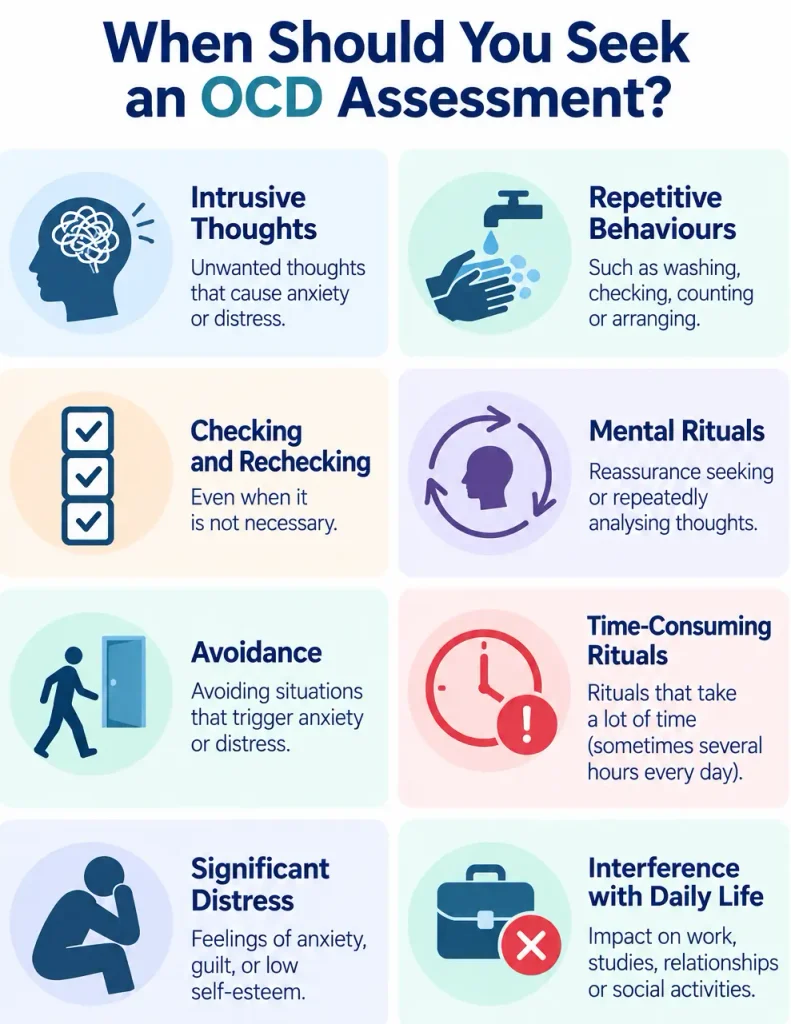
When Should You Seek an OCD Assessment?
Professional assessment may be appropriate when intrusive thoughts, repetitive behaviours, mental rituals, checking, washing, avoidance, or reassurance seeking begin to cause significant distress or interfere with everyday life. Some people recognise the problem because rituals consume several hours every day, while others spend a great deal of mental energy analysing thoughts, repeatedly seeking reassurance, or avoiding situations that trigger anxiety.
Assessment is also advisable when you recognise that a behaviour is excessive but find it extremely difficult to stop. OCD can be hidden behind problems such as arriving late because of checking rituals, taking unusually long to complete simple tasks, avoiding physical contact because of contamination fears, or experiencing persistent guilt about unwanted thoughts.
If these patterns are affecting everyday life, a professional OCD assessment in Dubai can clarify whether the symptoms are caused by obsessive-compulsive disorder or another condition and provide a clear direction for treatment.
What Information Is Helpful During an OCD Assessment?
Patients do not need extensive preparation before seeing a psychiatrist for possible OCD. However, it can be helpful to remember approximately when the symptoms began, whether they developed gradually or suddenly, and whether their severity has changed over time.
The psychiatrist will also explore the connection between intrusive thoughts and subsequent behaviours. What happens if you decide not to check again? What do you fear might happen if you do not wash your hands? Why does an action need to be repeated, and how long does the relief last after completing the ritual?
These questions help reveal the structure of the obsessive-compulsive cycle. Symptoms that may appear unrelated should also be discussed, as depression, panic attacks, general anxiety, concentration difficulties, sleep problems, substance use, and changes in everyday functioning may all contribute to the diagnostic picture.
OCD Diagnosis in Dubai at CHMC
At CHMC German Clinic for Psychiatry and Psychology in Dubai, OCD diagnosis is based on a comprehensive psychiatric assessment that considers the patient’s symptoms, personal history, level of distress and impact on everyday functioning. Particular attention is given to identifying less obvious symptoms, including mental compulsions, reassurance seeking and avoidance.
The assessment also considers possible co-existing psychiatric conditions and alternative explanations for the symptoms. This individualised approach helps establish an accurate diagnosis and provides the foundation for appropriate treatment planning.
At the end of the assessment, the psychiatrist discusses the diagnostic findings with the patient, explains whether further evaluation is necessary and outlines the recommended next steps. The aim is to provide a clear understanding of the patient’s condition and establish a reliable foundation for subsequent treatment.
If intrusive thoughts, persistent doubts or repetitive rituals are affecting your daily life, you can arrange an OCD assessment with our consultant psychiatrist at CHMC Dubai.
Book an OCD Assessment at CHMC Dubai
What Happens After an OCD Diagnosis?
Once obsessive-compulsive disorder has been diagnosed, the psychiatrist discusses the findings with the patient and explains how obsessions, compulsions and avoidance behaviours contribute to the difficulties experienced in everyday life. Understanding these mechanisms is an important first step towards effective treatment.
OCD treatment is individualised according to symptom severity, previous treatment response, co-existing psychiatric conditions and the patient’s personal circumstances and preferences. The main evidence-based approaches are cognitive behavioural therapy (CBT), particularly exposure and response prevention (ERP), and medication. Depending on the clinical situation, either approach may be recommended alone or in combination.
CBT with ERP helps patients gradually confront situations or thoughts that trigger obsessive fears while reducing the compulsive rituals and avoidance behaviours that maintain OCD. Medication, particularly selective serotonin reuptake inhibitors (SSRIs), may be recommended when symptoms are more severe, psychotherapy alone has not produced sufficient improvement or additional psychiatric conditions require treatment.
Regular follow-up is an important part of OCD treatment. The psychiatrist monitors symptom improvement, evaluates medication effectiveness and tolerability when medication is prescribed, and adjusts the treatment plan when necessary. Psychotherapy also involves applying the strategies learned during sessions to everyday situations.
The long-term goal is not only to reduce obsessive thoughts and compulsive behaviours but also to improve independence, relationships, work performance and overall quality of life.
For more information about the available treatment approaches, read our guide to OCD Treatment in Dubai.

Frequently Asked Questions About OCD Diagnosis in Dubai
How is OCD diagnosed?
OCD is diagnosed through a comprehensive psychiatric assessment, not through a single test. The psychiatrist evaluates obsessive thoughts, compulsive behaviours, mental rituals and avoidance patterns, including their frequency, severity and impact on everyday life. The diagnosis is based on recognised clinical criteria, such as those outlined in the DSM-5-TR, while also considering possible alternative explanations for the symptoms.
What are the main diagnostic criteria for OCD?
According to the DSM-5-TR, an OCD diagnosis requires the presence of obsessions, compulsions, or both. These symptoms must be time-consuming or cause clinically significant distress or impairment in everyday functioning. They must not be attributable to a substance or medical condition and must not be better explained by another mental disorder. The psychiatrist also specifies the patient’s level of insight and whether there is a current or past tic disorder.
How long do OCD symptoms need to last before diagnosis?
Unlike some other psychiatric disorders, OCD does not have a fixed minimum symptom duration required for diagnosis. The psychiatrist considers the persistence, severity and pattern of the symptoms, together with the distress and functional impairment they cause. Some people seek assessment after symptoms become noticeable, while others have experienced OCD for many years before receiving a diagnosis.
Do OCD symptoms have to take more than one hour per day?
No. The DSM-5-TR describes obsessions or compulsions taking more than one hour per day as an example of time-consuming symptoms. However, OCD may also be diagnosed when symptoms cause clinically significant distress or impairment, even if they occupy less than one hour daily. The effect on work, relationships and everyday activities is therefore an essential part of the assessment.
Is there a blood test, brain scan or online test for OCD?
No blood test, EEG, CT scan, MRI or online questionnaire can independently diagnose OCD. The diagnosis is established through a psychiatric assessment. Questionnaires, such as the Yale-Brown Obsessive Compulsive Scale (Y-BOCS), may help evaluate symptom severity and monitor changes over time. Medical investigations may be recommended when another possible cause of the symptoms needs to be examined.
Can OCD be diagnosed during the first psychiatric consultation?
Yes. In some cases, OCD can be diagnosed during the first comprehensive psychiatric consultation when the symptoms and clinical history are sufficiently clear. More complex presentations may require additional assessment, particularly when symptoms overlap with other psychiatric conditions or important information about their development remains uncertain. The priority is an accurate diagnosis rather than reaching a conclusion as quickly as possible.
Can someone have OCD without visible compulsions?
Yes. OCD may involve obsessions, compulsions, or both, and compulsions are not always visible. Some people perform mental rituals, such as silently counting, repeating phrases, reviewing memories or mentally checking whether something happened. Others repeatedly analyse intrusive thoughts or seek reassurance. Identifying these less obvious symptoms is an important part of the psychiatric assessment.
Can I have OCD even if I know my fears are irrational?
Yes. Many people with OCD recognise that their fears are exaggerated or unrealistic but still experience intense anxiety and find it difficult to resist compulsive behaviours. This is described as good or fair insight. Other patients have poor insight or strongly believe that their obsessive fears are justified. The level of insight varies and is assessed as part of the diagnosis.
How does a psychiatrist distinguish OCD from anxiety, depression or perfectionism?
The psychiatrist examines the nature of the thoughts, the reasons behind repetitive behaviours and the distress they cause. OCD typically involves obsessions and compulsions intended to reduce anxiety or prevent feared consequences. Generalised anxiety disorder is more commonly characterised by excessive worry about everyday concerns, while depression may involve persistent negative thoughts or rumination. Perfectionism, by itself, does not necessarily involve obsessive fears or compulsive rituals. A careful differential diagnosis helps distinguish these conditions and identify those that may occur together.
What happens after an OCD diagnosis at CHMC Dubai?
Following an OCD diagnosis, the psychiatrist explains the findings and discusses the severity of the symptoms and their impact on everyday functioning. An individualised treatment plan is then developed according to the patient’s clinical needs, previous treatment response and preferences. Treatment may include cognitive behavioural therapy (CBT) with exposure and response prevention (ERP), medication or a combination of both. Further details are available on our OCD Treatment in Dubai page.
Read More About OCD
- OCD Treatment
- OCD Symptoms
- OCD Diagnosis
- OCD Differential Diagnosis
- Psychiatrist for OCD
- Psychotherapy for OCD
- ERP for OCD
- OCD Medication
- Forms of OCD
- Causes of OCD
- Difference Between Perfectionism and OCD
- OCD vs OCPD: Understanding the Difference
- How to Help a Family Member with OCD
- Self-Help Strategies for OCD