

Exposure and Response Prevention (ERP) for OCD is one of the best-established treatments for obsessive-compulsive disorder. Usually delivered as part of Cognitive Behavioural Therapy (CBT), ERP directly targets the cycle of obsessions, anxiety, avoidance and compulsive behaviour that keeps OCD going.
During ERP, patients gradually approach situations, thoughts, images or feelings that trigger obsessive fear or uncertainty. At the same time, they learn to reduce the response that normally follows, such as checking, washing, repeating, avoiding, seeking reassurance or performing mental rituals.
Both parts are important. Exposure creates an opportunity to face the trigger, while response prevention helps the patient experience anxiety or uncertainty without automatically performing a compulsion. With repeated practice, the connection between obsessive fear and compulsive behaviour can gradually weaken.
ERP can be used as a primary psychotherapy for OCD or combined with other approaches. In more severe or complex cases, psychotherapy may also be combined with medication for OCD as part of an individual treatment plan.
For Exposure and Response Therapy for OCD Contact Our Specialists at CHMC:
Why Does Exposure and Response Prevention (ERP) Work for OCD?
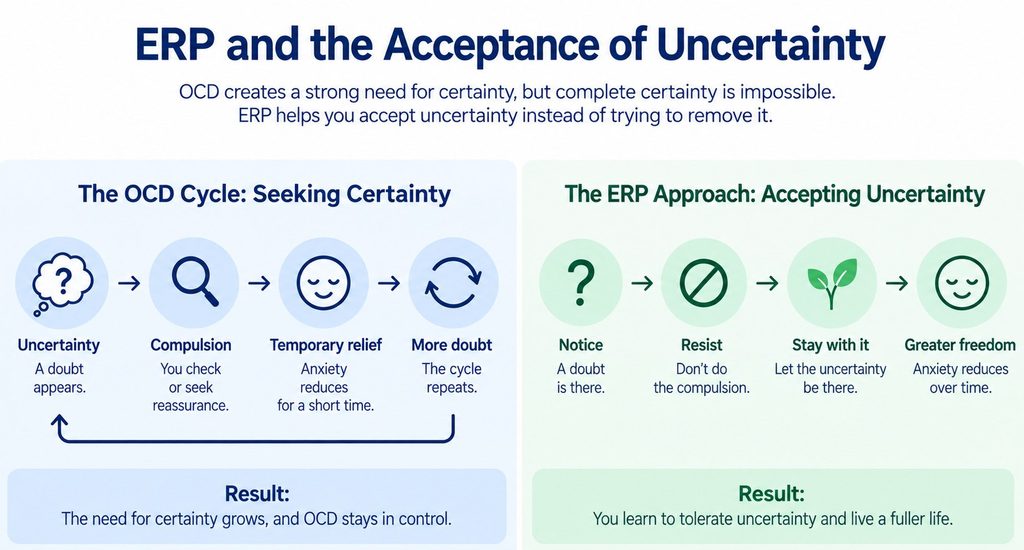
OCD is maintained by a powerful learning cycle. An intrusive thought, doubt, or external situation produces anxiety, disgust, guilt, uncertainty or another uncomfortable feeling. The person performs a compulsion or avoids the situation, and the discomfort temporarily decreases. This immediate relief is precisely what makes compulsions so persistent.
The person learns that performing the ritual apparently prevented something bad from happening or made an intolerable feeling manageable. The next time the same trigger appears, the urge to perform the compulsion becomes even stronger. ERP interrupts this learning process. The person encounters the trigger but does not respond in the usual compulsive way.
With repeated practice, a different experience becomes possible. Anxiety does not have to be immediately neutralised. Uncertainty can be tolerated. An intrusive thought can remain present without requiring action. The aim is therefore not simply to make the patient feel less anxious. It is to weaken the connection between the trigger and the compulsive response.
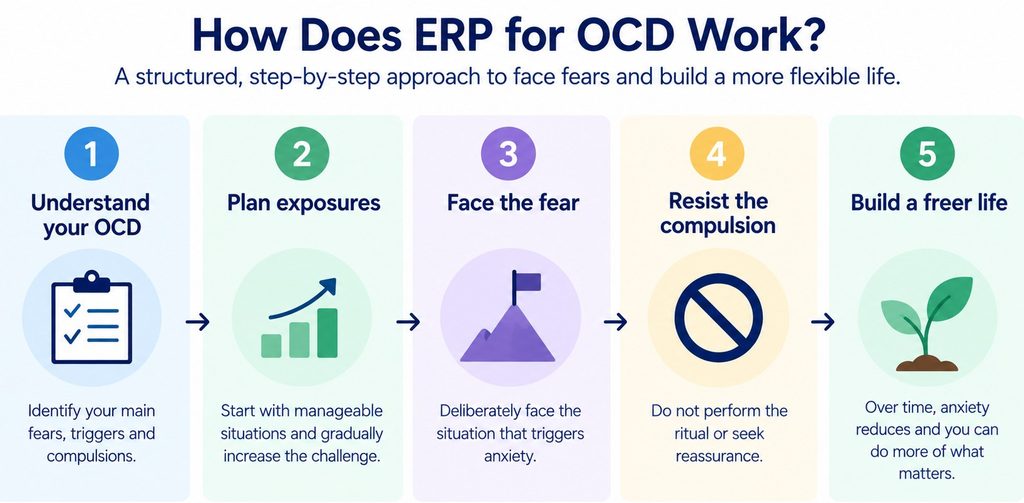
How Does ERP for OCD Work?
Exposure and Response Prevention combines two closely connected therapeutic processes. Exposure helps the patient approach the situations, thoughts or feelings that OCD has taught them to fear or avoid, while response prevention involves reducing the compulsive behaviours normally used to relieve the resulting distress. Both elements are necessary because exposure alone may reinforce the OCD cycle if the person continues to neutralise anxiety through visible or mental compulsions.
Exposure: Approaching What OCD Tells You to Avoid
Exposure means deliberately approaching situations, objects, thoughts, images or feelings that have become associated with obsessive fear. For someone with contamination OCD, an exposure might involve touching something considered contaminated. A person with checking compulsions may leave home without repeatedly checking appliances or locks. Someone who avoids certain words, numbers or situations because they feel dangerous may deliberately encounter them rather than organising everyday life around avoiding them.
The exposure must correspond to the person’s actual OCD symptoms. There is no standard exercise that works for everyone because the feared consequences differ considerably between patients. The purpose is also not to expose someone to genuinely dangerous situations. ERP targets excessive avoidance and compulsive safety behaviours generated by OCD, not reasonable precautions.
Response Prevention: The Essential Second Half of ERP
Exposure creates the opportunity for new learning, but this learning can be undermined if the person immediately performs a compulsion. This is why response prevention is central to ERP. If someone touches a feared object but washes their hands immediately afterwards, the original pattern remains largely intact. The same applies when a person resists visible checking but mentally reviews the situation repeatedly to make sure everything is safe.
Response prevention means identifying and gradually reducing the behaviours used to neutralise obsessive fears. These include obvious compulsions such as washing, checking or repeating actions, but also less visible responses such as avoidance, reassurance seeking, excessive analysing and mental rituals. Recognising these hidden forms of neutralisation is particularly important, as patients may stop one compulsion only to replace it, often without noticing, with another.
Mental Compulsions Can Interfere with ERP
Not every compulsion can be seen from the outside. A person may successfully resist washing or checking while continuing to perform elaborate rituals internally. They may repeatedly review what happened, reassure themselves that nothing bad will occur, mentally repeat certain phrases, suppress unwanted thoughts, analyse whether they are a good person or transfer responsibility to someone else.
These mental strategies can serve the same function as visible compulsions: they attempt to remove uncertainty or neutralise distress. Even when a visible ritual such as handwashing is stopped, patients may switch to mental rituals, distraction, thought suppression or attempts to transfer responsibility to the therapist. Effective ERP therefore requires careful attention not only to what the patient does but also to the less obvious strategies used to feel safe.
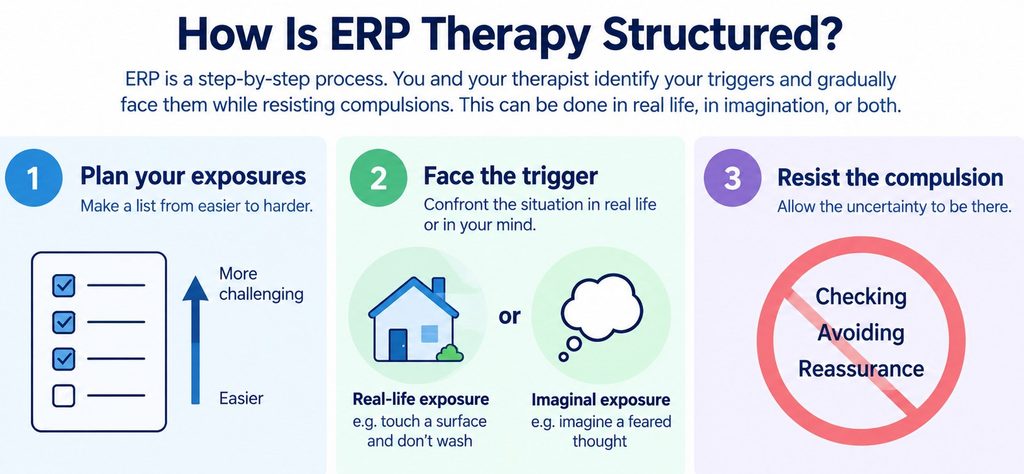
How Is ERP Therapy Structured?
Before beginning exposure exercises, the therapist and patient identify the situations, thoughts and triggers that activate OCD and examine the compulsions associated with them. Depending on the nature of the obsessive fear, treatment may involve real-life exposure, imaginal exposure or a combination of both.
Creating an Exposure Hierarchy
ERP is usually structured rather than random. Before beginning exposure exercises, therapist and patient identify the situations, thoughts and triggers that activate OCD and examine the compulsions associated with them. These triggers can then be organised into an exposure hierarchy according to how difficult or distressing they are expected to be. The purpose of the hierarchy is not simply to produce a list. It turns what may initially feel like an overwhelming problem into a series of more manageable therapeutic tasks.
Treatment does not necessarily begin with the most frightening situation. An initial exposure can be chosen at a level that is challenging enough to activate the OCD cycle but manageable enough for the patient to practise a different response. As confidence and experience increase, progressively more difficult situations can be addressed. The hierarchy is not fixed permanently. New compulsions, avoidance patterns or previously unnoticed triggers may emerge during treatment and can be incorporated into the therapeutic plan.
In Vivo Exposure
In vivo exposure means confronting the trigger in a real-life situation. For contamination fears, this may involve touching an object that the person would normally avoid. For checking OCD, it might involve leaving the house after checking the door only once rather than returning repeatedly. Real-life exposure is particularly useful when the feared situation can be reproduced safely and appropriately. It differs from imaginal exposure, in which the person confronts the feared situation, thought or consequence in their imagination rather than in the external environment.
Whenever possible, ERP eventually needs to extend beyond the therapy session. If someone can resist a ritual only while sitting with a therapist but returns immediately to compulsive behaviour at home, the therapeutic change remains limited.
Imaginal Exposure
Some obsessive fears cannot easily be recreated in real life. This is particularly relevant when OCD revolves around catastrophic future scenarios, moral responsibility, aggressive or sexual intrusive thoughts, religious fears or the possibility of causing harm. In these situations, imaginal exposure, sometimes called in sensu exposure, can be used. Instead of physically recreating the feared situation, the person deliberately confronts the feared thought or scenario in imagination. Depending on the therapeutic approach, this can involve imagining it, writing about it, reading it aloud or listening to a recording.
The purpose is not to endorse the feared event or suggest that it will happen. The objective is to stop treating the thought itself as something that must immediately be suppressed, analysed or neutralised. This can be particularly important in OCD dominated by intrusive thoughts, where the main compulsions may take place internally rather than through visible behaviour.
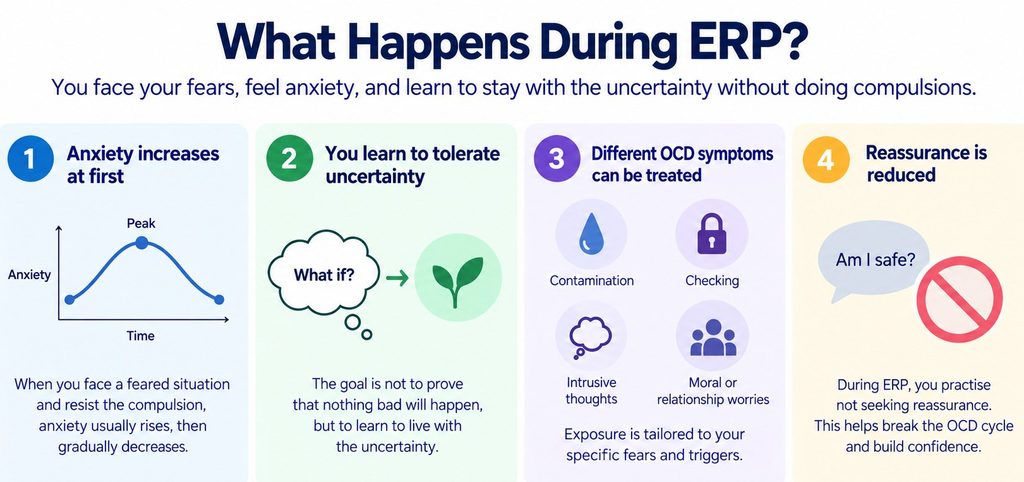
What Happens During ERP?
ERP deliberately changes the way a person responds when obsessive fear, doubt or uncertainty is activated. Distress may initially increase, but the patient practises remaining engaged with the feared experience without relying on the compulsions, reassurance or avoidance that previously provided temporary relief. The therapeutic goal is not to prove that nothing bad can happen, but to develop a different relationship with anxiety and uncertainty.
What Happens to Anxiety During Exposure?
Many patients begin ERP with the understandable expectation that confronting their triggers will make their anxiety worse. Initially, it often does. When a person approaches something they have been avoiding and simultaneously resists the usual compulsion, anxiety or tension can increase.
Traditionally, ERP has often been explained through habituation: if the person remains in contact with the trigger without performing the ritual, distress eventually reaches a peak and begins to decrease. Repeated exposure can then produce progressively less intense reactions.
However, the therapeutic objective should not become a new rule that anxiety must disappear during every exposure. Otherwise, monitoring whether anxiety has fallen sufficiently can itself become another form of control. The broader goal is learning that distress and uncertainty can be experienced without immediately escaping, neutralising or performing a compulsion.
ERP Is Not About Proving That Nothing Bad Will Happen
This is one of the most important aspects of ERP for OCD. It can be tempting to treat an exposure as an experiment designed to prove that the obsessive fear is false: “I did not check the stove and the house did not burn down, therefore I am safe.” For some anxiety disorders, this type of behavioural experiment can be useful. With OCD, however, it can easily become another search for certainty.
Many obsessive fears concern events that can never be disproved completely. A person may always think, “Yes, nothing happened this time, but what about next time?” ERP for OCD is not primarily a reality test designed to prove that the feared event can never happen. A residual “what if?” will often remain because ordinary life always contains uncertainty. ERP teaches the person to stop demanding absolute certainty before continuing with life.
Different OCD Symptoms Require Different Exposures
ERP has to be adapted to the individual form of OCD. With contamination and washing compulsions, the connection between trigger and ritual is often relatively easy to identify. The patient encounters something considered contaminated and practises not washing excessively.
Checking OCD may involve leaving appliances, doors or other situations without repeated verification. Other forms of OCD are less straightforward. Someone with aggressive intrusive thoughts may avoid knives, family members or situations in which they fear losing control. A person with religious or moral OCD may repeatedly analyse whether a thought or action was sinful or morally wrong. Someone with relationship-related obsessive doubts may repeatedly examine their feelings or seek reassurance from their partner.
In these cases, the most important therapeutic target may not be a visible ritual. It may be repeated mental analysis, reassurance seeking or avoidance of uncertainty. Good ERP therefore begins with understanding what the patient fears and what the patient does to make that fear feel safer.
Why Reassurance Seeking Matters
Reassurance can appear harmless because it often takes the form of an ordinary question. A patient may ask a partner, family member or therapist whether something is safe, whether they have done something wrong or whether an intrusive thought means something about their character. Receiving reassurance reduces anxiety temporarily. When reassurance is repeatedly used to neutralise obsessive doubt, however, it can function as a compulsion.
This creates a particular challenge for relatives. Family members understandably want to reduce the person’s distress, but repeatedly providing certainty may unintentionally become part of the OCD cycle. During ERP, patients therefore learn to recognise reassurance seeking as one of the possible responses that may need to be reduced.
Family members can also learn how to provide support without unintentionally reinforcing compulsive reassurance seeking.
Read more about how to help a family member with OCD.
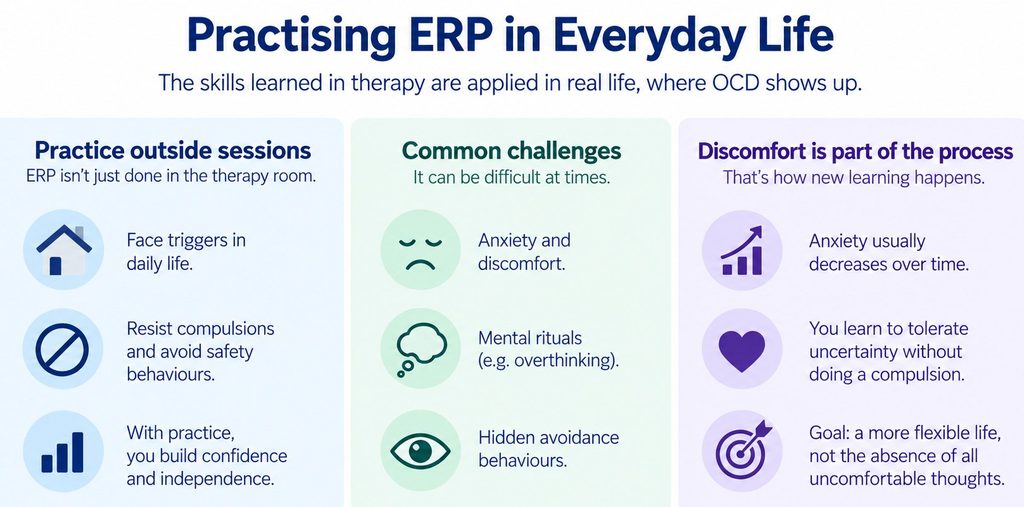
Practising ERP in Everyday Life
ERP becomes most useful when the skills developed in therapy are transferred into everyday life. Patients gradually practise approaching triggers and resisting compulsive responses outside the therapy session, where OCD normally affects their decisions and behaviour. This process can be uncomfortable and may reveal subtle avoidance strategies or hidden compulsions that need to be addressed as treatment progresses.
ERP Requires Practice Outside Therapy Sessions
ERP is not limited to exercises performed during an appointment. The OCD cycle occurs in everyday life, and this is ultimately where new responses have to become established. The exposure, reduction of avoidance and response prevention need to become part of daily life rather than something practised only during therapy sessions.
Initially, a therapist may help select exposures, identify hidden rituals and work through particularly difficult situations. Over time, the patient increasingly learns to recognise triggers and practise response prevention independently. This transition is important because the long-term objective is not dependence on the therapist. It is the ability to respond differently when OCD appears in ordinary life.
Common Difficulties During ERP
ERP can fail to produce the expected improvement when the exposure activates the fear but the underlying compulsive response remains intact. One common problem is replacing a visible compulsion with a mental one. Another is distracting oneself throughout the exposure rather than actually experiencing the uncertainty. Some patients repeatedly reassure themselves that the feared consequence will not occur. Others ask the therapist to guarantee that the exercise is safe, effectively transferring responsibility to the therapist.
Another difficulty is treating the disappearance of anxiety as the measure of whether an exposure was successful. Unpleasant emotions cannot be eliminated from life, and attempting to control them completely can become part of the obsessive pattern itself.
Perfectionism can also interfere with treatment. Patients may become concerned about whether they are performing ERP “correctly” and start analysing the exercise itself. ERP does not have to be perfect to be useful. Hidden rituals are often discovered only gradually as treatment progresses.
Is ERP Supposed to Be Uncomfortable?
ERP deliberately approaches experiences that OCD has taught the person to fear, so some discomfort is expected. However, ERP should not be understood as forcing a patient into the most frightening possible situation. Exposure exercises are planned according to the individual clinical picture and should be undertaken with the patient’s understanding and agreement.
The therapist’s role is not to remove every uncomfortable emotion during exposure. Instead, the therapist helps the patient remain engaged with the experience without returning to the compulsive strategies that previously provided temporary relief. Over time, patients learn that anxiety, disgust, guilt or uncertainty can be tolerated without immediately performing a ritual.
ERP and the Acceptance of Uncertainty
Many apparently different forms of OCD share a common problem: an excessive need for certainty. The person wants to know with complete confidence that their hands are clean, the door is locked, nobody has been harmed, they have not committed a moral error, their relationship is right or an intrusive thought does not reveal something dangerous about them.
Compulsions promise to provide this certainty but rarely succeed for long. Every answer can generate another question and every check can create a reason to check once more. ERP takes a different approach. Instead of trying to finally resolve the uncertainty, the person practises leaving the question unanswered.
This does not mean becoming careless or accepting unreasonable dangers. It means accepting the ordinary degree of uncertainty that is unavoidable in everyday life without trying to eliminate it through compulsive behaviour.
Relapse Prevention After ERP
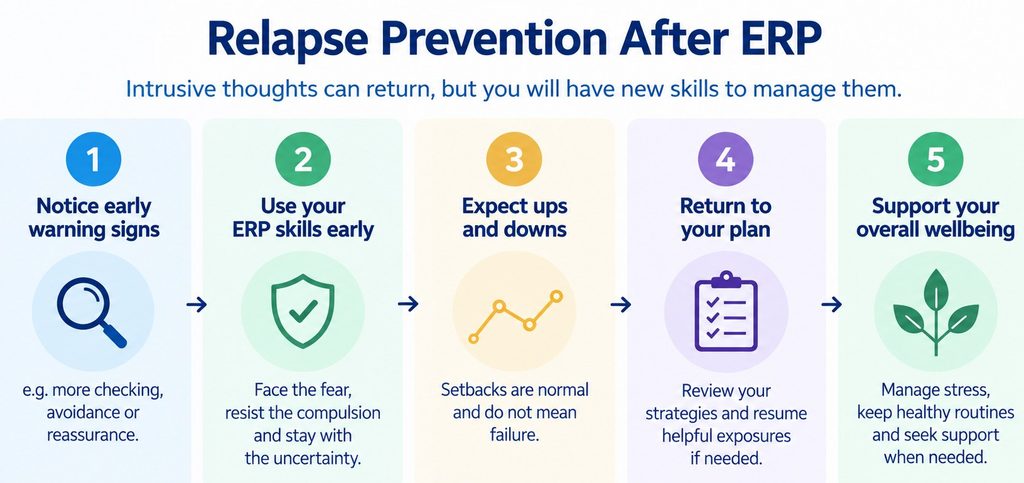
Successful ERP does not mean that an intrusive thought or compulsive urge can never return. Periods of stress or major life changes can reactivate old patterns. The important difference is that someone who has completed ERP has already learned an alternative response. Relapse prevention therefore involves recognising early signs of returning avoidance, reassurance seeking, mental rituals or compulsive behaviour and responding before these patterns become firmly established again.
Temporary setbacks do not mean that treatment has failed or that previous progress has been lost. When old triggers become problematic again, ERP strategies can be resumed or intensified to prevent compulsive patterns from regaining control.
How Effective Is ERP for OCD?
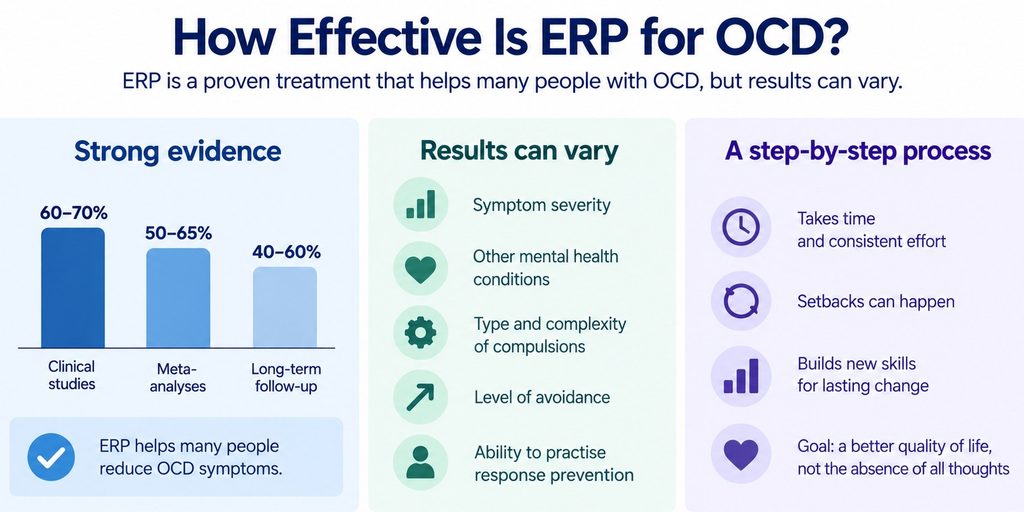
ERP is one of the best-established psychological treatments for obsessive-compulsive disorder. Its effectiveness has been demonstrated in controlled clinical studies and meta-analyses, making ERP a central evidence-based treatment for OCD, particularly when integrated with cognitive therapeutic approaches.
Treatment outcome nevertheless varies. Severity, co-existing psychiatric conditions, the nature of the compulsions, the degree of avoidance and the patient’s ability to practise response prevention can all influence progress. ERP should therefore be understood as an effective treatment method rather than a mechanical exercise that produces identical results in every patient.
ERP and Medication
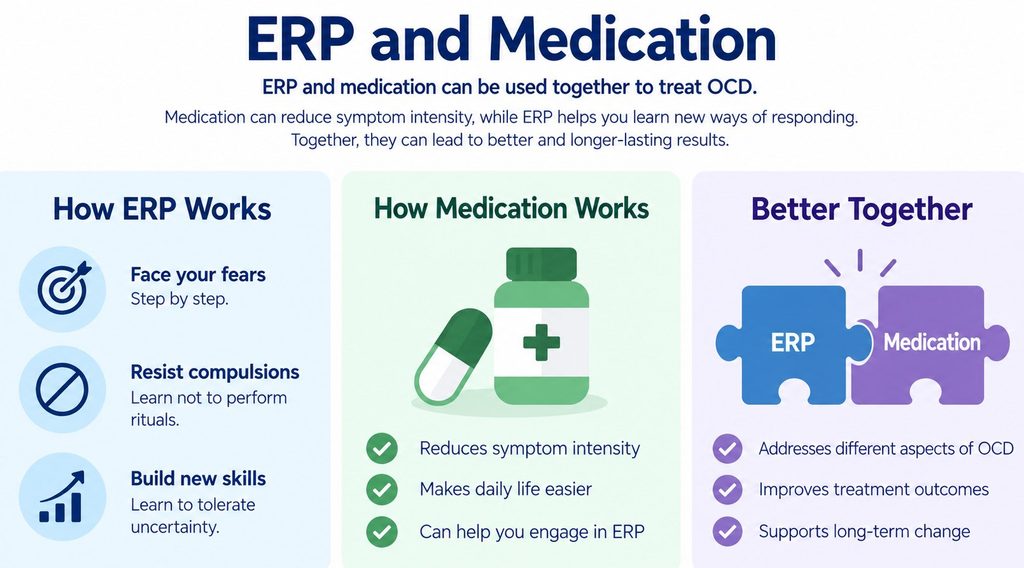
ERP can be used as the main treatment for OCD or as part of a treatment plan that also includes medication. For more severe OCD, medication may reduce symptom intensity sufficiently to make active participation in ERP easier. Conversely, ERP addresses behavioural and psychological patterns that medication alone does not directly retrain.
Whether medication for OCD is needed depends on the severity of the condition, previous treatment response, co-existing psychiatric conditions and the individual clinical situation. The decision is therefore made as part of the broader treatment plan rather than being an inherent part of ERP itself.
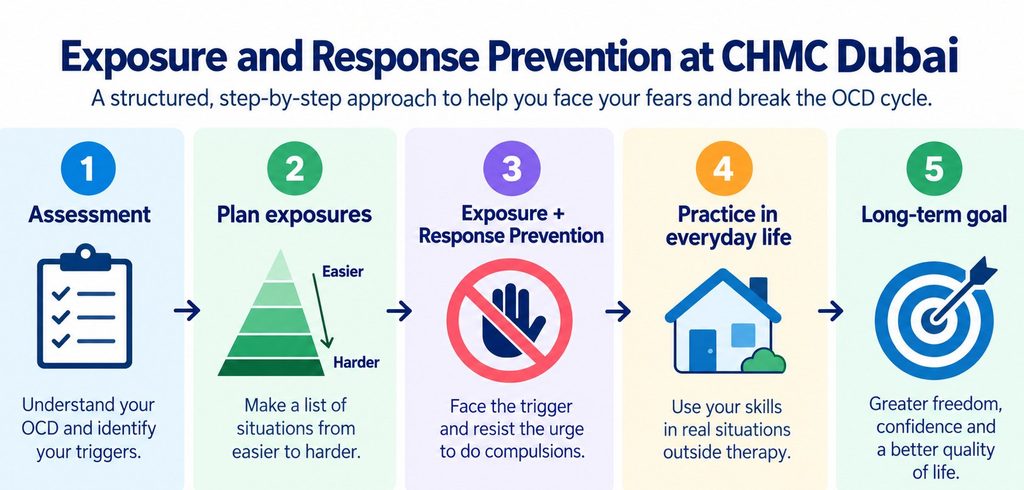
Exposure and Response Prevention at CHMC Dubai
At CHMC German Clinic for Psychiatry and Psychology, we provide Exposure and Response Prevention (ERP) for OCD in Dubai as part of an individualised psychiatric and psychotherapeutic treatment plan.
ERP begins with an assessment of the patient’s individual obsessive fears, compulsions, avoidance patterns, reassurance seeking and mental rituals. The purpose is to identify the specific cycle that maintains the symptoms before exposure exercises are planned.
Where ERP is appropriate, triggers can be organised according to their difficulty and used to develop an individual exposure hierarchy. Treatment may involve real-life or imaginal exposure depending on the nature of the OCD. Particular attention is given to response prevention because visible compulsions are often only part of the problem. Mental rituals, reassurance seeking and subtle forms of avoidance may also need to be identified and addressed.
The exercises are gradually transferred from the therapeutic setting into everyday life. The objective is not simply to complete increasingly difficult exposures. It is for the patient to become progressively less dependent on compulsions as a way of managing intrusive thoughts, distress and uncertainty.
ERP forms part of the broader psychotherapy for OCD and may be combined with cognitive methods or medication when clinically appropriate. The treatment plan depends on the severity and characteristics of the OCD as well as the patient’s wider psychiatric and psychological situation.
Key Takeaway
Exposure and Response Prevention works by changing the way a person responds to obsessive fear. Instead of avoiding a trigger or attempting to neutralise an intrusive thought, the person approaches the feared experience while reducing the compulsive response. Repeated practice weakens the established connection between obsessions, distress and rituals.
The goal is not to achieve absolute certainty, eliminate every intrusive thought or guarantee that anxiety will never return. It is to learn that uncertainty and uncomfortable emotions can be experienced without allowing OCD to dictate what happens next.

Read More About OCD
- OCD Treatment
- OCD Symptoms
- OCD Diagnosis
- OCD Differential Diagnosis
- Psychiatrist for OCD
- Psychotherapy for OCD
- ERP for OCD
- OCD Medication
- Forms of OCD
- Causes of OCD
- Difference Between Perfectionism and OCD
- OCD vs OCPD: Understanding the Difference
- How to Help a Family Member with OCD
- Self-Help Strategies for OCD