

OCD symptoms include recurring unwanted thoughts, persistent doubts and repetitive behaviours or mental rituals that are difficult to control. The two main features of obsessive-compulsive disorder are obsessions and compulsions. Common symptoms include excessive checking, repeated washing, intrusive thoughts, counting, reassurance seeking and the need for order or symmetry.
Some OCD symptoms are immediately noticeable, while others remain hidden because the person performs mental rituals rather than visible actions. Symptoms can range from relatively mild difficulties to severe distress that interferes with work, education, relationships and everyday life.
Understanding the different ways in which the disorder can present is an important first step towards diagnosing and seeking appropriate treatment for OCD.
For OCD Assessment Contact Our Consultant Psychiatrist:
What Are the Symptoms of OCD?
The two main symptoms of OCD are obsessions and compulsions. Most people with obsessive-compulsive disorder experience both, although one may be much more noticeable than the other.
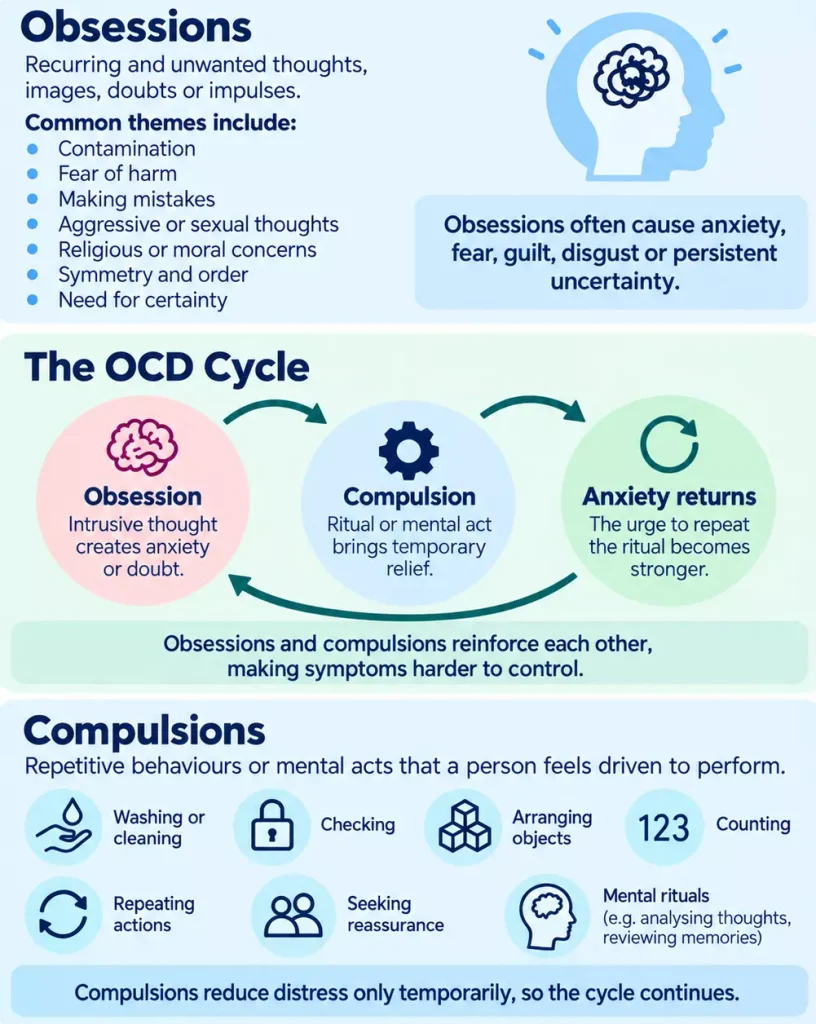
Obsessions are recurring and unwanted thoughts, images, doubts or impulses that enter the mind and are difficult to dismiss. They commonly produce anxiety, fear, guilt, disgust or persistent uncertainty. Common OCD obsessions involve contamination, responsibility for harm, making mistakes, aggressive or sexual thoughts, religious or moral concerns, symmetry, order and the need for certainty.
Compulsions are repetitive behaviours or mental acts that a person feels driven to perform, usually in response to an obsession. They are intended to reduce distress, gain reassurance or prevent a feared event. Common OCD compulsions include excessive washing or cleaning, repeated checking, arranging objects, counting, repeating actions, seeking reassurance and performing mental rituals.
Obsessions and compulsions reinforce each other in an OCD cycle. Obsessive thoughts create anxiety or doubt, while compulsions provide only temporary relief. When anxiety returns, the urge to repeat the ritual strengthens, making symptoms increasingly persistent. OCD is therefore more than excessive tidiness or perfectionism. Compulsions may involve visible rituals such as washing or checking, or mental processes such as repeatedly analysing thoughts, reviewing memories or seeking absolute certainty.
When Normal Thoughts and Behaviours Become OCD
Most people occasionally experience unwanted thoughts or double-check something important. A person leaving home may briefly wonder, “Did I turn off the cooker?” They might check once, feel reassured and continue with their day. This alone is not a sign of OCD. For someone with OCD, the same doubt may become persistent. They check the cooker but remain uncertain. After leaving the apartment, the doubt returns: perhaps they did not look carefully enough. They go back and check again. Even after several checks, they may still be unable to achieve a lasting sense of certainty.
The important difference is not simply the act of checking but the intensity of the doubt, the repeated need for certainty and the difficulty stopping the behaviour. The compulsion temporarily reduces anxiety without resolving the underlying obsession. When uncertainty returns, the person feels driven to check again. This pattern can develop around many different themes, including contamination, mistakes, responsibility, relationships, morality, religion, sexuality, health or fears of harming another person.
What distinguishes OCD from ordinary worries and habits is the repetitive nature of the symptoms, the distress they cause and the extent to which they interfere with everyday life. Many people with OCD recognise that their fears or rituals are excessive. However, understanding rationally that a fear is unlikely does not remove the emotional need to obtain certainty or perform the compulsion.
Common OCD Obsessions
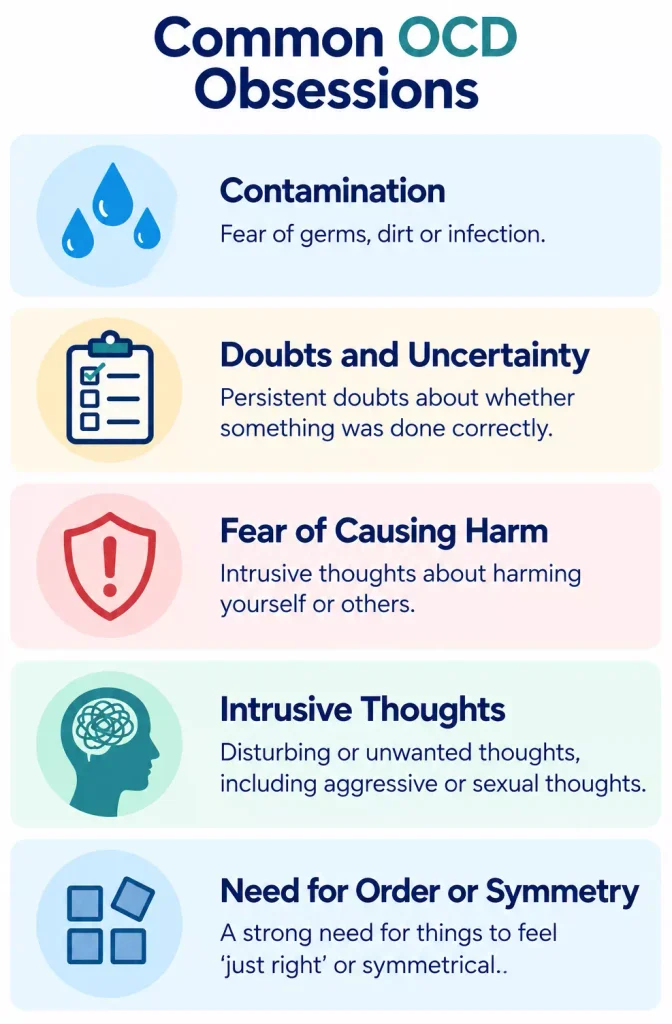
OCD obsessions are recurring, unwanted thoughts, images, doubts or impulses that enter the mind involuntarily and cause distress. They often conflict with a person’s values or intentions. For example, someone who would never intentionally hurt another person may experience disturbing images of causing harm. Others may struggle with unwanted sexual or religious thoughts that feel completely inconsistent with their beliefs.
Because these thoughts are distressing, people with OCD may attach excessive importance to them and question what they mean. They may worry that having a particular thought reveals something about their character or increases the likelihood of a feared event.
Common obsession themes include contamination, responsibility for harm, making mistakes, intrusive aggressive or sexual thoughts, religious or moral concerns, and the need for order or symmetry. Although their content varies, these obsessions typically involve persistent uncertainty and repeated attempts to obtain reassurance or prevent a feared consequence.
Intrusive Thoughts in OCD
Intrusive thoughts occur in many people, including those without OCD. They may be unpleasant, disturbing or completely inconsistent with a person’s values. The difference lies primarily in how these thoughts are interpreted and how the person responds to them.
Someone without OCD may notice a disturbing thought and allow it to pass. A person with OCD may become preoccupied with understanding why it occurred or whether it reveals something dangerous about their intentions. Questions such as “What if I lose control?” or “What does this thought say about me?” can become persistent sources of anxiety.
In response, the person may repeatedly analyse the thought, review memories, monitor emotional reactions or seek reassurance. These mental rituals provide temporary relief but can increase attention to the unwanted thought and maintain the obsessive-compulsive cycle. Importantly, an unwanted aggressive or sexual thought does not, by itself, indicate a wish or intention to act on it.
Contamination OCD and Fear of Contamination
Fear of contamination is one of the most common and recognisable OCD symptoms. Contamination obsessions may involve germs, viruses, bodily fluids, dirt or other substances that the person believes could cause illness, harm or contamination. In contamination OCD, the perceived threat can extend far beyond reasonable concerns about hygiene. Touching a door handle, for example, may create an intense feeling of being contaminated.
Contamination fears are not always driven by fear of infection or illness. Some people experience intense disgust or a persistent feeling that an object, place or part of their body is somehow dirty or unclean, even when they recognise that there is little or no objective risk. As the perceived contamination spreads, the person may increasingly avoid certain objects, places or people. They may also feel compelled to wash, clean or decontaminate themselves and their surroundings.
Harm OCD and Fear of Causing Harm
Fear of causing harm is another common form of OCD obsession. The person may become excessively concerned that something they did, or failed to do, could cause an accident, injury or other serious consequence. Someone may repeatedly doubt whether they switched off an electrical appliance and fear that it could cause a fire. Another person may worry that they left a tap running and could be responsible for flooding a building. The possibility continues to feel threatening even when the person remembers checking and there is no evidence that anything is wrong.
A characteristic example is hit-and-run OCD. While driving, a person may suddenly wonder whether they could have hit a pedestrian without noticing. A bump in the road, an unexpected sound or simply passing a pedestrian may trigger intense doubt. Despite having no evidence that an accident occurred, the person may struggle to dismiss the possibility and may feel compelled to retrace the route or search for reassurance.
At the centre of many harm-related OCD symptoms is an exaggerated sense of responsibility combined with difficulty accepting ordinary uncertainty. The person wants complete certainty that nobody has been harmed. Because absolute certainty is rarely possible, the doubt repeatedly returns.
Common OCD Compulsions
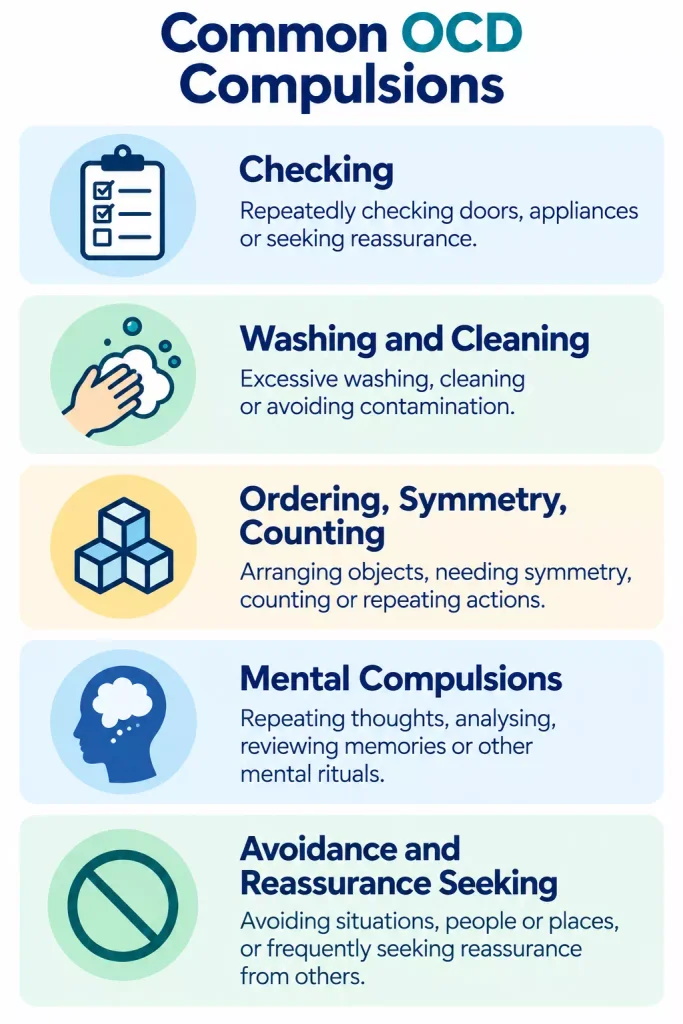
Compulsions are repetitive behaviours or mental rituals that a person with OCD feels driven to perform. They usually develop in response to an obsession and are intended to reduce anxiety, gain certainty or prevent a feared consequence. From the person’s perspective, performing the compulsion may feel necessary even when they recognise that it is excessive.
In some cases, they understand that there is little or no realistic connection between the ritual and what they are trying to prevent. Nevertheless, resisting the compulsion can produce considerable anxiety, tension or doubt. OCD compulsions can be visible behaviours or entirely mental rituals. Some follow strict rules. An action may need to be performed in a particular order, repeated a specific number of times or continued until it feels “just right.” If the ritual is interrupted, the person may feel compelled to start again.
Checking Compulsions
Repeated checking is one of the most common OCD compulsions. It is usually driven by persistent doubt and the need to prevent mistakes, danger or harm. A person may repeatedly check doors, electrical appliances or windows before leaving home. Similar rituals can occur at work, where emails, documents or completed tasks are reviewed many times because of fears about making mistakes.
Although checking initially reduces anxiety, the reassurance rarely lasts. Repeating the same action may even weaken confidence in what was previously checked, creating further uncertainty and another urge to repeat the ritual. As a result, simple activities can become unnecessarily time-consuming and interfere with work, punctuality and everyday life.
Washing and Cleaning Compulsions
Washing and cleaning compulsions commonly occur in people with contamination-related OCD. A person may wash their hands repeatedly, shower for unusually long periods, change clothes frequently or clean objects and areas of the home according to rigid rules. These rituals may have to be performed in a particular sequence or repeated until the person feels sufficiently clean or safe. If they believe they touched something contaminated during the process, they may feel that the entire cleaning routine has been invalidated and needs to begin again.
In more severe contamination OCD, washing and cleaning can occupy substantial parts of the day. Excessive handwashing or showering may also cause physical consequences, including irritated, cracked or damaged skin. The rituals can extend beyond the individual.
Ordering, Symmetry, Counting and Repeating
Not every compulsion is related to contamination or checking. Some people experience a strong need for objects to be arranged in a particular way. Items on a desk, shelves or furniture may have to be positioned precisely, and moving something can create considerable discomfort until the arrangement is corrected. Others repeatedly count or perform an action a particular number of times before it feels complete. Words, movements and ordinary activities may also have to be repeated according to specific internal rules.
Some rituals appear unrelated to the feared consequence. A person may believe that stepping on a crack, using a particular number or performing actions in the wrong sequence could somehow cause something bad to happen to a loved one. This pattern is sometimes referred to as magical thinking. For other people, there may be no clearly defined feared consequence. Instead, they experience a powerful feeling that something is incomplete or “not right” and repeat or rearrange an action until the uncomfortable sensation disappears.
Mental Compulsions and “Hidden” OCD
Not all OCD compulsions are visible. Some people perform elaborate mental rituals while appearing calm and unaffected to others. These may include silently counting, repeating phrases, reviewing memories, mentally checking past events or attempting to replace disturbing thoughts with reassuring ones.
For example, someone experiencing an aggressive intrusive thought may repeatedly analyse whether they could lose control. Another person may spend hours reviewing a conversation to determine whether they said something inappropriate or caused offence. Although these rituals take place internally, they can be just as exhausting and time-consuming as visible compulsions.
Because mental rituals are difficult for others to recognise, OCD may remain undetected for years, even when symptoms significantly affect the person’s emotional well-being and everyday functioning.
Avoidance and Reassurance Seeking
Avoidance and repeated reassurance seeking can also maintain OCD symptoms. Someone with contamination fears may avoid public transport or touching objects in public places. A person with aggressive intrusive thoughts may avoid certain situations because they fear what their thoughts could mean. Others may postpone decisions or responsibilities to avoid the possibility of making mistakes.
Avoidance can provide immediate relief because the feared situation is temporarily removed. However, it prevents the person from learning to tolerate uncertainty, and everyday activities may become increasingly restricted.
Reassurance seeking follows a similar pattern. Repeatedly asking whether a door is locked or whether something was done correctly may briefly reduce anxiety, but the doubt soon returns. As reassurance becomes a repeated response to uncertainty, it can function as a compulsion and reinforce the OCD cycle.
How OCD Symptoms Affect Daily Life
The severity of OCD is determined not only by the type of obsession or compulsion but also by the distress, time consumed and disruption to everyday life. Some people spend several hours each day dealing with intrusive thoughts, repeated checking or mental rituals. Ordinary activities such as leaving home, reading, completing work or sending emails may take considerably longer than necessary.
OCD can also affect relationships and social life. Family members may become involved in rituals or repeatedly provide reassurance to reduce the person’s anxiety. Avoidance, embarrassment and fear of triggering symptoms can gradually lead to social withdrawal. In severe cases, OCD may substantially interfere with education, employment, relationships and independent living.
Shame and Hiding OCD Symptoms
Many people with OCD feel embarrassed or ashamed of their symptoms, particularly when intrusive thoughts involve aggression, sexuality, religion or morality. They may fear that others will misunderstand these thoughts or interpret them as reflecting their actual wishes and intentions.
As a result, some patients conceal their compulsions, avoid discussing distressing thoughts or develop explanations for unusually time-consuming activities. Someone may continue working and maintaining relationships while privately spending hours managing obsessions and mental rituals. The absence of obvious symptoms therefore does not necessarily mean that OCD is mild.
OCD Symptoms by Age and Gender
Obsessive-compulsive disorder (OCD) can develop at different ages and affects both men and women. Although the underlying symptoms are similar, their presentation may vary depending on age, personal circumstances and individual experiences. Obsessions and compulsions may also change over time. What matters most is the distress they cause and their impact on everyday functioning.
OCD Symptoms in Adults
In adults, OCD often interferes with work, relationships and daily responsibilities. Some people repeatedly check their work, struggle to make decisions or spend excessive time completing ordinary tasks. Others experience intrusive thoughts or mental rituals that remain unnoticed by colleagues, friends and family members.
Many adults develop ways of hiding or accommodating their symptoms, particularly when OCD has been present for years. As a result, someone may appear to function normally while privately spending considerable time managing obsessive thoughts, anxiety and compulsive behaviours.
OCD Symptoms in Women and Men
The core symptoms of OCD are essentially the same in women and men. Both may experience contamination fears, repeated checking, intrusive aggressive or sexual thoughts, mental rituals, reassurance seeking and concerns about order or symmetry.
However, the content of obsessive thoughts may reflect individual circumstances. For example, pregnancy, parenthood or concerns about a child’s safety may become themes of OCD. Some patients experience considerable shame about aggressive, sexual or religious intrusive thoughts and may avoid disclosing them because they fear being misunderstood.
These differences are not strictly related to gender. A careful psychiatric assessment focuses on the nature of the obsessions and compulsions, the distress they cause and their effect on daily life rather than whether particular symptoms are considered typical of men or women.
OCD Symptoms in Children and Teenagers
OCD can begin in childhood or adolescence. Common symptoms include repeated washing, checking, counting, ordering and asking the same questions repeatedly. Young people may take unusually long to complete homework, prepare for school or go to bed because they feel compelled to follow particular rules or rituals.
Children and teenagers may find it difficult to explain their obsessive thoughts or recognise their behaviour as excessive. Parents can gradually become involved in compulsions by providing repeated reassurance, checking things for their child or participating in rituals. OCD may also interfere with concentration, school performance, friendships and family life.
How OCD Symptoms Can Change Over Time
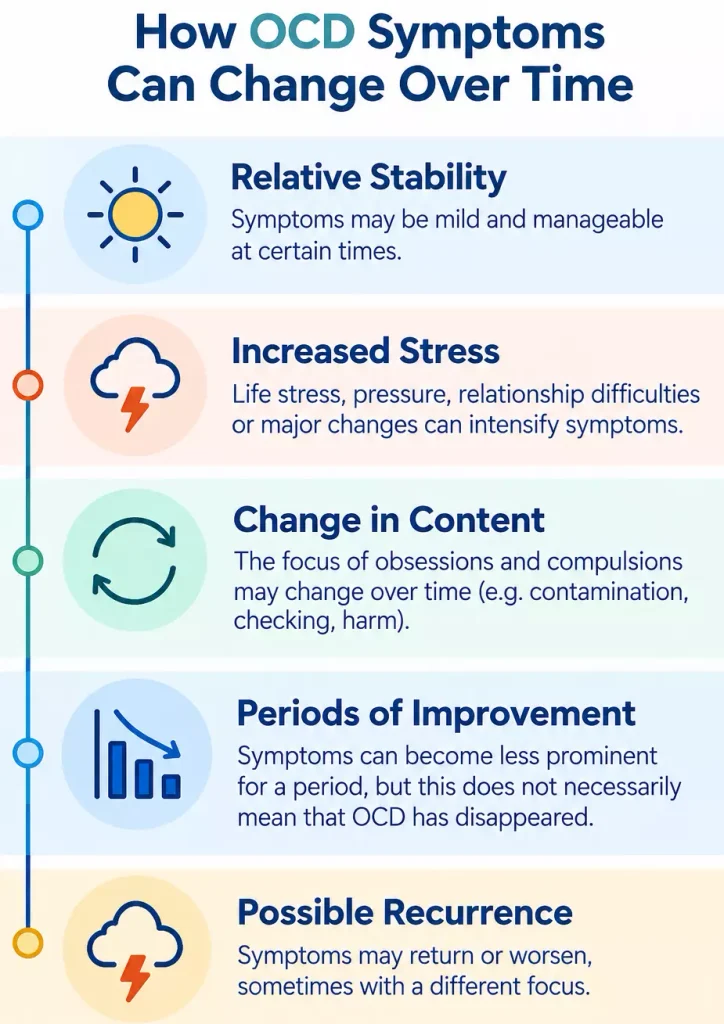
OCD symptoms can change over time, both in their intensity and in their content. At some stages of life, symptoms may be relatively manageable, while at others they can become more intrusive and time-consuming. Some people experience periods of substantial improvement followed by a recurrence or worsening of symptoms.
The content of OCD can also change. Someone who previously struggled mainly with contamination fears may later develop repeated checking or obsessions involving responsibility for harm. Although the theme has changed, the underlying pattern may remain the same: an intrusive thought or doubt creates anxiety or uncertainty, followed by compulsions or other attempts to gain certainty and reduce distress.
Periods of increased stress can make OCD symptoms more prominent. Professional pressure, relationship difficulties or major life changes may increase intrusive thoughts and strengthen the urge to perform compulsions. Rituals that previously occupied a relatively small part of the day may gradually become more time-consuming.
Stress does not explain every case of OCD, but it can influence symptom severity. Understanding these fluctuations is important because an improvement or change in symptoms does not necessarily mean that OCD has disappeared. The disorder can become less noticeable for a period and become more prominent again later.
OCD and Other Mental Health Conditions
OCD does not always occur alone. Depression, anxiety, and tic disorders can occur alongside obsessive-compulsive disorder, and some patients have symptoms associated with other conditions within the obsessive-compulsive spectrum.
Anxiety is naturally a prominent feature of OCD because obsessions frequently produce fear, tension, and uncertainty. However, OCD and anxiety disorders are not the same condition. Distinguishing between them can be important when establishing the correct diagnosis.
Some people with OCD also have repetitive movements or vocalisations associated with tic disorders. These may include blinking, facial movements, movements of the head or shoulders, throat clearing, sniffing, or other repetitive sounds.
Co-existing conditions can also influence how OCD appears. A person with both OCD and depression, for example, may become increasingly withdrawn and lose motivation while also spending substantial amounts of time dealing with obsessions and compulsions.
When several types of symptoms occur together, a comprehensive psychiatric assessment can differentiate whether OCD symptoms are present, whether another condition could better explain them and whether several disorders are occurring at the same time.
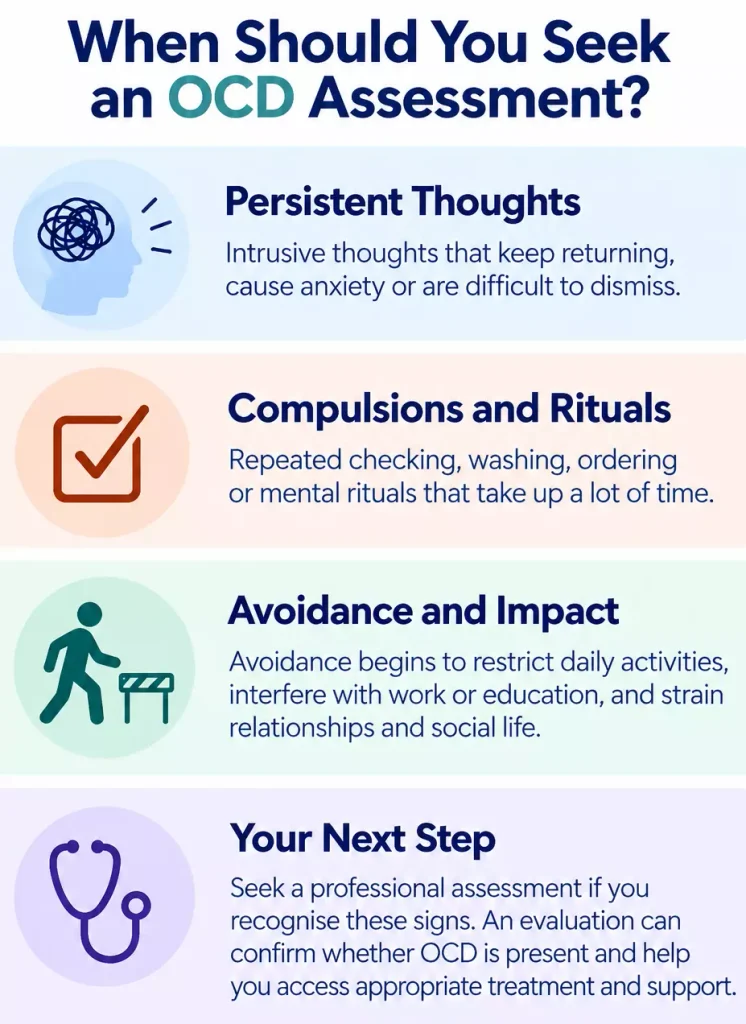
When Should You Seek an OCD Assessment?
Not every repetitive thought or habit indicates OCD. Most people occasionally double-check something important, worry about contamination or experience an unwanted thought. The important question is whether these experiences have become persistent, distressing, time-consuming and difficult to control.
An OCD assessment should be considered when intrusive thoughts repeatedly return despite attempts to dismiss them, when rituals consume increasing amounts of time or when avoidance begins to restrict normal activities. Assessment may also be appropriate when reassurance from other people is repeatedly needed or when everyday tasks take much longer because they must be performed according to rigid rules.
Possible warning signs include excessive washing or cleaning, repeated checking, distressing thoughts, unusually long periods needed to complete everyday activities, and persistent concerns about order or symmetry. Mental rituals, repeated reassurance seeking and extensive avoidance can be equally important even though they may be less visible.
The effect on everyday life is particularly important. A professional assessment considers how symptoms affect work or education, relationships, social activities, independence and quality of life rather than looking only at whether an individual obsession or compulsion is present.
Seeking an assessment can be especially important when symptoms are being hidden because of embarrassment. Intrusive aggressive, sexual or religious thoughts can feel frightening, but discussing them openly with a psychiatrist can help determine whether they are part of OCD and whether treatment is needed.
Frequently Asked Questions About OCD Symptoms
What are the most common symptoms of OCD?
The main symptoms of OCD are obsessions and compulsions. Obsessions are recurring, unwanted thoughts, images, doubts or impulses that cause distress. Compulsions are repetitive behaviours or mental rituals that a person feels driven to perform to reduce this distress or prevent a feared outcome.
Common symptoms include contamination fears, excessive washing or cleaning, repeated checking, intrusive aggressive or sexual thoughts, concerns about order and symmetry, counting, repeating, mental rituals and reassurance seeking.
However, OCD can take many forms. A person does not need to have cleaning or checking compulsions to have obsessive-compulsive disorder.
How do I know whether a thought is an OCD thought?
An obsessive thought in OCD is typically unwanted, repetitive and difficult to dismiss. It may cause significant anxiety, guilt, disgust, fear or uncertainty and can conflict strongly with the person’s actual beliefs, intentions and values.
This is one reason aggressive, sexual or religious obsessions can be particularly distressing. The person does not want the thought and may make considerable efforts to understand why it occurred or prove that it does not reflect who they are.
The reaction to the thought is therefore important. Someone with OCD may repeatedly analyse the thought, monitor their reactions, avoid situations associated with it, seek reassurance or perform mental or behavioural rituals to feel safe again.
Does Having Violent Intrusive Thoughts Mean I Am Dangerous?
Not necessarily. Aggressive intrusive thoughts can occur as part of OCD and should not automatically be interpreted as an intention to act. In OCD, people are often deeply frightened by these thoughts precisely because they conflict with what they want and with their personal values.
However, thoughts about harming oneself or others can occur in different clinical situations. If there is uncertainty about their nature, a psychiatric assessment is important to distinguish OCD-related intrusive thoughts from thoughts associated with other mental health conditions or an actual intention to cause harm.
Can You Have OCD Without Visible Compulsions?
Yes. Some OCD compulsions are entirely mental and therefore invisible to other people. A person may silently count, repeat phrases, review memories, replace disturbing thoughts with “safe” thoughts or mentally check whether a feared event occurred.
Another person may repeatedly analyse an intrusive thought in an attempt to determine what it “really means.” Reassurance seeking and avoidance may also be less obvious than traditional washing or checking rituals.
This is one reason OCD can remain unnoticed by relatives, friends and colleagues. The absence of visible rituals does not mean that compulsions are absent.
Is Repeated Checking Always a Sign of OCD?
No. Checking something once or twice can be completely normal, particularly when the consequences of a mistake could be important.
In OCD, checking becomes repetitive, difficult to resist and disproportionate to the actual risk. More importantly, checking fails to provide lasting certainty. A person may look at a locked door, know that it is locked and still feel compelled to check it again.
Repeated checking becomes clinically significant when it causes substantial distress, consumes excessive amounts of time or interferes with everyday functioning.
Why Do People With OCD Keep Performing Rituals When They Know They Don’t Make Sense?
Because understanding something rationally and feeling certain about it are not always the same thing. A person may know that washing their hands again is unnecessary but still experience intense contamination anxiety. Another may know that the cooker is switched off while feeling unable to leave home without checking it again.
Performing the ritual temporarily reduces anxiety, tension or uncertainty. This short-term relief reinforces the behaviour, making the person more likely to repeat the ritual when the obsession returns. Trying to resist a compulsion can initially increase anxiety and tension, which helps explain why simply deciding to stop the ritual can be extremely difficult.
Can OCD Symptoms Become Severe?
OCD ranges from relatively mild symptoms to severe symptoms that occupy many hours of the day. Severe obsessions, compulsions and avoidance can make an ordinary daily routine extremely difficult. OCD may interfere with work, education, relationships, social activities and independent living. In particularly severe cases, a person may become increasingly isolated or unable to complete essential everyday activities.
For this reason, the severity of OCD should not be judged only by how unusual a particular thought or ritual sounds. The amount of distress, time consumed and impairment in everyday functioning are often much more important indicators of severity.

Read More About OCD
- OCD Treatment
- OCD Symptoms
- OCD Diagnosis
- OCD Differential Diagnosis
- Psychiatrist for OCD
- Psychotherapy for OCD
- ERP for OCD
- OCD Medication
- Forms of OCD
- Causes of OCD
- Difference Between Perfectionism and OCD
- OCD vs OCPD: Understanding the Difference
- How to Help a Family Member with OCD
- Self-Help Strategies for OCD