

Psychotherapy for OCD helps patients understand and change the psychological processes that maintain obsessive thoughts, compulsions, avoidance and reassurance seeking. OCD treatment focuses not only on the symptoms themselves but also on how a person interprets intrusive thoughts and responds to the anxiety, doubt or uncertainty they create.
Obsessive-compulsive disorder can become deeply embedded in everyday life. A person may recognise that repeatedly checking a door, washing their hands, avoiding certain situations or asking others for reassurance is excessive, yet still feel unable to stop. These behaviours often provide temporary relief, which can unintentionally reinforce the obsessive-compulsive cycle and make the same response more likely the next time anxiety occurs.
The best-established psychological treatment for OCD is Cognitive Behavioural Therapy (CBT), particularly Exposure and Response Prevention (ERP). Treatment helps patients gradually face obsessive fears while reducing the compulsions, avoidance and reassurance seeking that maintain them. Cognitive approaches also address patterns such as excessive responsibility, perfectionism and difficulty tolerating uncertainty.
Other psychotherapeutic techniques can be integrated when clinically appropriate. Acceptance-based methods can help patients develop a different relationship with intrusive thoughts, while psychodynamic psychotherapy may address underlying emotional conflicts, self-criticism, relationship patterns or other psychological difficulties that accompany OCD.
The goal of psychotherapy for OCD is not to eliminate every unwanted thought or achieve complete certainty. It is to help patients respond differently to obsessive thoughts and compulsive urges, reduce their influence on behaviour and regain greater freedom in everyday life.
For Assessment and Therapy of OCD Contact Our Specialists at CHMC:
How Psychotherapy for OCD Targets the OCD Cycle
To understand how psychotherapy for OCD works, it is helpful to first understand why OCD symptoms such as obsessive thoughts and compulsive behaviours become persistent. OCD is maintained by a cycle involving intrusive thoughts, threatening interpretations, anxiety or uncertainty and attempts to reduce that discomfort. The following sections explain the main psychological mechanisms and why checking, avoidance and reassurance can unintentionally strengthen the disorder.
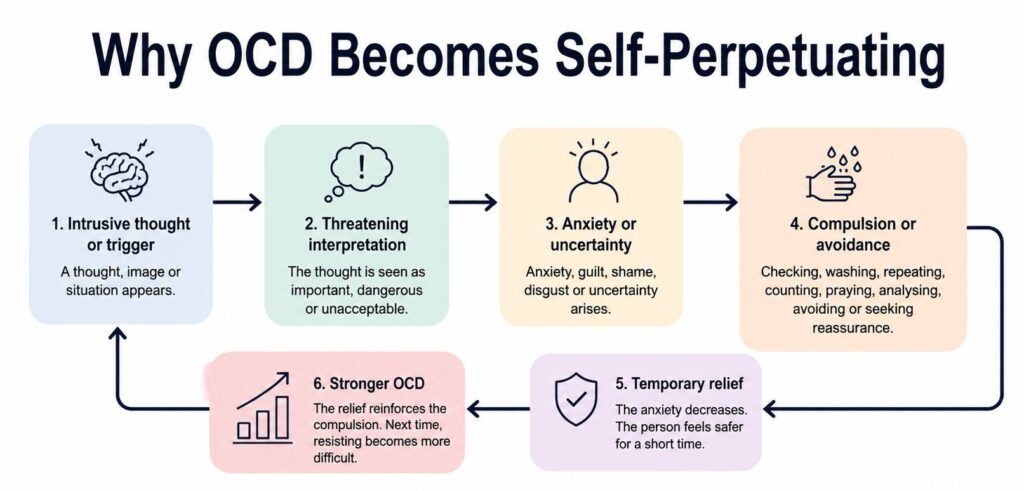
Why OCD Becomes Self-Perpetuating
Intrusive thoughts are not unique to OCD. People without the disorder can also experience sudden thoughts or images involving contamination, violence, sexuality, mistakes, accidents, religion or other disturbing subjects. The important difference is often what happens after the thought appears. Most people eventually allow an unusual thought to pass. Someone with OCD may interpret it as important or threatening. They may wonder why it occurred, whether it reveals something about their character or whether failing to respond could make them responsible for harm.
This interpretation can produce anxiety, guilt, shame, disgust, or an intense feeling of uncertainty. The person then tries to reduce the discomfort through checking, washing, repeating, counting, praying, analysing, avoiding situations or seeking reassurance. These strategies often provide temporary relief. However, the relief can reinforce the compulsive behaviour. The person learns that performing the ritual apparently restored safety. When the next intrusive thought occurs, resisting the compulsion becomes more difficult.
The OCD cycle can therefore be understood as:
intrusive thought or trigger → threatening interpretation → anxiety or uncertainty → compulsion or avoidance → temporary relief → stronger OCD
Psychotherapy for OCD aims to interrupt this cycle rather than simply suppress its visible symptoms.
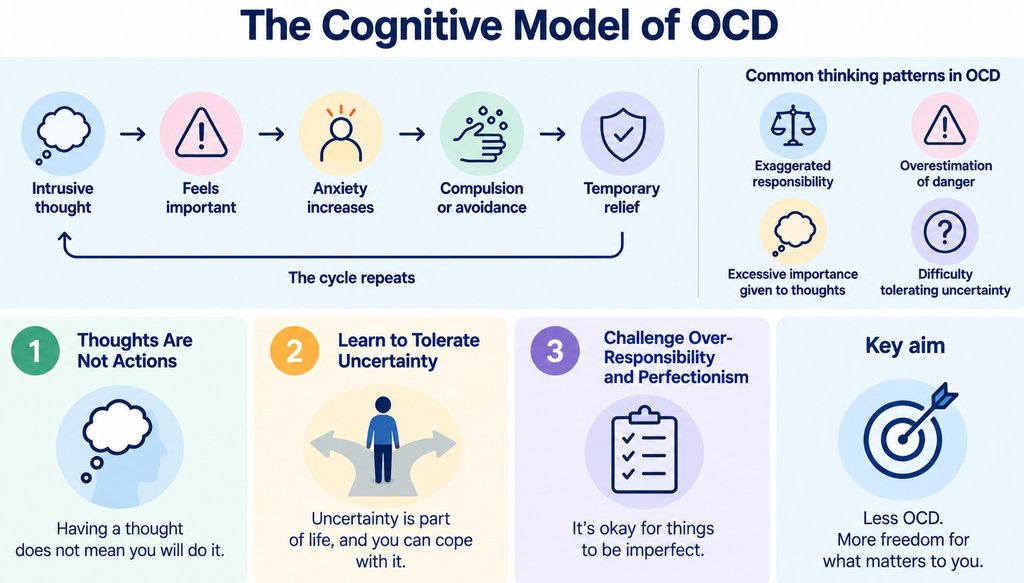
The Cognitive Model of OCD
The cognitive model proposes that OCD is maintained partly by the meaning assigned to intrusive experiences. A disturbing thought becomes more powerful when it is interpreted as evidence of danger, responsibility or moral significance. Someone experiencing an unwanted aggressive thought may wonder whether having the thought means they could act on it. Another person may believe that failing to check something perfectly would make them responsible if an accident occurred. Someone with contamination fears may feel unable to continue with everyday activities without complete certainty that nobody has been exposed to danger.
Common cognitive patterns in OCD include exaggerated responsibility, overestimation of danger, perfectionism, excessive importance given to thoughts, distrust of memory and difficulty tolerating uncertainty. Cognitive therapy does not simply reassure patients that nothing bad will happen. Reassurance may reduce anxiety briefly, but another doubt can quickly take its place. Instead, patients learn to question unrealistic assumptions about responsibility, danger and certainty while becoming less dependent on reassurance.
Thoughts Are Not Actions
A common problem in OCD is assigning excessive significance to thoughts. Someone experiencing an unwanted image of harming another person may interpret it as evidence that they are dangerous. A person with religious obsessions may believe that an unwanted blasphemous thought says something important about their morality.
This can lead to constant monitoring, suppression, and analysis of thoughts. Attempts to prevent a thought can make it more prominent because the person must continually check whether the thought is present. Psychotherapy therefore does not aim to eliminate intrusive thoughts. Patients learn to distinguish between having a thought and performing an action. A disturbing mental event can be acknowledged without requiring analysis, reassurance or neutralisation.
This is particularly important because compulsions are not always visible. Someone may stop physically checking a door but continue mentally reviewing whether it was locked. Another person may stop asking relatives for reassurance but spend hours analysing conversations or memories. Recognising these mental compulsions is an important part of psychotherapy for OCD.
Learning to Tolerate Uncertainty
Many forms of OCD involve a strong need for certainty. OCD repeatedly suggests that one more check, one more wash or one more mental review will finally remove the doubt. Instead, each attempt to achieve complete certainty can reinforce the belief that certainty is necessary.
Psychotherapy gradually reverses this pattern. Patients learn to distinguish reasonable everyday precautions from compulsive attempts to eliminate all uncertainty. This does not mean becoming careless. It means recognising that ordinary life always involves some uncertainty and learning to continue without repeatedly neutralising it through rituals, avoidance or reassurance.
Excessive Responsibility and Perfectionism
Many people with OCD apply unusually strict standards to themselves. A minor mistake may feel like complete failure. The possibility of accidentally causing harm may feel almost equivalent to actually causing it. An unwanted thought may even be interpreted as evidence of moral failure.
Cognitive psychotherapy helps patients recognise these patterns and develop more flexible ways of evaluating responsibility, risk and imperfection. The aim is not to replace every frightening thought with a reassuring one. It is to reduce the influence obsessive doubt has over behaviour.
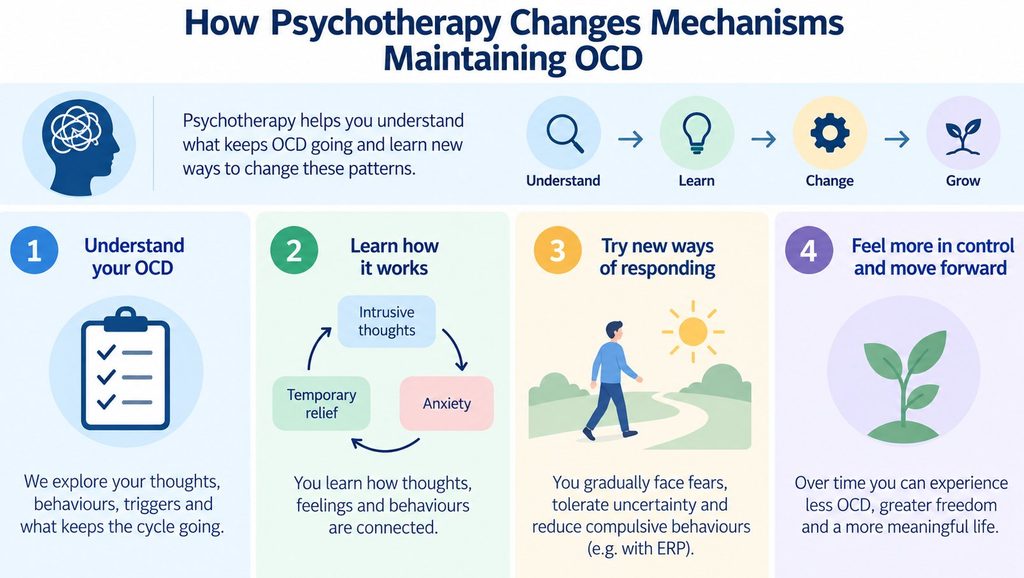
How Psychotherapy Changes Mechanisms Maintaining OCD
Once the mechanisms maintaining OCD have been identified, psychotherapy focuses on changing them. Treatment helps patients recognise compulsive patterns, reconsider how they interpret intrusive thoughts and develop greater tolerance of anxiety and uncertainty. Different therapeutic approaches can contribute to this process, although evidence-based CBT and ERP remain central when treating core obsessive-compulsive symptoms.
Assessment and Individual Understanding of OCD
Effective psychotherapy begins with understanding the individual patient’s OCD. Two people may both have checking compulsions while the fears behind them are very different. One may fear causing a fire, another may fear being blamed for negligence, while someone else may be unable to tolerate the feeling that an action has not been completed correctly.
The OCD assessment explores how the patient’s obsessions, compulsions, avoidance, reassurance seeking, triggers and underlying fears interact. The therapist also explores what happens when symptoms appear and what the patient does to reduce the resulting discomfort.
This process can reveal behaviours that the patient may not initially recognise as compulsions, such as reviewing memories, comparing feelings, repeatedly researching a feared subject or asking subtle questions to obtain reassurance. Identifying these patterns allows treatment to focus on the mechanisms maintaining the patient’s OCD.
Psychoeducation and Understanding the OCD Cycle
Psychoeducation helps patients apply the OCD cycle described above to their own symptoms. Rather than learning the model only in theory, patients identify their individual triggers, interpretations, anxiety and compulsive responses.
This can be particularly important for people who interpret intrusive thoughts as evidence that something is fundamentally wrong with them. Understanding that the thought itself is not the central problem can help patients focus instead on how they interpret and respond to it. This understanding prepares patients for the practical changes required during psychotherapy.
Exposure and Response Prevention (ERP) in Psychotherapy for OCD
Exposure and Response Prevention (ERP) is an evidence-based component of CBT for OCD. Patients gradually approach situations, thoughts or feelings that trigger obsessive fears while reducing the compulsive responses normally used to relieve anxiety or uncertainty. The purpose is not simply to provoke anxiety. Patients learn through experience that difficult thoughts, feelings and uncertainty can be tolerated without automatically performing a ritual.
ERP is adapted to the individual form of OCD. The practical use of exposure exercises, response prevention and exposure hierarchies is discussed separately in our guide to Exposure and Response Prevention for OCD. Within psychotherapy for OCD, ERP is an important method for translating psychological understanding into behavioural change.
Read more about Exposure and Response Prevention (ERP)
Acceptance Rather Than Thought Suppression
People with OCD often spend considerable energy trying not to think about particular subjects. They may attempt to suppress aggressive images, sexual thoughts, religious doubts, contamination concerns or fears about mistakes. Thought suppression can have the opposite effect. Monitoring the mind for an unwanted thought repeatedly directs attention back to it.
Psychotherapy therefore encourages a different relationship with intrusive experiences. Instead of trying to eliminate every unwanted thought, patients learn that a thought can be present without determining what they do next. This principle is also used in mindfulness-based approaches and Acceptance and Commitment Therapy (ACT).
These approaches can help patients gain psychological distance from obsessive thoughts and reduce the struggle to control internal experiences. Acceptance does not mean agreeing with an intrusive thought or believing that a feared event will happen. It means allowing the thought to exist without automatically suppressing, analysing or neutralising it.
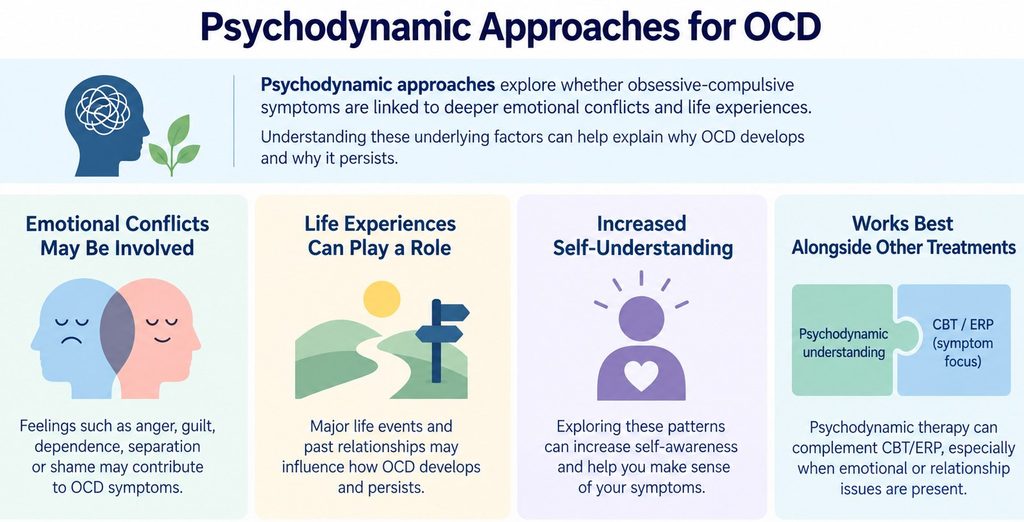
Psychodynamic Approaches for OCD
Psychodynamic approaches explore whether obsessive-compulsive symptoms are connected with broader emotional conflicts involving aggression, guilt, dependency, separation, shame or emotional control. For example, a person may understand that an aggressive obsession does not mean they are violent but still experience intense guilt whenever they feel ordinary anger toward someone they love. Another person may use perfectionism and compulsive control to manage feelings of inadequacy.
Psychodynamic psychotherapy may also explore ambivalence. Love can coexist with anger, closeness with a desire for independence, and admiration with resentment. Some patients find such emotional contradictions difficult to tolerate and respond with an increased need for certainty and control. OCD symptoms may also intensify during major life transitions involving separation, marriage, parenthood, loss or increasing independence. Exploring these patterns can help explain why symptoms become stronger during particular periods.
However, understanding why OCD developed is not necessarily enough to change it. Past experiences or emotional conflicts may have contributed to the symptoms, while present-day checking, avoidance, reassurance seeking and mental rituals continue to maintain them. Psychodynamic understanding can therefore complement OCD treatment when significant emotional or interpersonal difficulties are present. It should not replace symptom-focused CBT when the main objective is reducing obsessions and compulsions.
Integrating Different Approaches to Psychotherapy for OCD
Different psychotherapeutic approaches can address different aspects of OCD. Cognitive therapy examines beliefs about danger, responsibility, perfection and certainty. Behavioural treatment changes the responses that reinforce obsessive fears. Acceptance-based approaches reduce the struggle to control unwanted thoughts and feelings. Psychodynamic psychotherapy can address emotional conflicts, relationship patterns, shame, guilt and self-esteem difficulties when these are clinically relevant.
The treatment hierarchy should remain clear. Evidence-based psychotherapy for OCD should directly address the mechanisms maintaining obsessions and compulsions. Additional approaches can be incorporated when psychological or interpersonal difficulties extend beyond the core OCD symptoms. The central clinical question is therefore not whether one school of psychotherapy is universally better than another. It is which mechanisms are maintaining the individual patient’s OCD and which additional psychological problems also require treatment.
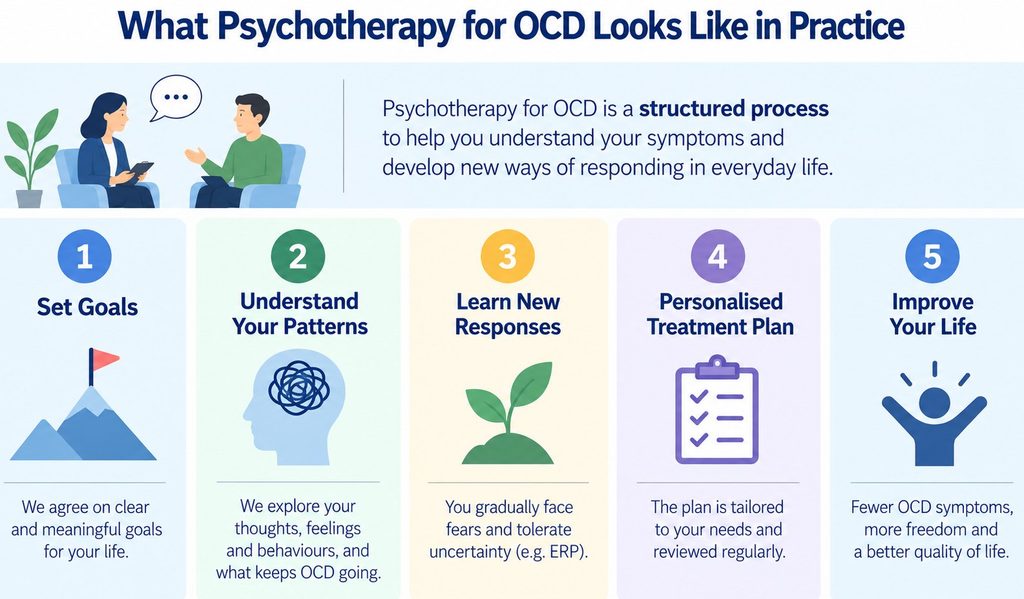
What Psychotherapy for OCD Looks Like in Practice
Psychotherapy for OCD is not limited to discussing thoughts and feelings during therapy sessions. Treatment involves identifying the patient’s individual patterns, setting practical goals and applying therapeutic strategies in everyday situations. The process may also involve family members or address other psychiatric conditions when these interfere with recovery.
Setting Individual Treatment Goals
Psychotherapy for OCD should begin with clear and realistic treatment goals. Reducing symptoms is important, but treatment should also focus on how OCD interferes with everyday life. For one patient, the main goal may be leaving home without repeatedly checking doors or electrical appliances. Another may want to reduce excessive washing, stop asking family members for reassurance or spend less time analysing intrusive thoughts. Others may want to return to work, improve relationships or make decisions without hours of obsessive doubt.
These goals help translate treatment into measurable changes in daily functioning. The objective is usually not to eliminate every unwanted thought or uncomfortable feeling. Instead, psychotherapy helps patients reduce compulsive responses and regain activities that OCD has restricted.
Identifying Obsessions, Compulsions and Avoidance
An important part of psychotherapy for OCD is identifying the full range of symptoms. Some compulsions are obvious, such as washing, checking, arranging or repeating actions. Others are less visible. Mental reviewing, counting, repeating phrases internally, analysing memories or trying to determine whether a thought was meaningful can also function as compulsions.
Avoidance is equally important. A person with contamination fears may avoid public places. Someone with aggressive obsessions may avoid knives or being alone with family members. A patient with religious OCD may avoid situations that trigger unwanted thoughts.
These behaviours can reduce anxiety temporarily but also prevent the patient from learning that feared thoughts and uncertainty can be tolerated. Treatment therefore examines not only what the patient fears, but also what the patient does because of that fear.
Recognising Reassurance Seeking
Reassurance seeking is common in OCD and can easily be overlooked. A patient may repeatedly ask a partner whether the door was locked, whether something was cleaned properly or whether an action could have caused harm. More subtle forms include repeatedly describing an event while waiting for confirmation that nothing inappropriate happened.
Reassurance may also come from internet searches, online forums or repeated medical consultations. The problem develops when reassurance becomes a repetitive strategy for reducing obsessive doubt. Psychotherapy helps patients recognise this pattern and gradually become less dependent on external confirmation.
Developing a Treatment Plan
Once the main symptoms and maintaining mechanisms have been identified, the therapist and patient can develop an individual treatment plan. The plan should reflect the patient’s specific obsessions, compulsions, avoidance patterns and level of impairment. It should also consider depression, anxiety, personality factors, relationship difficulties and other psychiatric conditions when these are present.
Treatment priorities may change over time. A patient who initially focuses on visible checking rituals may later recognise that mental reviewing or reassurance seeking has become the main problem. For this reason, psychotherapy for OCD is not a fixed sequence of exercises. Treatment is adjusted according to progress and the difficulties that emerge during therapy.
Working Between Therapy Sessions
Much of the therapeutic change in OCD takes place outside the consulting room. Patients need opportunities to practise new responses in the situations where OCD normally occurs. This may involve reducing rituals, approaching avoided situations, tolerating uncertainty or noticing an intrusive thought without analysing it.
The exact exercises depend on the individual treatment plan. They should be challenging enough to promote change but realistic enough to be practised consistently. Regular practice is important because OCD has often been reinforced over months or years. New responses also require repetition before they become easier.
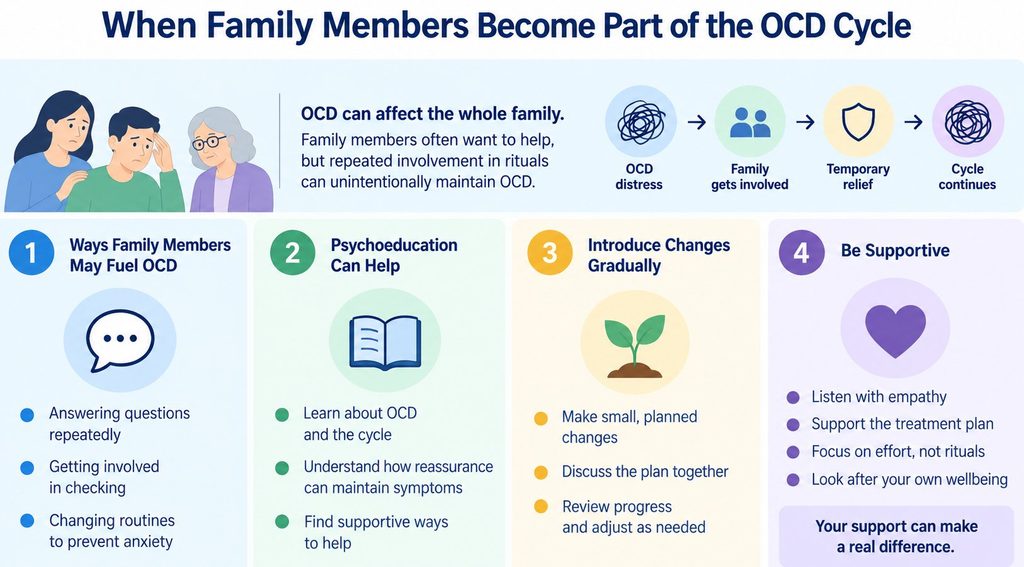
When Family Members Become Part of the OCD Cycle
OCD can affect the entire family. Partners, parents or other relatives may become involved in rituals without initially recognising what is happening. They may repeatedly answer questions, check things on the patient’s behalf, change household routines or avoid particular situations to prevent anxiety. This behaviour is understandable. Family members of OCD patients usually want to reduce the patient’s distress. However, repeated participation in compulsions can unintentionally help maintain OCD.
When appropriate, psychotherapy may include psychoeducation for partners or family members. They can learn how to provide emotional support without repeatedly providing reassurance or participating in rituals. Changes should usually be introduced gradually. Abruptly refusing all reassurance without understanding the treatment plan can create unnecessary conflict and distress.
For more detailed guidance for partners and relatives, see How to Help a Family Member with OCD.
Treating OCD When Other Psychiatric Problems Are Present
OCD frequently occurs together with other psychological or psychiatric problems. Depression, anxiety disorders, panic symptoms, ADHD, eating disorders and personality difficulties can influence both the severity of OCD and the course of psychotherapy. Depression can reduce motivation and make therapeutic exercises more difficult. Severe anxiety may increase avoidance. Attention problems can interfere with structured therapeutic work. Longstanding interpersonal or personality patterns may require additional attention beyond the core OCD symptoms.
A comprehensive treatment plan therefore considers the whole clinical picture rather than treating every symptom as part of OCD. This does not mean that all problems need to be addressed at the same time. The therapist and patient determine which difficulties require priority and how different elements of treatment should be combined.
Combining Psychotherapy and Medication for OCD
Psychotherapy and medication for OCD are not competing treatments. For some patients, psychotherapy for OCD is sufficient. Others benefit from combining psychotherapy with medication, particularly when symptoms are severe or substantially interfere with everyday functioning. Medication can reduce the intensity of obsessive-compulsive symptoms and may make it easier for some patients to participate in psychotherapy.
However, medication does not replace the psychological work of recognising compulsive patterns and learning different responses to obsessive thoughts and uncertainty. The decision to use medication depends on symptom severity, previous treatment, co-existing psychiatric conditions and the individual patient’s clinical situation. When psychotherapy and medication are combined, they should form part of one coordinated treatment strategy.
Patients who want to understand the pharmacological options in more detail can read our guide to Medication for OCD.
How Long Does Psychotherapy for OCD Take?
There is no single duration that applies to every patient. Treatment length depends on the severity and complexity of OCD, how long symptoms have been present, the amount of avoidance and the presence of additional psychiatric or psychological problems. The patient’s ability to practise therapeutic strategies between sessions also influences progress.
Some patients respond to a relatively focused course of treatment. Others require longer psychotherapy, particularly when OCD is severe, longstanding or accompanied by depression, personality difficulties or major interpersonal problems. Progress should therefore be evaluated clinically rather than by counting a predetermined number of sessions.
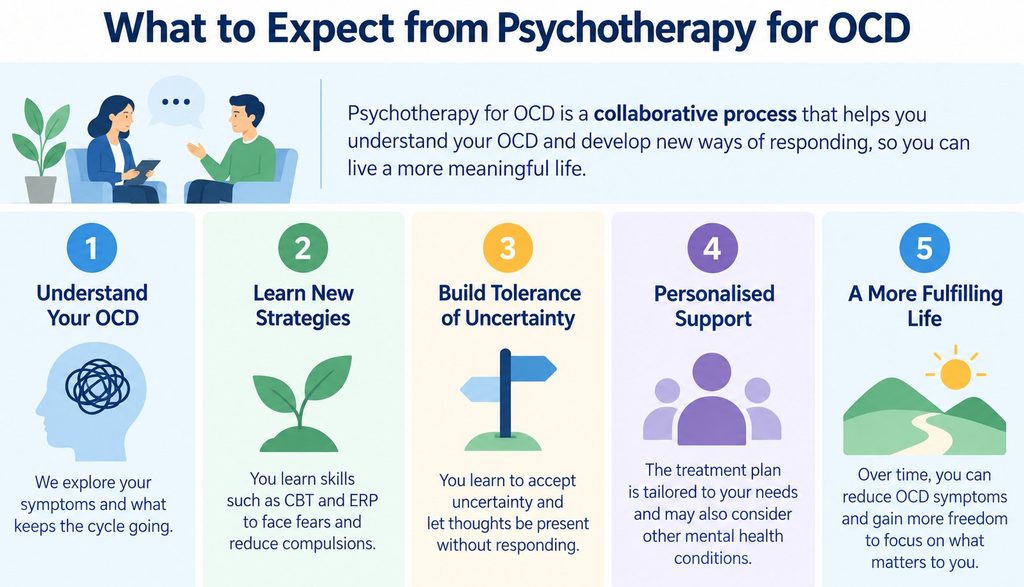
What to Expect from Psychotherapy for OCD
Psychotherapy for OCD requires active participation and usually produces change gradually rather than immediately. Progress may include fewer compulsions, less avoidance and a greater ability to tolerate intrusive thoughts without responding to them. Understanding what realistic improvement looks like can help patients approach psychotherapy with appropriate expectations.
Psychotherapy Requires Active Participation
Psychotherapy for OCD is an active treatment. Understanding the disorder is important, but improvement also requires patients to change how they respond when obsessive thoughts, anxiety and compulsive urges occur. This can be difficult at first. Compulsions often provide immediate relief, while resisting them may temporarily increase discomfort. A patient may understand why repeated checking maintains OCD and still feel a powerful urge to check again.
Therapy helps patients work through this difficulty gradually. With practice, they can become less dependent on rituals, reassurance and avoidance. What initially feels uncomfortable often becomes easier as new patterns of responding develop. The therapist provides structure, guidance and support, but much of the change occurs when therapeutic principles are applied in everyday life.
Progress Is Usually Gradual
Improvement in OCD does not always follow a straight line. Some symptoms may improve quickly, while others remain more persistent. A patient may successfully reduce one compulsion only to recognise that another form of reassurance or mental checking has taken its place. Periods of stress can also temporarily intensify symptoms. This does not necessarily mean that psychotherapy has stopped working.
Progress is better measured by changes in everyday functioning. Is less time spent performing rituals? Has avoidance decreased? Can the patient tolerate doubt for longer? Are work, relationships and everyday activities becoming easier? These changes are often more meaningful than the complete absence of intrusive thoughts.
The Goal Is Not to Eliminate Intrusive Thoughts
One of the most important expectations in psychotherapy for OCD is that treatment does not aim to create a mind free from disturbing thoughts. Intrusive thoughts occur in people with and without OCD. Trying to eliminate them completely can become another attempt to achieve impossible certainty and control.
The therapeutic goal is different. Patients learn that an intrusive thought can occur without requiring a response. They can experience doubt without checking, anxiety without immediately escaping and an unwanted thought without analysing what it means. As this ability develops, intrusive thoughts may still occur but become less important. They occupy less time and have less influence over behaviour.
What Improvement With OCD Psychotherapy Can Look Like
Successful treatment can significantly reduce the impact of OCD on everyday life. A person who previously spent hours checking may be able to leave home without repeatedly returning to the door. Someone with contamination fears may regain activities that had been avoided. A patient with primarily mental compulsions may learn to recognise obsessive analysis without becoming trapped in it.
Improvement can also affect relationships. Partners and relatives may no longer need to provide repeated reassurance or participate in rituals. Decisions can become easier, routines shorter and everyday activities more spontaneous. The broader goal is greater psychological freedom. Patients become better able to make decisions according to their needs, responsibilities and values rather than according to the demands of OCD.
When OCD Does Not Improve as Expected
Not every patient improves at the same speed. When progress is limited, the treatment plan should be reviewed rather than simply repeating the same interventions. Sometimes important compulsions have not been recognised. Mental rituals, subtle reassurance seeking or avoidance may continue even after visible compulsions have decreased. In other cases, therapeutic exercises may not be sufficiently focused on the fears maintaining the symptoms.
Other psychiatric conditions or significant life stress can also interfere with treatment. In some cases, psychotherapy may need to be adjusted or combined with medication. A careful reassessment can help determine why improvement has been limited and which aspects of treatment need to change.
Maintaining Improvement After Psychotherapy
OCD symptoms can fluctuate over time. Stress, sleep disruption, major life changes or emotional conflicts may temporarily increase obsessive thoughts and compulsive urges. An important part of psychotherapy for OCD is learning to recognise early signs that old patterns are returning. These include more frequent checking, increasing avoidance, renewed reassurance seeking or spending more time analysing intrusive thoughts.
Recognising these changes early allows patients to use the strategies learned in therapy before compulsions become firmly established again. The aim is not to guarantee that obsessive thoughts never return. It is to develop the ability to recognise OCD and respond without automatically returning to old rituals.
When Should You Seek Psychotherapy for OCD in Dubai?
Professional assessment should be considered when obsessions or compulsions become difficult to control, consume significant amounts of time or interfere with work, education, relationships or everyday activities. Treatment may also be appropriate when symptoms are not obvious to other people but cause substantial internal distress. This is particularly relevant when OCD mainly involves intrusive thoughts, mental rituals, reassurance seeking or avoidance rather than visible compulsions.
Early treatment may prevent obsessive-compulsive patterns from becoming more established. However, longstanding OCD can also improve with appropriate treatment. Experiencing symptoms for many years does not mean that psychotherapy can no longer be effective.
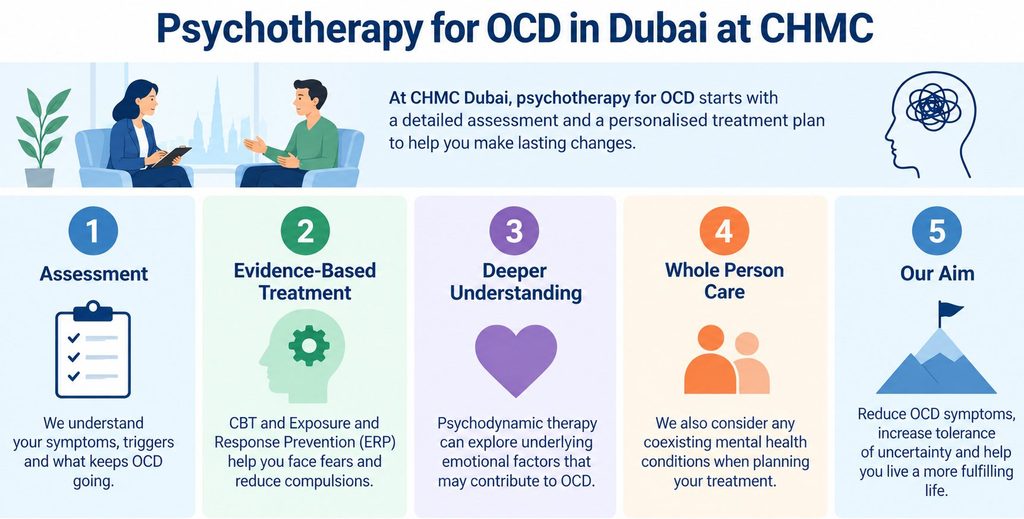
Psychotherapy for OCD in Dubai at CHMC
At CHMC German Clinic for Psychiatry, psychotherapy for OCD in Dubai begins with a detailed psychiatric and psychotherapeutic assessment. The aim is to understand the patient’s obsessions, compulsions, mental rituals, avoidance and reassurance seeking, as well as the fears and beliefs maintaining these patterns.
Treatment is adapted to the individual clinical picture. CBT, particularly Exposure and Response Prevention (ERP), forms the foundation of symptom-focused psychotherapy for OCD. Cognitive and acceptance-based methods can be integrated where appropriate.
Psychodynamic psychotherapy may also contribute when emotional conflicts, self-esteem difficulties or interpersonal patterns require additional attention.
The assessment also considers co-existing psychiatric conditions and whether psychotherapy should be combined with medication. The overall aim of psychotherapy for OCD is to reduce compulsive responses, improve tolerance of uncertainty and help patients regain greater control over their everyday lives.
Psychotherapy for OCD: Key Takeaway
OCD is maintained not only by intrusive thoughts but also by the responses that follow them. Checking, reassurance seeking, avoidance and mental rituals can provide temporary relief while reinforcing the disorder.
Effective psychotherapy helps patients recognise and change these patterns. CBT and ERP have the strongest role in treating core obsessive-compulsive symptoms, while cognitive, acceptance-based and selected psychodynamic approaches can address additional psychological difficulties when appropriate.
The goal of psychotherapy for OCD is not complete control over intrusive thoughts. It is to reduce their influence over behaviour and help patients regain greater freedom in everyday life.