

CHMC provides specialist OCD treatment in Dubai for adults and adolescents. Treatment begins with a comprehensive psychiatric assessment and may include cognitive behavioural therapy (CBT), particularly exposure and response prevention (ERP), and medication. The treatment plan depends on the symptoms’ severity, the patient’s individual circumstances, and any coexisting mental health conditions.
OCD treatment can help people with obsessive-compulsive disorder (OCD) reduce intrusive thoughts, compulsive behaviours, and their impact on everyday life. Without appropriate therapy, OCD tends to become more severe and persistent, interfering with work, relationships, and daily functioning.
Some patients benefit mainly from psychotherapy, while others require medication or a combination of both. The aim is not simply to suppress symptoms but to help the patient regain freedom, functioning, and quality of life.
Book an OCD Assessment at CHMC Dubai
What Is Obsessive-Compulsive Disorder (OCD)?
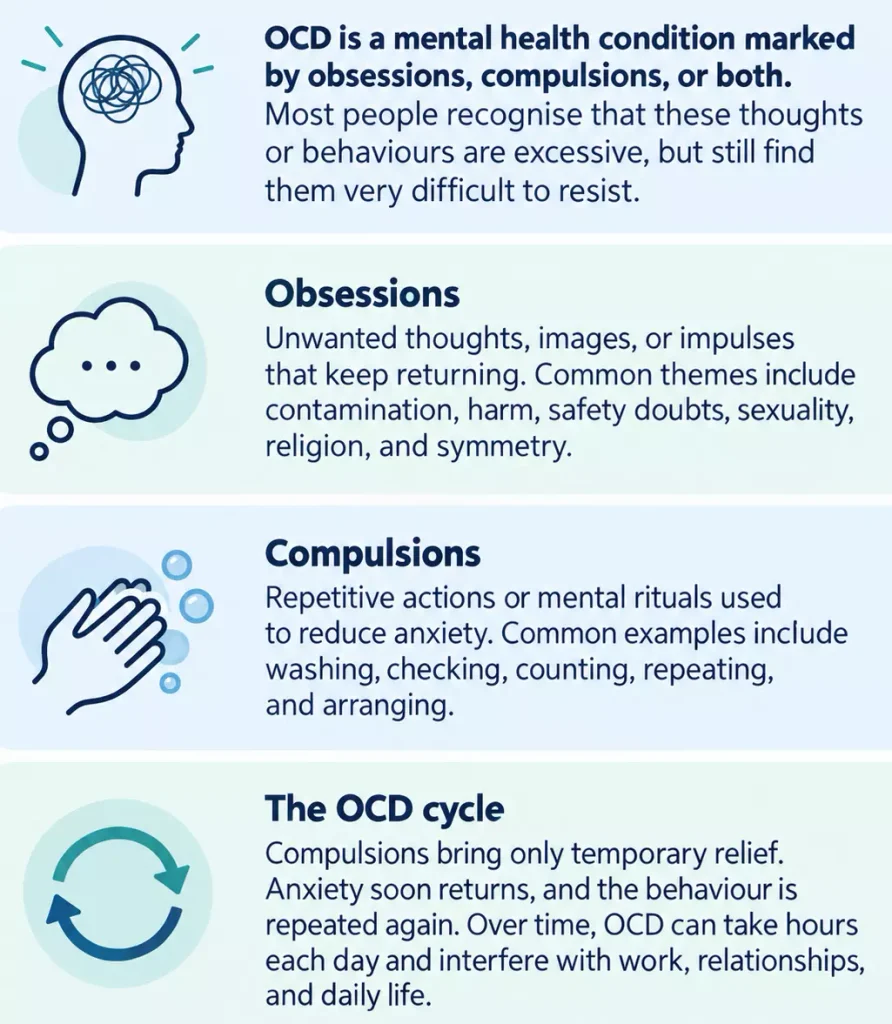
Obsessive-compulsive disorder, commonly known as OCD, is characterised by recurring obsessive thoughts, compulsive behaviours, or both. People with OCD usually recognise that these thoughts or actions are unreasonable, yet they find them extremely difficult to resist.
Obsessions are unwanted thoughts, images, or impulses that repeatedly enter the mind. They may involve contamination, fear of causing harm, doubts about safety, sexuality, religion, or a need for symmetry. Compulsions are repetitive actions or mental rituals performed to reduce the anxiety or discomfort caused by these thoughts. Common examples include excessive washing, checking, counting, repeating, and arranging.
The relief produced by a compulsive action is usually temporary. This creates a cycle in which the person feels compelled to repeat the behaviour whenever anxiety returns. Over time, OCD can consume several hours each day and lead to reduced performance, social withdrawal, and significant limitations in everyday life.
When Is OCD Treatment Necessary?
Occasionally checking whether the door is locked or wondering whether the stove has been switched off does not mean that someone has OCD. Treatment becomes important when obsessive thoughts or compulsive behaviours cause significant distress, take up considerable time, or interfere with everyday life.
A person may spend an hour getting ready because washing has to be repeated according to a particular ritual. Someone else may return home several times to check the door, electrical appliances, or water taps. Others become trapped in mental rituals, repeatedly trying to suppress an unwanted thought.
Many people recognise that their behaviour is excessive but still cannot stop it. Attempting to resist the compulsion can produce intense anxiety, uncertainty, or inner tension. Performing the ritual temporarily reduces these feelings while reinforcing the OCD cycle.
Professional treatment is particularly important when OCD begins to affect education, work, relationships, and daily functioning. Without adequate treatment, OCD frequently becomes chronic and may gradually extend into more areas of everyday life.
Goals of OCD Treatment
The goal of OCD treatment is not limited to reducing the number of obsessive thoughts or compulsive rituals. Successful treatment should also improve the patient’s ability to function independently and participate normally in everyday life. This may mean being able to leave home without repeated checking, touch objects without excessive washing, complete work without constant repetition, or experience an intrusive thought without spending hours trying to neutralise it.
Improving quality of life, daily functioning, social participation, and relationships are important treatment goals alongside symptom reduction. Treatment should also provide patients with strategies that help them recognise and manage symptoms in the future and reduce the risk of relapse.
How Is OCD Treated?
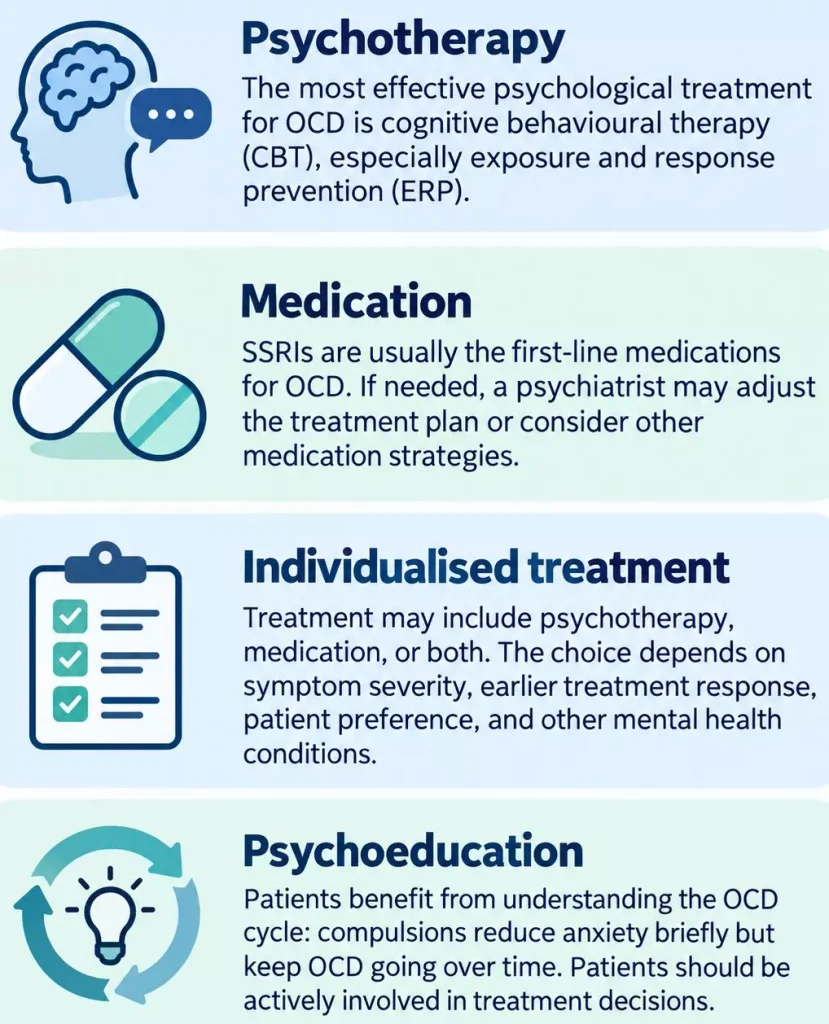
Modern OCD treatment is based primarily on psychotherapy and medication. The most effective evidence-based psychological treatment is cognitive behavioural therapy (CBT), particularly exposure and response prevention (ERP).
Medication is another established treatment option. SSRIs are generally the first-line medications for OCD. If treatment is not sufficiently effective or well tolerated, other medication strategies may be considered by the psychiatrist.
The choice between psychotherapy, medication, and combined treatment depends on several factors. These include symptom severity, previous treatment response, patient preference, and the presence of co-occurring psychiatric conditions.
Psychoeducation is also an important part of OCD treatment. Understanding why compulsions temporarily reduce anxiety but maintain OCD over the longer term can help patients approach treatment differently. Patients should be actively involved in treatment decisions rather than simply being given a standard treatment plan.
Treatment for OCD with Psychotherapy
Psychotherapy plays a central role in the treatment of OCD. The first-line psychological approach is Cognitive Behavioural Therapy (CBT), particularly Exposure and Response Prevention (ERP). CBT helps patients recognise the patterns that maintain OCD and develop different ways of responding to intrusive thoughts, anxiety, uncertainty, and compulsive urges.
Treatment is adapted to the individual patient’s symptoms and difficulties. It may address visible compulsions as well as avoidance, reassurance seeking, and mental rituals that are less obvious but can continue to reinforce OCD. Psychotherapy requires active participation, with therapeutic strategies gradually applied beyond the sessions and in everyday life.
Other psychological approaches may be integrated when appropriate, particularly when emotional, interpersonal, or coexisting psychiatric difficulties require additional attention.
Read more about Psychotherapy for OCD.
Exposure and Response Prevention (ERP)
Exposure and Response Prevention (ERP) is a core component of CBT and one of the best-established psychological treatments for OCD. Patients gradually approach situations, thoughts, or feelings that trigger obsessive fears while reducing the compulsions, avoidance, or reassurance they would normally use to relieve the resulting discomfort.
The objective is not simply to provoke anxiety or prove that a feared event will never happen. Through repeated practice, patients learn that intrusive thoughts, anxiety, and uncertainty can be tolerated without automatically responding with a ritual. Exposure exercises are individually planned and increasingly transferred into everyday life as treatment progresses.
The practical process of creating exposure hierarchies, using in vivo and imaginal exposure, identifying hidden compulsions, and practising response prevention is explained in our dedicated guide to:
Read more about Exposure and Response Prevention (ERP) for OCD.
Medication for Treatment of OCD
Medication can play an important role in OCD treatment, particularly when symptoms are moderate or severe, psychotherapy alone has not produced sufficient improvement, or symptoms make active participation in CBT and ERP difficult.
Selective serotonin reuptake inhibitors (SSRIs) are generally the first-line medications for OCD. Their effect develops gradually, and treatment usually requires an adequate trial with appropriate dose adjustment before the response can be properly evaluated. When medication is effective, longer-term treatment may be recommended to maintain improvement and reduce the risk of relapse.
If an SSRI is not sufficiently effective or causes significant side effects, the psychiatrist may consider an alternative medication strategy. When substantial symptoms persist despite an adequate medication trial, augmentation treatment may also be considered. The choice depends on previous treatment response, symptom severity, coexisting psychiatric or medical conditions, possible interactions, and tolerability.
Medication treatment should therefore be individually planned and monitored rather than following a standard sequence for every patient. Medication may be used alone or combined with psychotherapy depending on the clinical situation.
Read more about OCD Medication.
Combining Medication and Psychotherapy
Medication and psychotherapy should not be viewed as competing approaches. For many patients, they complement each other. CBT with exposure directly addresses the behavioural and psychological processes that maintain OCD. Medication can reduce the intensity of symptoms, anxiety, and inner pressure. This may make it easier for some patients to engage in exposure exercises that initially seem overwhelming.
Combining medication with CBT and ERP can be particularly useful when significant OCD symptoms remain despite one treatment approach or when OCD occurs together with depression. Treatment should still be individualised. Not every patient requires medication, and medication should not replace appropriate OCD-specific psychotherapy simply because taking a tablet initially feels easier than confronting feared situations.
How Long Does OCD Treatment Take?
There is no standard duration of OCD treatment. Some patients experience meaningful improvement after a relatively limited course of psychotherapy, while others require longer or more intensive treatment. Improvement is usually gradual, particularly when symptoms are severe or have been present for many years.
Medication also requires time to work and may need to be continued after improvement to reduce the risk of relapse. Treatment duration should therefore be based on the individual response rather than a fixed timetable.
OCD often has a fluctuating course. Symptoms may remain stable for long periods but become stronger again during stress or major life changes. Some patients may therefore benefit from additional treatment later.
The goal is not to finish treatment as quickly as possible but to achieve lasting improvement, better daily functioning and skills that help patients manage OCD symptoms in the long term.
Treatment-Resistant OCD
Some patients continue to experience significant OCD symptoms despite treatment. However, treatment-resistant OCD should only be considered after adequate evidence-based treatment has been provided.
Before concluding that treatment has failed, the psychiatrist should review whether medication was taken at an appropriate dose and for a sufficient duration and whether OCD-specific psychotherapy included adequate CBT and exposure and response prevention (ERP).
If symptoms persist despite appropriate treatment, the treatment strategy may be adjusted. Options include changing or augmenting medication and intensifying specialised CBT with ERP.
For severe and persistent treatment-resistant OCD, specialised biological treatments may be considered. Repetitive transcranial magnetic stimulation (rTMS) can be an option for selected patients who have not responded sufficiently to established treatments. Deep brain stimulation (DBS) is reserved for exceptionally severe, treatment-refractory OCD and is performed only in specialised centres after established pharmacological and psychotherapeutic treatments have been exhausted.
These interventions are not routine treatments for OCD and require careful specialist assessment.
Treating OCD With Other Mental Health Conditions
OCD frequently occurs alongside other mental health conditions, particularly depression and anxiety disorders. It may also co-exist with trauma-related disorders, eating disorders, substance-related problems, tic disorders or personality disorders.
These conditions can influence how OCD is treated. Severe depression, for example, may reduce motivation and make exposure therapy more difficult. In other cases, successful OCD treatment may also improve depressive or anxiety symptoms that developed as a consequence of long-term distress and restriction.
When another psychiatric condition significantly interferes with OCD treatment, it may need to be addressed before or alongside intensive OCD-focused CBT and ERP.
A comprehensive psychiatric assessment is necessary for securing the diagnosis and identifying other co-existent mental health conditions.
What Can Patients Do to Support Treatment?
Successful OCD treatment also depends on what happens between appointments. Patients undergoing CBT with exposure and response prevention (ERP) should practise agreed exercises in everyday situations so that progress extends beyond the therapy sessions.
It is also helpful to recognise avoidance and reassurance seeking as parts of the OCD cycle. Family members can support treatment by encouraging progress without participating in compulsive rituals or repeatedly providing reassurance.
Regular daily activities, exercise and maintaining social or occupational routines can provide additional support. Self-help strategies may complement professional treatment, but they should not replace appropriate treatment when OCD symptoms are moderate or severe.
Read More About Self-Help Strategies for People with OCD
Why Choose CHMC for OCD Treatment in Dubai?
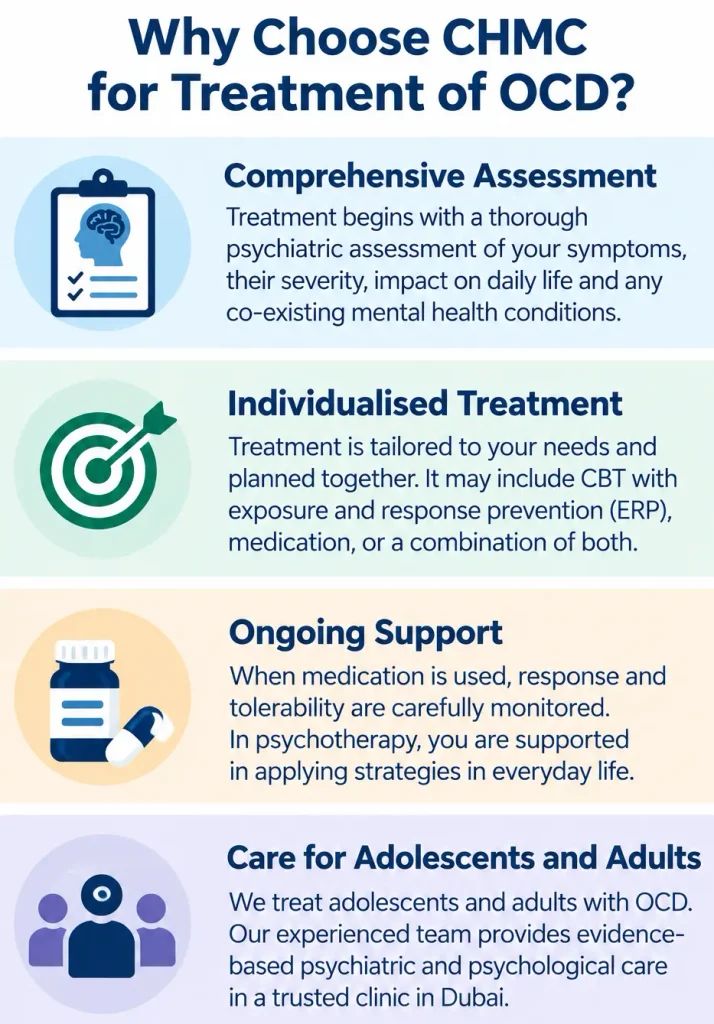
Effective OCD treatment begins with an accurate diagnosis and a clear understanding of how the disorder affects the individual patient. At CHMC German Clinic for Psychiatry and Psychology in Dubai, treatment starts with a comprehensive psychiatric assessment of OCD symptoms, their severity, their impact on daily life and any co-existing mental health conditions.
Treatment is individualised and planned together with the patient. Depending on the clinical situation, it may include cognitive behavioural therapy (CBT) with exposure and response prevention (ERP), medication, or a combination of both. When medication is used, response and tolerability are monitored over time. When psychotherapy is recommended, patients are supported in applying therapeutic strategies beyond the sessions and in everyday life.

FAQ About OCD Treatment
What is the most effective treatment for OCD?
Cognitive behavioural therapy (CBT) with exposure and response prevention (ERP) is a first-line psychological treatment for OCD. Medication, particularly SSRIs, is also effective when clinically indicated. Some patients benefit from CBT with ERP alone, while others benefit from combining psychotherapy with medication. The appropriate treatment depends on symptom severity, previous treatment response, co-existing conditions and individual patient needs.
Is medication or psychotherapy better for OCD?
There is no single approach that is best for every patient. CBT with ERP directly addresses the patterns that maintain OCD and can be used without medication in many patients. Medication may be particularly useful when symptoms are severe, significant depression is also present or participation in psychotherapy is initially difficult. Treatment should be individualised according to the clinical situation and the patient’s preferences.
Can OCD be treated without medication?
Yes. Many patients can be treated with OCD-specific CBT and ERP without medication. Medication may be added when symptoms are severe, psychotherapy alone has not produced sufficient improvement or co-existing psychiatric conditions influence treatment. The decision depends on the individual clinical situation.
How long does medication take to work for OCD?
Medication for OCD often takes longer to work than patients expect. An adequate trial of an SSRI or clomipramine may require around 12 weeks, including appropriate dose adjustment, before the response can be properly evaluated. Medication should therefore not be considered ineffective after only a few weeks.
What happens if OCD treatment does not work?
Insufficient improvement does not necessarily mean that OCD is treatment-resistant. The diagnosis, medication dose and duration, adherence and adequacy of previous psychotherapy should first be reviewed. If significant symptoms persist despite appropriate treatment, options may include adjusting medication or intensifying specialised CBT with ERP. Selected patients with severe treatment-resistant OCD may require additional specialist treatment.
Can OCD return after successful treatment?
Yes. OCD can have a fluctuating course, and symptoms may become stronger again during periods of stress or major life changes. Relapse prevention therefore includes recognising early warning signs and continuing to use strategies developed during CBT and ERP. When medication is used, it should not be stopped abruptly and should be reduced under medical supervision when appropriate.
Book an OCD Assessment at CHMC Dubai