

Dr. Gregor Kowal is a German Board-Certified Consultant Psychiatrist and Psychotherapist with three decades of clinical experience. After graduating from the University of Heidelberg, Germany, he held senior leadership positions as Head of Department and Medical Director at psychiatric hospitals in Germany. Since 2010, he has been the Medical Director of CHMC German Clinic for Psychiatry and Psychology in Dubai. He specialises in the diagnosis and treatment of ADHD, and other psychiatric conditions in adults, using evidence-based treatment tailored to each patient’s individual needs.
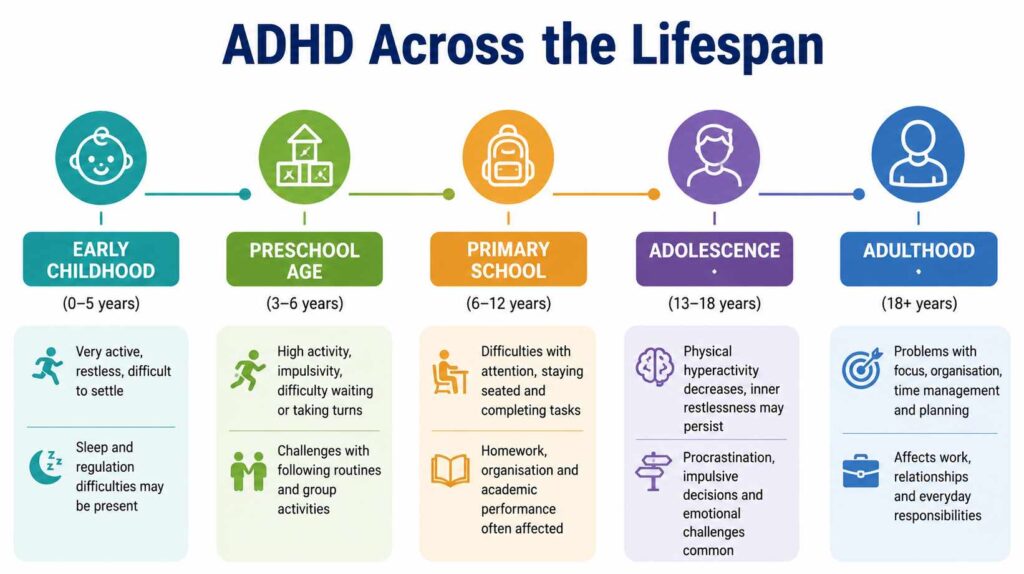
ADHD can change considerably with age. Hyperactivity and obvious motor restlessness often become less prominent from childhood into adulthood, while difficulties with attention, organisation, impulse control and executive functioning may persist.
The way ADHD appears also depends on the demands of each stage of life. A young child may struggle mainly with sitting still, waiting and following instructions. An adolescent may have increasing problems with organisation and academic responsibilities. In adulthood, difficulties with concentration, time management, planning and completing tasks often become more prominent.
Some people experience a substantial reduction in symptoms as they mature; others continue to have impairing ADHD symptoms in adulthood. The course of ADHD therefore varies considerably between individuals.
Therefore, an accurate diagnosis of ADHD requires a comprehensive clinical interview covering different stages of the patient’s life, from childhood and adolescence through adulthood. This developmental history helps determine whether characteristic ADHD symptoms were present early in life, how they have changed over time, and how they have affected functioning in different environments.
For More Information Contact Our Specialist at CHMC:
ADHD in Early Childhood
ADHD is a neurodevelopmental disorder, meaning that the underlying developmental differences begin early in life. However, diagnosing ADHD in very young children can be difficult because high activity, impulsivity and short attention spans are also common during normal early development. Some children who are later diagnosed with ADHD may have been unusually active, restless or difficult to settle from an early age, and parents may describe difficulties with sleep, emotional regulation or adapting to routines.
These features are not specific to ADHD and cannot by themselves predict whether a child will later develop the disorder. Developmental difficulties involving language, motor coordination or other areas may also occur alongside ADHD, but they are not defining symptoms and may require separate assessment.
ADHD at Preschool Age

ADHD symptoms often become easier to recognise during the preschool years because children are increasingly expected to follow routines, listen to instructions and participate in structured activities.
Hyperactivity can be particularly noticeable at this age, with children constantly moving, climbing, running or rapidly switching between activities. They may find it difficult to play quietly, remain engaged with one activity, wait for their turn or control immediate reactions when frustrated.
These behaviours sometimes become more apparent in kindergarten or preschool than at home because group environments place greater demands on attention, behavioural control and cooperation. However, activity and impulsivity alone do not establish an ADHD diagnosis. The behaviour must be excessive for the child’s developmental level, occur across relevant situations and cause meaningful impairment.
ADHD During Primary School
For many children, starting school is the point at which ADHD becomes particularly noticeable. The classroom requires them to remain seated, concentrate for longer periods, follow instructions, organise materials and complete tasks even when these activities are repetitive or uninteresting.
A child with ADHD may understand the material but repeatedly lose concentration, forget instructions, make careless mistakes or struggle to finish assignments. Homework can become particularly difficult because it requires sustained attention and organisation after an already demanding school day. Academic ability and ADHD are not the same thing. Children with normal or high intellectual ability can perform below expectations when difficulties with attention and executive functioning interfere with their ability to use their skills consistently.
Repeated problems at school can also affect self-esteem, particularly when a child begins to interpret difficulties as evidence of being lazy or incapable. Learning disorders, anxiety, oppositional behaviour and other conditions may further complicate the clinical picture and should therefore be considered during an ADHD assessment.
ADHD During Secondary School
The transition to secondary school introduces a different type of challenge. Students must manage several subjects, teachers, assignments and deadlines while becoming increasingly responsible for organising their own work. These demands place greater pressure on executive functioning, and an adolescent with ADHD may understand the academic material but repeatedly forget homework, underestimate how long assignments will take, start studying too late or struggle to prioritise competing responsibilities. This helps explain why difficulties can become more apparent during secondary school even when visible hyperactivity has already started to decrease.
How Does ADHD Change During Adolescence?
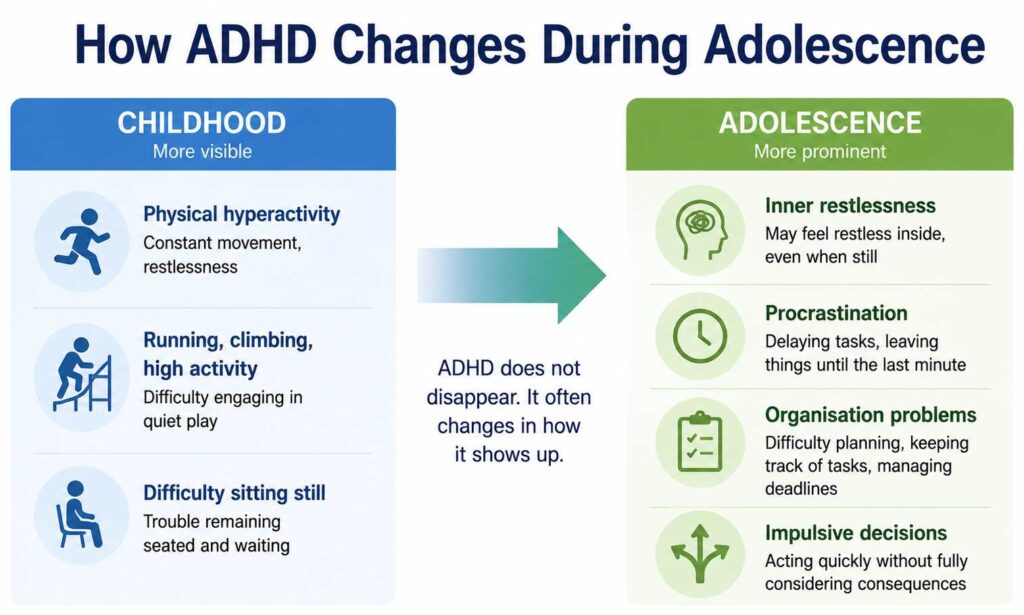
One of the most noticeable changes during adolescence is often a reduction in physical hyperactivity. A teenager who was constantly running or climbing as a young child may no longer appear unusually active, while restlessness may become more internal and appear as a persistent need for stimulation or difficulty remaining mentally settled.
Problems with attention, organisation and impulse control can nevertheless continue at a time when adolescents face greater academic independence, more complex social relationships and increasing responsibility for their own decisions. Procrastination, inconsistent academic performance and poor time management may therefore become more important than overt hyperactivity.
Impulsive decisions and difficulties regulating emotions can also affect relationships and behaviour, and adolescents with marked impulsivity may be more vulnerable to risk-taking, although such outcomes are by no means inevitable. Long-standing academic and interpersonal difficulties can contribute to frustration and reduced self-esteem. The individual course depends not only on the severity of ADHD symptoms but also on co-existing conditions, family circumstances, social support and access to appropriate treatment.
Does ADHD Go Away With Age?
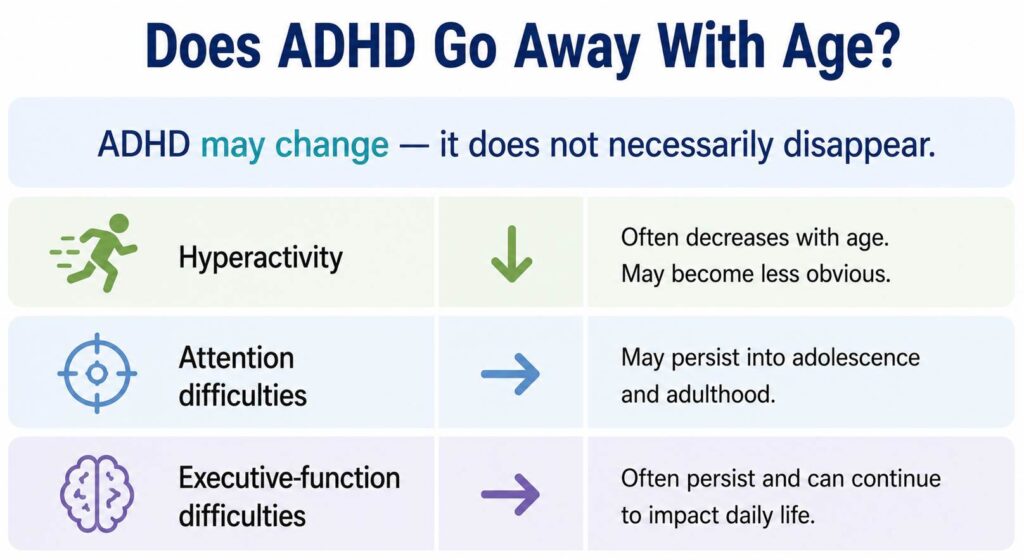
ADHD does not follow the same course in everyone. Some people experience a substantial reduction in symptoms as they mature, while others continue to meet diagnostic criteria for ADHD in adulthood. Some retain individual symptoms but experience considerably less impairment than they did during childhood.
Different symptoms can also change at different rates: hyperactivity generally becomes less prominent with age, whereas difficulties with attention, organisation and executive functioning may persist. This is one reason why adult ADHD can look very different from childhood ADHD, and why an adult does not need to appear physically hyperactive to have the disorder.
Why ADHD Symptoms Change With Age
ADHD changes with age because both development and the surrounding environment change. The demands placed on a preschool child are very different from those faced by a university student, working adult or parent. During childhood, difficulties may become apparent through problems sitting still, following instructions and completing schoolwork.
During adolescence, organisation, deadlines and independent decision-making become increasingly important, while in adulthood similar underlying executive-function difficulties may interfere with employment, finances, relationships and managing multiple responsibilities.
People also develop strategies that can compensate for some of these difficulties, while treatment, supportive environments and accumulated experience may further reduce their impact. The clinical presentation of ADHD therefore reflects an interaction between underlying neurodevelopmental characteristics and the demands placed on the individual at a particular stage of life.
Does ADHD Treatment Change With Age?
Treatment should reflect the person’s current symptoms, impairment and circumstances rather than age alone. In childhood, parents and schools often play an important role in creating structure and supporting behavioural strategies. Adolescents increasingly need to develop independent organisational skills, while treatment in adulthood may focus more strongly on professional functioning, time management, relationships and everyday responsibilities.
Medication may be appropriate for some patients, while psychotherapy, psychoeducation and practical strategies can address other areas of functioning. Treatment priorities can therefore change substantially across the lifespan even when the underlying ADHD diagnosis remains the same.
ADHD in Adulthood

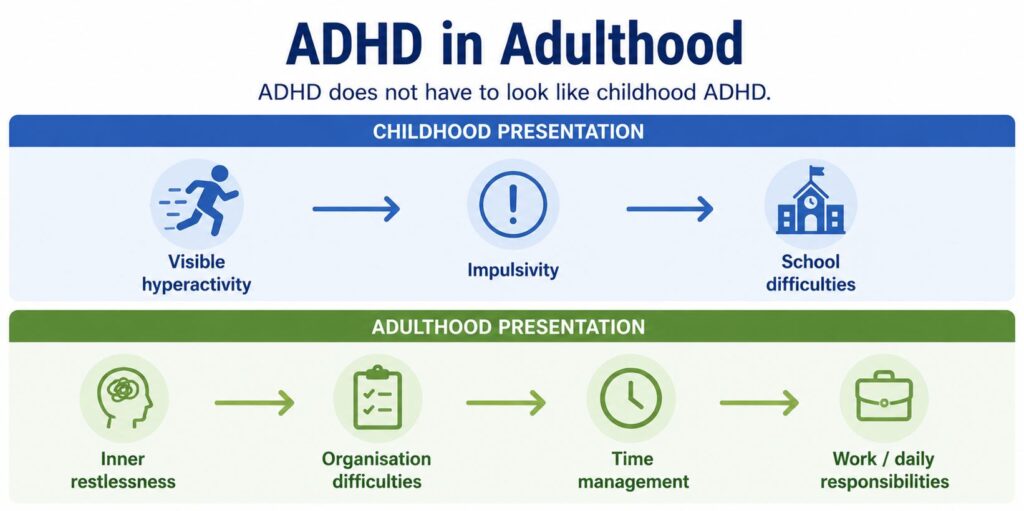
In adulthood, ADHD is often characterised less by obvious hyperactivity and more by problems with concentration, organisation, time management and executive functioning. Adults may experience inner restlessness rather than constant physical activity, while impulsivity can appear as impatience, interrupting conversations or making decisions too quickly.
Executive-function difficulties may become particularly important: a person may procrastinate, forget appointments, lose important objects, underestimate how much time tasks require or struggle to prioritise competing responsibilities. Starting projects may be relatively easy while completing them consistently is much more difficult.
These difficulties can affect professional life as well as finances, household responsibilities, relationships and family commitments, all of which require planning and sustained organisation. At the same time, many adults develop effective compensatory strategies. Calendars, reminders, structured routines and carefully chosen working environments may allow them to function well despite persistent ADHD symptoms.
Can ADHD Be Diagnosed for the First Time in Adulthood?
Many adults diagnosed with ADHD did not receive the diagnosis during childhood. However, an adult assessment should investigate whether characteristic symptoms or related functional difficulties were already present earlier in life. School history, childhood behaviour and previous problems with attention, impulsivity or organisation can provide useful information, while old school reports or information from family members may sometimes help clarify the developmental history.
At the same time, concentration difficulties in adulthood should not automatically be attributed to ADHD. Depression, anxiety disorders, bipolar disorder, sleep problems, substance use and several medical conditions can also affect attention and executive functioning. Careful differential diagnosis is therefore an important part of an adult ADHD diagnosis.
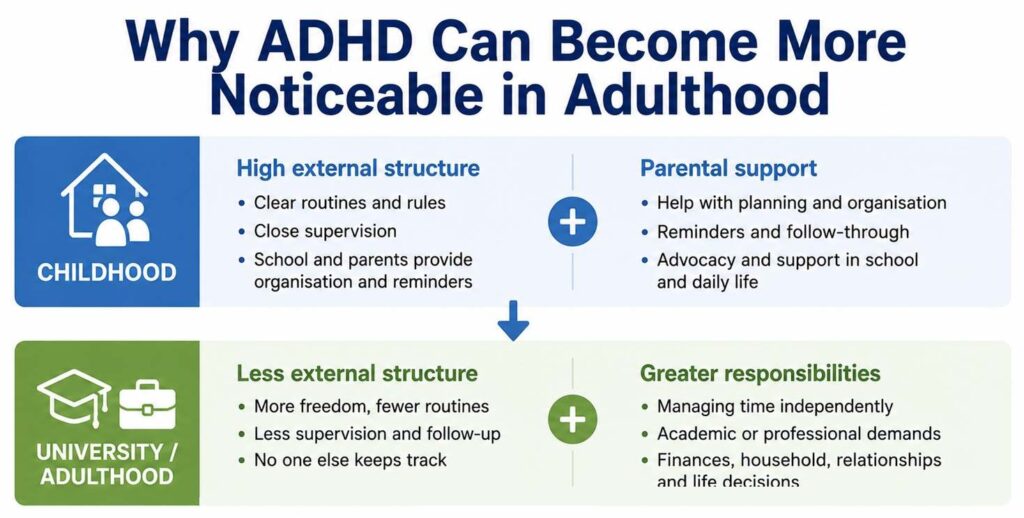
Why Can ADHD Become More Noticeable in Adulthood?
Some people first seek an ADHD assessment during university or adulthood, but this does not necessarily mean that ADHD suddenly developed at that age. Earlier symptoms may have been relatively mild, overlooked or successfully compensated for through supportive parents, highly structured schooling or strong intellectual abilities.
Difficulties can become much more apparent when external structure decreases and personal responsibilities increase. University, professional work, managing a household and family responsibilities require considerably greater independent organisation, and difficulties that were previously manageable may then become clinically significant.
This distinction is important because ADHD is considered a neurodevelopmental disorder. An adult diagnosis therefore involves examining whether characteristic symptoms or related functional difficulties can be traced back to earlier stages of development rather than assuming that problems with attention beginning in adulthood necessarily represent ADHD.
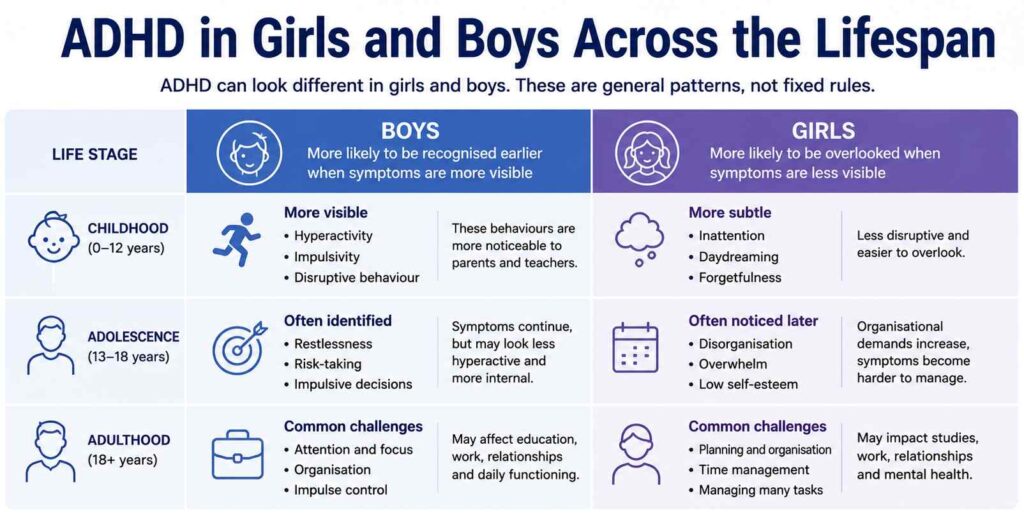
ADHD in Girls and Boys Across the Lifespan
ADHD is diagnosed more frequently in boys during childhood, particularly when hyperactivity, impulsivity or disruptive behaviour is prominent. These behaviours are highly visible and are more likely to attract the attention of parents and teachers. Girls may more often present with predominantly inattentive difficulties such as distractibility, disorganisation, forgetfulness and daydreaming.
Because these presentations can be less disruptive, they may be easier to overlook, and some girls are not assessed until adolescence or adulthood when organisational demands increase. These are general patterns rather than fixed differences, and both males and females can experience inattentive, hyperactive and impulsive symptoms.
ADHD Across the Lifespan: Summary
ADHD is not a static condition. Its presentation can change considerably from childhood to adulthood. Hyperactivity is often particularly visible during the preschool and early school years and frequently becomes less prominent with age. Difficulties with attention, organisation, impulse control and executive functioning may persist much longer.
Some people experience substantial improvement as they mature, while others continue to have clinically significant symptoms in adulthood. Whether these symptoms cause impairment also depends on the demands of the person’s environment and the strategies they have developed to compensate for their difficulties.
For this reason, ADHD assessment should consider both developmental history and current functioning. Reduced hyperactivity does not necessarily mean that ADHD has disappeared, just as receiving an ADHD diagnosis in adulthood does not mean that the disorder suddenly began at that age.
If you’re concerned about your mental health condition, feel free to contact us on WhatsApp