

Knowing how to help a family member with OCD can be difficult. Obsessive-Compulsive Disorder (OCD) affects not only the person experiencing obsessions and compulsions but often the entire family. Relatives may feel helpless, frustrated or exhausted as they watch someone they care about struggle with intrusive thoughts, repeated rituals and severe anxiety.
Family members often try to help by providing reassurance, participating in rituals, avoiding triggers or changing household routines. Although these responses are usually motivated by care and compassion, they can unintentionally reinforce OCD.
Supporting a loved one with OCD therefore means learning how to provide emotional support without supporting compulsions. Understanding OCD, reducing family accommodation, encouraging appropriate treatment and maintaining healthy boundaries can allow relatives to become an important part of recovery.
For professional advice about OCD treatment in Dubai, contact Dr. Gregor Kowal, Consultant Psychiatrist and Psychotherapist at CHMC.
Understanding OCD and Why It Feels So Powerful
Obsessive-Compulsive Disorder is a mental health condition characterized by intrusive thoughts, images, or fears known as obsessions. These obsessions create intense anxiety and emotional discomfort. In response, the person develops compulsive behaviours or mental rituals aimed at reducing that anxiety.
For example, someone may repeatedly wash their hands because of contamination fears, check doors and appliances for hours, or constantly seek reassurance from family members. Others may struggle with disturbing intrusive thoughts related to harm, religion, relationships, or morality.
Many people with OCD recognise that their fears or rituals may be excessive, although the degree of insight varies between individuals. However, insight alone is usually not enough to stop the compulsions. The emotional pressure caused by OCD can feel overwhelming, and rituals temporarily reduce that distress. Unfortunately, this relief reinforces the disorder and keeps the cycle alive. Without effective treatment, these patterns may become increasingly persistent and interfere with relationships, work and everyday life.
How Family Members Become Part of the OCD Cycle
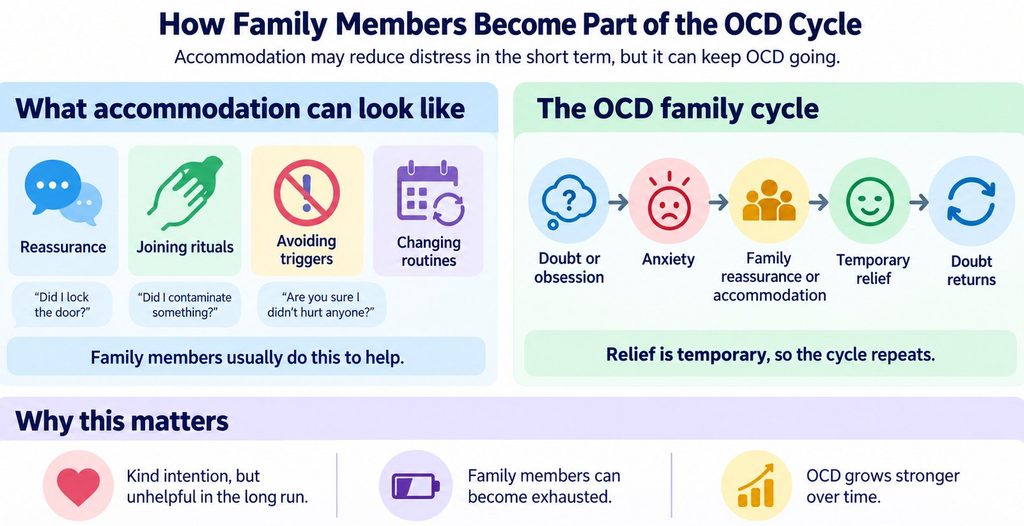
One of the most difficult aspects of OCD is that it often pulls relatives into the disorder itself. This process is known as family accommodation in OCD.
Accommodation occurs when family members begin participating in rituals, adapting routines, avoiding triggers, or repeatedly reassuring the person with OCD. Initially, this may seem helpful because it reduces distress and prevents conflict. However, in the long run, it strengthens the OCD.
For example, a family member may repeatedly answer questions such as:
- “Are you sure I locked the door?”
- “Do you think I contaminated something?”
- “Are you certain I didn’t hurt anyone?”
The reassurance calms anxiety temporarily, but the doubt quickly returns. As a result, the person with OCD asks again and again, while the family becomes increasingly exhausted. In more severe cases, entire households begin revolving around OCD rules. Family members may avoid touching certain objects, follow strict cleaning routines, wait hours for rituals to finish, or change their own behaviour to prevent anxiety in the affected person.
Although these accommodations are usually done out of kindness, they unintentionally feed the disorder. OCD learns that anxiety can only be managed through rituals and reassurance, which makes the symptoms stronger over time.
Learn About OCD to Support a Loved One
Education is one of the most useful tools for relatives. The more family members understand OCD, the easier it becomes to recognise obsessions, compulsions, reassurance seeking and avoidance without becoming drawn into them. Logical explanations alone rarely resolve obsessive doubt because the problem is not simply a lack of information. Anxiety, uncertainty and the temporary relief produced by compulsions help keep the OCD cycle going.
Encouraging Treatment Without Pressure
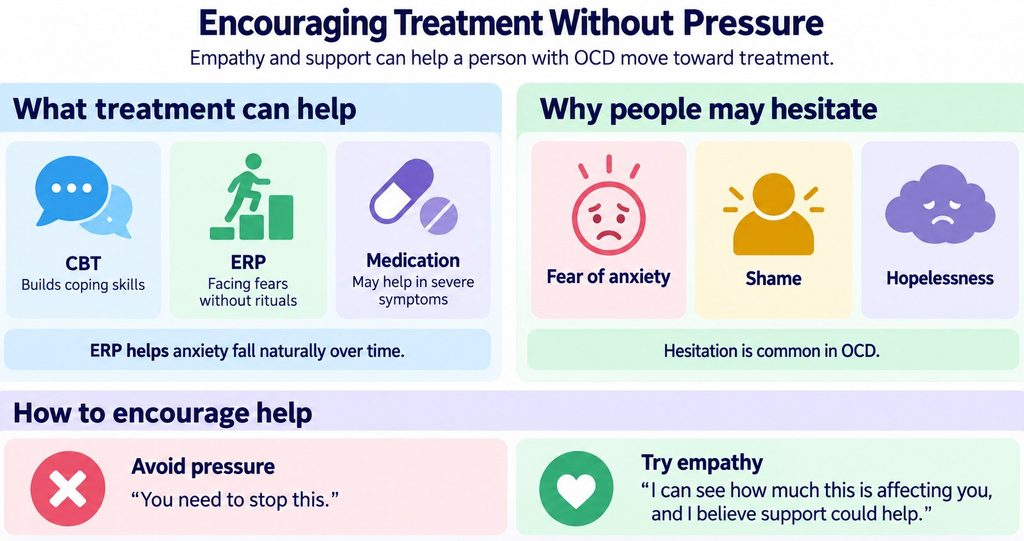
Exposure and Response Prevention (ERP), a specialised form of Cognitive Behavioral Therapy (CBT), is a first-line psychological treatment for OCD.
During ERP, the person gradually confronts feared situations, thoughts or uncertainty while learning not to perform the usual compulsion. With repeated practice, the urge to rely on rituals can decrease and the person learns that anxiety can be tolerated without compulsive behaviour.
Medication may also be helpful for some individuals, especially when symptoms are severe. However, many people with OCD hesitate to seek treatment. Some fear the anxiety involved in therapy, while others feel ashamed or hopeless. It is important to approach the topic with empathy rather than criticism.
Instead of saying:
“You need to stop this.”
Try saying:
“I can see how much this is affecting you, and I believe support could help.”
Compassionate encouragement is usually more effective than pressure or confrontation.
Reducing Reassurance and Accommodation
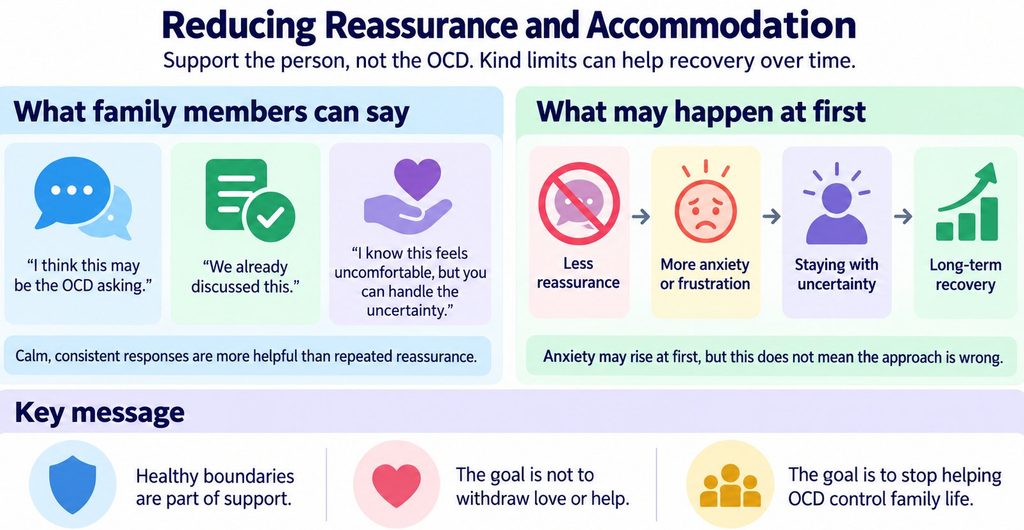
Reducing reassurance and family accommodation is often one of the most difficult parts of helping someone with OCD. This does not mean becoming cold, rejecting the person or withdrawing emotional support. It means supporting your loved one without repeatedly supporting the compulsions.
For example, rather than repeatedly answering reassurance questions, family members can respond calmly with statements such as:
- “I think this may be the OCD asking.”
- “We already discussed this.”
- “I know this feels uncomfortable, but you can handle the uncertainty.”
When reassurance or accommodation is extensive, it is often best to reduce it gradually and, where possible, as part of a treatment plan agreed with the person and their therapist.
The person with OCD may become upset or angry because the rituals and reassurance have become part of their coping system. Nevertheless, maintaining healthy boundaries is an important part of long-term recovery. It is also helpful to discuss these changes openly, explaining that the goal is not to withdraw support, but to stop helping the OCD control family life.
Providing Emotional Support
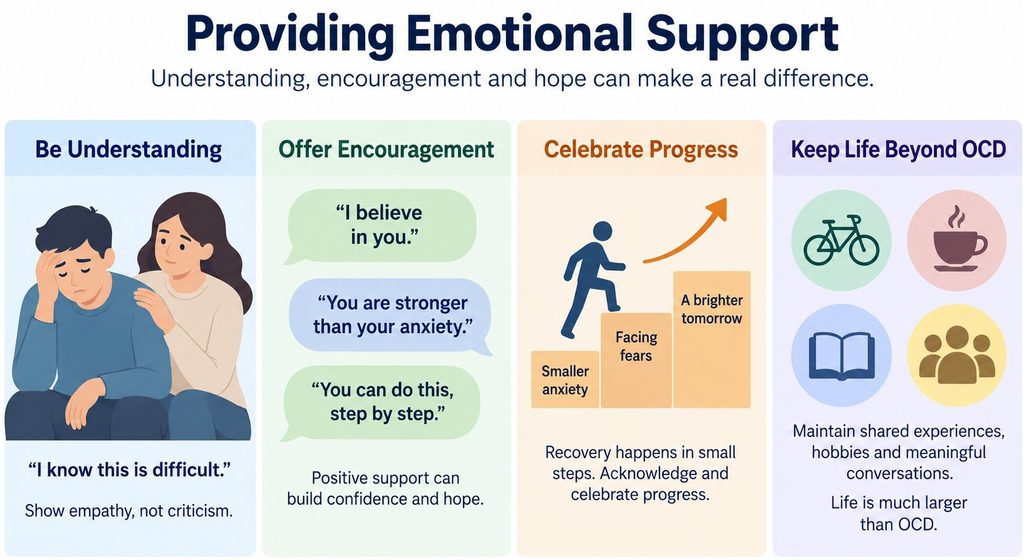
Although family members should avoid participating in compulsions, emotional support remains extremely important. People with OCD often experience shame, guilt, fear, and emotional exhaustion. They need understanding, encouragement, and hope. Small supportive statements can make a significant difference:
- “I know this is difficult.”
- “I believe in you.”
- “You are stronger than your anxiety.”
The key difference is that emotional support focuses on helping the person tolerate anxiety rather than removing anxiety for them. Recovery from OCD is rarely linear. Progress often happens in small steps, and setbacks are common. Celebrating even minor improvements, such as delaying a ritual, resisting reassurance, or facing a feared situation can reinforce progress in recovery.
It is equally important to preserve parts of the relationship that have nothing to do with OCD. Shared activities, hobbies, humour and meaningful conversations can help remind both the affected person and their relatives that their relationship—and life itself—is much larger than the disorder.
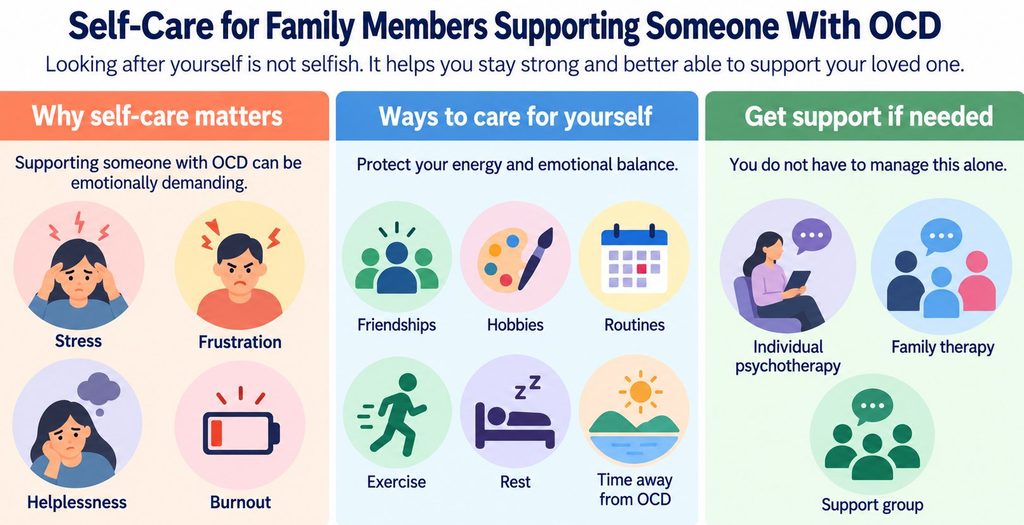
Self-Care for Family Members Supporting Someone With OCD
Living with and supporting someone who has OCD can be emotionally demanding. Family members may experience chronic stress, frustration, anger, helplessness or burnout, particularly when daily life has become organised around obsessions and compulsions. Some relatives gradually neglect their own needs because so much attention is focused on the affected person. Self-care is therefore not selfish; it is an important part of maintaining healthy family support.
Family members should try to preserve their own friendships, hobbies, routines, exercise, rest and time away from OCD-related concerns. If the strain becomes difficult to manage, individual psychotherapy, family therapy or an OCD family support group may also be helpful.
What to Do When Someone With OCD Refuses Treatment
One of the most painful situations for relatives is when someone with OCD refuses treatment altogether. This often creates feelings of helplessness and frustration within the family. There are many reasons why a person may avoid therapy. They may fear confronting their anxiety, feel hopeless about improvement, or believe their fears are realistic.
If a loved one refuses treatment, repeated arguments or pressure rarely help. Family members can continue expressing concern, provide information about treatment and remain emotionally supportive while maintaining reasonable boundaries around rituals and reassurance. The goal is to keep the possibility of professional help open without allowing OCD to control the entire household.
How to Support a Family Member With OCD: Key Points
Helping a family member with OCD requires a balance between compassion and healthy boundaries. Emotional support can be extremely valuable, but repeated reassurance, participation in rituals and avoidance may unintentionally maintain symptoms.
The goal is not to remove all anxiety for your loved one but to support them as they learn to tolerate uncertainty without relying on compulsions. Encouraging evidence-based treatment, reducing accommodation and recognising small steps toward recovery can make family support more constructive.
Family members should also protect their own well-being. Education, consistency, realistic boundaries and appropriate professional support can help the entire family step out of the OCD cycle.

Frequently Asked Questions About Helping Someone With OCD
How should you respond to someone with OCD asking for reassurance?
Respond with empathy without repeatedly confirming that the feared outcome will not happen. You might acknowledge the anxiety and encourage the person to tolerate uncertainty rather than repeatedly answering the same reassurance question.
Should family members participate in OCD rituals?
In general, participating in rituals can unintentionally reinforce OCD by providing short-term relief. Family involvement in compulsions is often referred to as family accommodation. When accommodation is extensive, reducing it gradually with professional guidance can be helpful.
What should you not say to someone with OCD?
Avoid criticism such as “just stop thinking about it” or “you know this is irrational.” The person may already recognise that the fear is excessive but still experience intense anxiety and a strong urge to perform compulsions.
How can I encourage someone with OCD to get treatment?
Express concern calmly, explain that effective treatments are available and offer practical help with finding a qualified professional. Compassionate encouragement is usually more helpful than threats, arguments or repeated pressure.
Can family reassurance make OCD worse?
Repeated reassurance can temporarily reduce anxiety, but this relief may reinforce reassurance seeking and make the person increasingly dependent on external certainty.
Can family members help with ERP?
Family members can often support ERP by encouraging agreed treatment goals and reducing accommodation. However, they should not design or force exposures themselves unless this has been discussed with the treating clinician.